Monday, December 07, 2009

On Migraines and Other Headaches

It takes a starlet

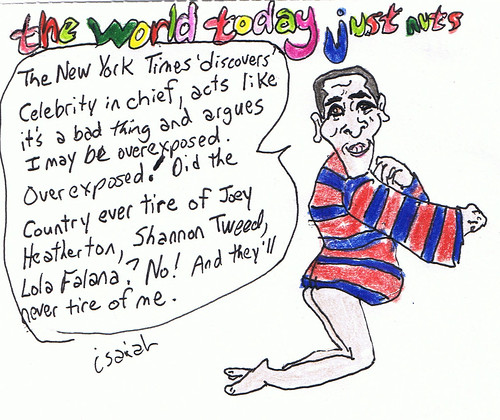
Isaiah's The World Today Just Nuts "It Takes A Starlet" went up last night and I have a killer headache. I just realized that I've been staring and staring at the screen and doing nothing. Not typing, nothing.

So I'm going to blog about headaches.

In The Way We Were, Barbra Streisand says she always eats for a headache and that often helps me. Not tonight -- half-way through a 8.75 ounces bag of Chex Mix and my head is killing me.

Sometimes a pill helps. I've taken two Advil Migraine I snagged from C.I.'s bag. (She packs a ton of migraine medication.) Nothing. I'm waiting another two hours and then I'll try some of her stronger stuff.

My headache tonight is a sharp pain in the back of my head, right side, right at the base of the skull. It hurts like crazy and, again, is a sharp pain.

Throbbing pains are bad but I can sleep through those. Not 8 hours but if I have a throbbing headache all night, usually around three in the morning, I'll doze off and get a little bit of sleep. These sharp pains? I can't sleep through those. I can't believe how much it hurts.

Or that, in 2009, we can't make a simple over the counter medicine which addresses these pains.

I mean, it's not like I'm asking for George Jetson, here. I'm not asking to fly in space to work or to have a robot maid or anything like that. Just a migraine pill that works.

If I seem extra cranky, please note, it is that time of the month.

And on that 'happy' thought, I'll end this for the night. Closing with C.I.'s "Iraq snapshot:"

Monday, December 7, 2009. Chaos and violence continue, an election measure may lead to Iraq elections (not this month or next), the Iraq Inquiry continues in England, calls for an investigation into an Iraq-related death to be reopened are made in England, and more.

Asked in Vanit
y Fair's Proust Questionnaire what she most dislikes, singer-songwriter Carly Simon responds, "War or anything to do with instruments of war, or war-like tendencies." Carly's latest album is Never Been Gone in which she revisist many of her best known songs (including "You're So Vain," "Anticipation," "Coming Around Again" and "Let The River Run") to find new nuances and shadings. (Kat praised the new album here.) We've got a 'heavy' snapshot so we'll open with Carly for that reason and also because friends at Van Fair have repeatedly asked for links in the past weeks and I haven't had time (for their pain). Staying with Carly for a minute more, as Kat noted Friday, Mike Ragogan (Huffington Post) interviewed her last week and here she's explaining the making of Never Been Gone:

It started in the summer of 2008, when I had been promoting This Kind Of Love which was the Starbucks album, and they had withdrawn Hear Music five days before my record was released. So I didn't have the marketing, I was riding on a horse and there was no horse under me. I was so unhappy, and it was embarrassing, and it was like, "Oh my god, what have I been doing for the last two years but writing this record, making this record, and being so proud of this record." But I was the horseless rider. So I was quite self-involved and indulgently so, and really depressed. It was the summertime and there were lots of people around my house -- Ben and his friends and a lot of musicians were up there working on a project with him. I couldn't be consoled I was so upset. Ben said to me, "Come on, let's turn this into productivity. We have all these musicians here, just sit down in the living room and play the songs the way you wrote them. Let's do an unplugged version," which you picked-up on in your review. There are no drums except for "You Belong To Me" and "No Freedom," we just didn't allow drums on the record, even on "You're So Vain" which was daunting to redo after it was my most popular song. But we did it and I really love the energy that was put into the song, and that really carries all the way through. It's got new vocal ideas, and I just think it's an inventive version.

Inventive was Barack's speech last week where he took Bully Boy's 'lyrics' and made them his own.
Al Jazeera's latest Inside Iraq began airing Friday and the topic was Afghanistan and Jasim al-Azawi was joined by retired US General Richard Myers (former commander of the Joint Chiefs of Staff and current War pushed from the boards of Aon Corporation, Northrop Grumman Corporation and United Technologies Corporation) and Professor As'ad Abu Khalil of the University of California at Berkeley.

Jasim al-Azzawi: General Myers, let's call a spade a spade. In Iraq, pretty much the US army bought off those fighters from the Awakening Councils, you know, paid them salaries and said "Stop shooting at us." And overnight the fighting stopped. Are they going to do the same? Are they going to pour money at the Pashtuns?

General Richard Myers: You know, it's a good question. I don't -- I don't know what incentives will be used and how they'll be used. In that part of the world, money is often used as an incentive. But I mean, Iraq is far from being stable and far from being a sure bet that it's going to be successful. On the other hand, it's been relatively stable and we'll see if they can get through elections here -- coming in January, there's some question about that. But if they do, then I think whatever methods were used, you'll have to say, "Well those were successful."

Jasim al-Azzawi: As'ad Abu Khalil

As'ad Abu Khalil: Let me say the following. I notice that General Myers uses the word "stable" government in Iraq and this is the new lingo because of American officials. It was used by the Bush administration, it's being used by the Obama administration. Remember that we were promised an exemplary democracy in Afghanistan and in Iraq. Instead, we have created some of the most corrupt governments on the face of the earth. Don't take my word for it, look at the recent rank by
Transparency International in London and you will find these two governments are literally among the most corrupt in the world. Plus, I want to take issue with the model of success by the revival council in Iraq. These are some of the most repressive, sexist and thuggish tribal councils that oppress women and want to impose traditional views on society. That is not the kind of alternative we need against the sexism and misogyny of the Taliban. Plus, he said that we are moving away from [US-installed Afghanistan 'president'] Hamid Karzai. I'm not sure that's the case. We are, in fact, using two tract policy. On the one hand, we are throwing more additional money -- taxpayers money -- to be embezzled and misused by the Hamid Karzai government and we're also, on the second tract, relying on new council like the so-called Kandahar Strike Council. That council is related to none other than the brother of Hamid Karzai. The notorious, corrupt person known as Ahmad Karzai. So it seems to me with that strategy, we are creating more corruption and we are giving more time for America's enemy to wait it out until the date of withdrawal. Obama is clearly emulating not only the policies and war actions of the Bush administration, he's even copying the rhetoric, the empty rhetoric, that is out there --

Jasim al-Azzawi: As'ad Abu Khalil, let's give the general a chance to answer this.

General Richard Myers: I -- I think that's -- I think those comments are probably -- uh, uhm -- there's a lot of hyperbole in those comments, in my view. If you look at Iraq and Afghanistan, they both adopted -- their citizens both adopted what most people consider liberal constitutions and yet -- it's not playing out, they've elected these governments. Certainly there is corruption but that's not new to that particular region and that's something that has to be worked on daily and I think the president [Barack Obama] said they were going to work on corruption. I know in my conversation with Adm [Mike] Mullens --

Jasim al-Azzawi: That being the case, General Myers, corruption is still rampant in Iraq. How you're going to prevent in Afghanistan? As'ad Abu Khalil just alluded to the president's brother who is somehow in bed with all the corrupt people not to mention trafficking in narcotics.

General Richard Meyer: Well I think, Jasim, I think that's going to be one of the focuses of the strategy in Afghanistan -- is to hold people accountable and, if there's corruption, to hold them accountable for that-that corruption. Now that's easily said, hard to do, but I think you're going to see that in the way both our military and-and the civilians. By the way, it's been little noticed but the embassy in Kabul is going to be increased from 320 staff earlier this year, in January of this year, to about 1,000 by the end of this month and a lot of those people will be deployed to the provinces and a lot of them, I think, will be trying to mentor --

Jasim al-Azzawi: Then again, General, you know the number of US officials in Baghdad was increased, I don't know how many folds. Maybe twenty, thirty. It's the biggest embassy in the world and yet corruption is rampant in Iraq.

As'ad Abu Khalil: 700 additional diplomats are not going to do the job just as 30,000 additional troops are not going to do the job. And just let me say for the record to the audience I would never refer to the government set up in Iraq as a liberal democracy. A constitution that was devised by a Grand Ayatollah who is inspired by Iran and who has not left his house except once in seven years is not a liberal democrat. And I think people in the region are clearly not impressed with whatever set-up -- sectarian, religious, traditional, and sexist government set up in both places. Again, go back to Transparency International. I take my clues from there.

The broadcast offers a look at and fact check on Barack's speech and Myers objects to the terms "colonize" and "occupation." He foolishly rejects both. For the record, it is an occupation and there was no reason for Myers to make an idiot out of himself on international television. The UN approved (after the war started) the occupation (they never approved the war), the UN mandate that was repeatedly renewed until the end of 2008.

He also expressed foolishness when he spoke of January elections when those have been off for some time. Saturday
AFP reported that the Iraqi Parliament adjourned today because they did not have a quorum despite the session being called by President Jalal Talabani. Then Sunday night, ten minutes before midnight, the Parliament passed (another) election measure which still has to go before the presidency council (like the last one) and will become law only if it is not vetoed. Warren P. Strobel and Mohammed Al Dulaimy (McClatchy Newspapers) did the best job reporting on the developments. They not only provided the details of what happened just before midnight, they provide the details of what happened before and they explain, "While agreements have been reached in the past only to fall apart, there were high hopes that this one would stick. Hashimi withdrew his veto threat early Monday morning." Ned Parker and Raheem Salman (Los Angeles Times) quote Tariq al-Hashimi (Iraq's Sunni vice president) stating on satellite TV, "All of our demands have been achieved. The displaced people have been treated fairly, the value of people inside and outside Iraq are the same. I am happy because of this accomplishment and I consider it a historic day in building the modern Iraq." Mu Xuequan (Xinhua) quotes a statement issued by United Nations Secretary-General Ban Ki-moon today, "The secretary-general congratulates the Iraqi Council of Representativeson finalizing amendments to the Election Law and commends Iraqi leaders and parliamentarians for overcoming their differences and reaching a compromise. The way is now paved to hold national elections in Iraq on a date to be determined by the Iraqi Presidency Council. The secretary-general firmly believes that these elections will be an important step forward for Iraq's political and democratic process." In a sign of just how incompetent the US 'diplomatic' mission is in Iraq, Jane Arraf (Christian Science Monitor) reports today that "uncertainty over" the vote had "US Ambassador Christopher Hill rushing back from Washington" -- along with not grasping that he goes by Chris -- officially, he is Chris Hill -- Arraf doesn't grasp that this is a huge detail and instead buries it in a puff piece. (It is puff -- Barack has no pull with the KRG. It was their 45 minute phone call with Joe Biden that sealed the Kurdish agreement to the deal. And it's nice that she's been led off the trail -- nice for the White House and other interests. The following paragraph is word for word from last night.

Parker and Salman note that the Kurdish Regional Government extracted a promise from the US that a census would take place in the coming year. Presumably, the promise had some form of 'teeth' to it since the US has long promised that the Constitutionally mandated census would take place and yet, year after year, it has not. The KRG is aware of that and presumably would not fall for yet another round of pretty words. If that is indeed the case, one wonders how the press will report on this issue since Barack and Bully Boy Boy Bush both asserted Iraq was a sovereign nation -- that was the whole point of ending the UN mandate (it truly was -- as a sovereign nation, Iraq could start the tag sales on their assets that they couldn't while under UN supervision). If Iraq's a sovereign nation and since Nouri al-Maliki, the current prime minister, has been the road block to a census since 2006, what did the US government promise the KRG this time that convinced them? The tensions between Baghdad and the KRG aren't exactly secret nor is the tremendous ill will towards Nouri from the KRG a secret. So if he's the roadblock and he's hoping to be the prime minister (elected by Parliament) again after the elections, what did the US promise the KRG, how did they convince the KRG that it would be different in 2010 then it has been in the last three years?

Dorothy Parker once said you can lead a horticultural but you cannot make her think -- true as well of the press which has a huge story staring it in the face but either can't see it or is on orders to refuse to see it. I have no idea which. People often ask, in DC when the gossip is flying, "Why don't reporters report on ____?" Because they're not able to either because they're so easily distracted or because their superiors won't let them. The big story is what the US government promised the KRG. I said it last night and said it for a reason. I can lead you to the water but I'm not putting in your mouth, kids. Let's note something.

The United States welcomes the resolution adopted December 6 by Iraq's Council of Representatives regarding the election law. This legislative action will allow Iraq to hold national elections within Iraq's constitutional framework. It is a decisive moment for Iraq's democracy and we congratulate the Iraqi people and their elected representatives. As part of the ongoing U.S. dialogue with the Iraqi leadership, the President and Vice President spoke on the morning of December 6 with Kurdistan Regional Government (KRG) President Massoud Barzani. The President and the Vice President confirmed the U.S. commitment to a long-term relationship with Iraq, including the KRG.

You say, "Uh, it's the White House's official statement. And?"
Click here and you go the KRG's website where that statement is posted in full. No, that is not common for the KRG's website. In fact, it's highly uncommon. You need to start using your brain because obviously you can't count on the press.

Though the press in the US has never been perfect, even as late as the 1980s, you could still count on the press to ask: What deals were made and how?

Apparently we need a sports star with a scandal or a woman willing to pose topless to get some attention to the deal that was struck. A deal was struck. Leaving aside what was all the talk in DC, we all know Barack has no pull with the KRG. We all know Joe was put in charge of Iraq -- after Barry's handpicked two-some failed (that's not a reference to Hillary, Iraq was never assigned to her) -- because the KRG trusted him and he had a solid relationship with them. Anyone who paid attention to pre-war and early war issues knows that the US used the KRG for the Iraq War and knows that the KRG agreed with the understanding that not only would Saddam Hussein be removed from office but also the KRG would stand to benefit. The Bush administration repeatedly broke key promises -- the PKK issue is what forever broke the trust the KRG had in the Bush administration. Barack, as senator or as president, has never had anything to do with the Kurdish issue and spent the bulk of his time -- on his for show trips to Iraq in 2008 and 2009 -- attempting to woo Nouri. Barack has no pull with the KRG. Joe Biden they trust. Barack spoke to them, but Barack offered pretty words and promises. It took Joe to sell them on the promises. The issue for the press should be what was promised?

"A census!" shout some. Uh, a census has been promised forever. In fact, the 2005 Iraq Constitution requires one. How did the US government convince the KRG that a census would take place in 2010? The press needs to be asking that question. Again, when sides in any conflict suddenly agree, the immediate question for a working press is always: What deals were made? That's the question that's not being asked and it's the most important question -- far more important than the elections. Iraq didn't fix its Constitutional crisis (or stop being a Failed State) by possibly passing a measure that will allow elections to take place AFTER the Constitutionally mandated deadline for them to be held. The elections had to take place at some point. And they will. Maybe with this measure, maybe with another. But to get this measure signed off on, deals were made.

The KRG feels (rightly or wrongly) that they have given and given and no one has lived up to the bargain on the other side. That is their attitude. They feel the previous administration made a ton of promises and it is the PKK issue that (still) most enrages them because it was supposed to be dealt with (by the US) in 2003. That didn't happen. They have a relationship of trust with Joe Biden but that relationship can go down the toilet if promises aren't kept. So the US public has a right to know what was promised? We have a right to know because if the promises aren't delivered what keeps being pimped by the press as "stability" in Iraq is going to get even worse.

Nouri has been the thing preventing the census. How can the US government promise the KRG that a census will take place? It hasn't thus far and it's in Iraq's Constitution. The census would especially effect Kirkuk -- a disputed territory sought by the central government in Baghdad (who asserts that it is not a predominately Kurdish population in the area) and by the KRG (who asserts that it is historically Kurdish and point out the Kurds were forced out by Saddam Hussein).
Liz Sly (Los Angeles Times) reports new construction is ongoing in oil-rich Kirkuk with Kurds constructing new homes. The Kurds want Kirkuk. They may or may not deserve it and they may or not end up getting it. But when the US government discussed "census" with the KRG, you better believe the KRG representatives and president brought up Kirkuk. What was promised? More importantly, what was the KRG led to believe?

If these promises aren't backed up, if these become failed promises, Iraq's going to see a lot more trouble and, despite press claims otherwise, Iraq hasn't been stable. You take the region that's been the most stable -- by comparison -- and you anger its government? It's government that already distrusts the current Iraqi Prime Minister (Nouri) and has nothing but ill will towards most of the Baghdad ministries? It's not going to be pretty.

Did someone say violence?Bombings?
Mohammed Al Dulaimy (McClatchy Newspapers) reports a Baghdad roadside bombing which wounded four people, a Baghdad sticky bombing which claimed 1 life and wounded five people and a bombing in Ali Yassir middle school which claimed the lives of 7 children and left "41 others" wounded. Reuters says the school death toll was 4 and 25 were wounded. Marc Santora and Duraid Adnan (New York Times) aren't specific on the death toll but explain, "Government officials gave contradictory school casualty figures, with the death toll varying from 1 to 15 children and the number of wounded from 41 to 56.

Shootings?

Mohammed Al Dulaimy (McClatchy Newspapers) reports 5 Sawha were shot dead at a Baghdad checkpoint.

Corpses?

Mohammed Al Dulaimy (McClatchy Newspapers) reports the corpses of 2 Sahwa were discovered in Kirkuk. Marc Santora and Duraid Adnan (New York Times) state the two Sahwa were poisoned to death by unknown persons who offered them free food which the guards ended up sharing with their dogs. Both dogs died..

In England, the Iraq Inquiry continues hearing public testimony today.
PA reports Edward Chaplin has testified this morning that the US refused to fund reconstruction in Basra adequately. Chaplin was the British Ambassador to Iraq in 2004 and it's interesting how his finger pointing at the US (I'm not denying the US has done appalling on reconstruction -- even worse, what they've overfunded has been waste; however, I believe we learned some of British's lack of funding for Basra last week). Chaplin's testimony can be seen as a diversion -- it is also far, far from the reasons the Inquiry was supposed to have been created -- why did England take part in the Iraq War? Along with Chaplin, the hearing heard from Maj Gen Tim Cross and Desmond Bowen today. Click here for video and transcript options for today's witnesses. And let's stick to Nothing-Was-Our-Fault Eddie Chaplin for a moment and with some of the most offensive remarks that the commitee has thus far heard.

Committee Member Lawrence Freedman: Part of this, perhaps particularly relevant for British opinion was the start of hostage taking. So we had in this period the Kenneth Bigley and Margaret Hassan cases. How aware were you of the danger to British nationals in Baghdad?

Edward Chaplin: Very aware. And, indeed, I think if you looked at the travel advice at the time, it would be "don't come anywhere near this place". They were terrible incidents. I mean, terrible obviously for the families, but terrible for the embassy in the sense that we were very helpless. Kidnapping was widespread at the time. This was often criminals rather than political. Of course, as we have seen elsewhere, often criminal gangs will carry out kidnappings of what they think are valuable people, valuable in the sense that they can be sold on to some political group. And I don't think we know even now exactly who was behind either kidnapping. I would have to refresh my memory. I mean, they were different in the sense that Ken Bigley, we didn't even now. He hadn't even registered with the embassy, we didn't know he was there. He was working with these two Americans for a Gulf company. The first thing we knew of his existence was when the news of the kidnap came through. Margaret Hassan was different. In fact, I had met her before when I was Ambassador in Jordan because she worked for CARE Australia, a very effective NGO, one of the few working inside Iraq before and after the invasion. So I admired the work that she was doing and the embassy kept in touch. So that was, if you like, an even greater blow. But just to explain -- I don't know if you want to go into detail about this, but I probably cannot because what happens when a kidnapping of a British citizen takes place is you have set up a really discrete team because this needs 24-hours-a-day attention. So that team was led my deputy and we had a lot of support particularly coming out from London, experience negotiators and so on. So after the initial phase, my job was really to keep it in the minds of Iraqi ministers who we thought would could help, the army and the police and so on, and do whatever else I could do to help.

Commitee Member Lawrence Freedman: What sort of response did you get from --

Edward Chaplin: Very positive and, of course, this was raised all the way to Allawi himself and it was raised by ministers, but they didn't have the capacity to help very much, I don't think. And, of course, they were dealing at any one time with lots of other kidnappings.

Committee Member Lawrence Freedman: We had no evidence oursevles of who was holding her?

Edward Chaplin: I think the assumption early on was it was a criminal gang of some sort, but we never got very far in pinning down exactly who was behind it and -- let alone having contacts that might lead to some progress.

Commitee Member Lawrence Freedman: And in the aftermath of her murder, we still seemed to have been in the dark as to what had happened and, indeed, where her body was.

Edward Chaplin: Some time later some of her clothes and possessions were found. We knew her husband as well, who stayed on in Baghdad. So we would see him from time to time. I don't know what the investigation -- continued investigation showed.

It takes a lot of nerve to speak of kidnapping victims and claim that you suffered from it -- you suffered as the family did. It takes even more nerve to do that when the kidnapped victims both ended up dead. That Edward Chaplin was ever put in charge of diplomacy anywhere is a puzzler. That he's so inept goes a long way towards explaining why Italy was able to rescue kidnapping victims, the US was able to and, thus far, the UK really doesn't have a record to point to with any pride in Iraq. Long before Chaplin got to Iraq, Margaret Hassan was already there so his it's-not-my-fault-we-warned-people-not-to-come-to-Iraq excuse is b.s. For him to claim to have known her and admired her work and yet to tell the committee today that he has no idea what was or wasn't found out about her death? That makes no sense. He's lying. Margaret Hassan was the most prominent kidnapping victim the UK had. To this day. As for his attempt to farm off any responsibility to his deputy -- Chaplin was still in charge. His deputy was his responsibility. Edward Chaplin is now an international embarrassment for the UK.

David Brown (Times of London) reports that both of Margaret Hassan's sisters were present at the inquiry and hoped to hear some details about their sister. He quotes Deidre Fitzsimons explaining, "We have been waiting years for the chance to hear what happened to my sister but she was worth so little that she received just three minutes. We came to find out the truth even though we were skeptical, because we were told this would not be a cover-up. We have been betrayed. The authorities did not do one thing to help her when she was kidnapped and they are now doing nothing to find out why. As for Ken Bigley, it was almost as if he didn't matter at all [by Chaplin's testimony]. He was an innocent man who was murdered for no reason."

Moving to another witness, Cross was in Iraq up until June 2003 and held the position of joint force logistic component commander before the war started. He also worked in DC with post-war planning. Committee Member Usha Prashar asked him about his visits to CentCom [US Central Command].

Maj Gen Tim Cross: My sense was this was a very joined-up headquarters, very well commanded and led with some very capable staff. They had been in place together as a team since 11th September, just before 11th September, they had planned and executed the initial operations in Afghanistan, they were now planning for possible operations in Iraq and, I think understandably, General [Tommy] Franks and his team, recognising that they would break as a team the following summer -- because inevitably normal postings and so forth would begin to kick in -- that they were pretty keen to get on with this. They had done a lot of hard work, they had been working 18 hours a day for months on these operations. So they were very --

Commitee Member Usha Prashar: You said "these operations", they were Afghanistan or are we looking towards Iraq?

Maj Gen Tim Cross: Both. They had been working long hours for Afghanistan and then in the post -- initial operations in Afghanistan and at the same time planning for operations in Iraq. They were, I think, tired, if I'm honest, but I'm not surprised. And I sense that there was a strong desire to move quickly in terms of Iraq, and I sense too in a broader sense -- and I got more of this in Washington -- that following military operations, there would be other things linked to what was then called the Global War on Terror.

Commitee Member Usha Prashar: But at that stage CentCom, was there any concentration on post-invasion planning or not?

Maj Gen Tim Cross: I wouldn't say there was concentration on it. The major force was making sure that should be operations in Iraq, the military campaign would win, would succeed, and from a personal point of view I had no problem with that. That's the prime purpose of this headquarters: it is to fight and to make sure they win. There are no prizes for coming second on the battlefield. So that was undoubtedly their prime concern. So far as Phase 4, post-war -- whatever words we want to use -- operations were concerned, there were some discussions. They had appointed a one-star brigade general to head up a task force, looking at aspects of this, an engineer, an American engineer. But if I'm honest -- and I remember one specific occasion when there was an attempt to introduce him to the assembled large number of very senior military officers. He really was -- he was not really welcomed into the team. This was a war fighting team and as far as they were concerned, this was not their major business.

Cross also testified that he and Jay Garner went to the United Nations together before the start of the Iraq War and "eventually we did go to New York for a day. We flew up very early in the morning, we spent a day with the UN and we saw both Lousie Frechette, who was then the deputy, and I would say 20 UN officials who sat in serried ranks opposite. There were only about five of us. And they were very, very strong on saying to Garner -- the main message was, 'You need to understand the legality of what you are into here. And if you end up as the occupying power, be quite clear what that means'."
Richard Norton-Taylor (Guardian) reports of Cross:

In a written statement, he said he had briefed Tony Blair at No 10 on 18 March 2003, two days before the invasion.
"We talked for about 30 minutes or so. I was as honest about the positions as I could be, essentially briefing that I did not believe postwar planning was anywhere near ready," said Cross. "I told him that there was no clarity on what was going to be needed after the military phase of the operation, nor who would provide it.
"Although I was confident that we would secure a military victory, I offered my view that we should not begin that campaign until we had a much more coherent postwar plan."
Describing his meeting with Blair in oral evidence, Cross said: "He was engaged. I gave him the background of what we had been doing. We had a very sensible conversation. At the end of it I remember saying, in so many words, I had no doubt we will win in the military. I do not believe we are ready for postwar Iraq.
"He nodded and didn't say anything particular. I didn't expect him to look me in the eye and say, 'This is terrible, we are going to pull the whole thing off.' I was just one of a number of people briefing him."


More pressing news out of England involves two Iraqi males arrested in Iraq by the British military and handed over to the US "who then took them to Afghanistan in 2004," the
BBC reports. The British actively took part in partnering with the US for rendition (kidnapping). Robert Verhaik (Independent of London) reports, "In February this year the former Defence Secretary, John Hutton, admitted that UK forces had captured two men in Iraq in February 2004, and handed them to US forces. In subsequent statements to parliament, the government revealed that in March 2004, British officials had become aware of the US intention to transfer the men from Iraq to Afghanistan." Reprieve is a United Kingdom human rights group and we'll note this from their press release:Reprieve's investigation reveals the identity of one man, Amanatullah Ali, together with damning evidence that the British government misled parliament and the public on the case.In February 2008, after years of government denials that the UK had been involved in any rendition operations, then-Secretary of State for Defence John Hutton announced to parliament that UK forces had captured two men in Iraq in February 2004, and handed them to US forces. In subsequent statements to parliament, the government revealed that in March 2004, British officials had become aware of the US intention to transfer the men from Iraq to Afghanistan.The British government admitted its complicity in a crime (kidnapping, otherwise called rendition), admitted it was wrong, and appeared to apologize. Yet the government will not identify the men, which would be most basic act that the government could do in order to reunite the men with their legal rights.Indeed, the British government has apparently taken no step over the past five years to ensure that they receive legal assistance.The day after Mr Hutton's statement to the House, Reprieve wrote to the Defence Secretary, asking him to identify the two men so that Reprieve lawyers – acting pro bono as always – could help make up for the regrettable involvement by the British government in this crime by acting for the men and their families and seek to secure their release.Despite the clear urgency of the situation, it took the UK government three months to reply. The Ministry of Defence wrote that they would not reveal the prisoners' names, taking the position that doing so would violate the prisoners's rights under the Data Protection Act. It is deeply disturbing that the MoD could apologize for our country's involvement in this wrongdoing, and yet refuse to assist to put matters right. Reprieve therefore embarked on an investigation.1) Britain's Iraq renditions and the legal consequences2) How Defence Secretary Hutton misled Parliament3) How the UK violated the MoU governing transfer of prisoners4) Why Mr Amanatullah urgently needs a lawyer5) Why Bagram Internment Facility makes us all less safe6) Further questions and timeline of events1) Britain's Iraq renditions and the legal consequencesOur complicated and expensive search for the identity of the men has covered three continents over six months. It now appears that the MoD statement to the House was factually incorrect on key points.Reprieve has now identified one of the men as Amanatullah Ali, and interviewed his family in a small village in the Pakistani Punjab. In his limited, and censored communications with his family he has told them that he was detained by the British, rather than the Americans; he has asked them to pray for his safe return, and to get him help. Amanatullah Ali is a fluent Arabic speaker. We have not been able to positively identify the second man, although our interviews with other released Bagram prisoners have gleaned some facts about him. He is apparently known as "Salahuddin". Significantly, he was brought up in the Gulf states (where the primary language is Arabic). "Salahuddin" has not been able to contact his family or even reassure them that he is alive. Reprieve has been told by multiple sources that as a result of his abuse in UK and US custody, "Salahuddin" is in catastrophic mental and physical shape, and now spends most of his time in the mental health cells at Bagram.Our claim is that the men must be formally identified, along with any information that could help us find their family members, so that we can seek a next friend authorization. This issue is now moot with respect to one of the men, but not the other.Furthermore, because the UK has been mixed up in the wrong-doing, our claim is that the UK is legally obliged to help us fight their case. This issue is very much alive for both men.Because we can already prove that one man (Amanatullah) is a Shia, the notion that he was a member of Lashkar-e-Taiba (LeT) becomes effectively impossible – as LeT is a Sunni extremist group that would view a Shia as an apostate. In other news out of England, Simon Walters (Daily Mail) reports, "Shocking new evidence reveals how the Labour Government bullied the Cabinet Minister who told Tony Blair that the Iraq War was illegal. Former Defence Secretary John Reid banned the head of the Army, General Sir Mike Jackson, from taking Attorney General Lord Goldsmith to Baghdad to investigate alleged mistreatment of Iraqi civilians by British soldiers."

And, stil in England, there's a call to reopen an inquiry into an infamous death.
Brendon Abbott (Daily Star) reports, "SIX doctors are taking legal action to demand the ­inquest into the death of weapons expert Dr David Kelly be re-opened." David Kelly was the source for many press reports including Andrew Gilligan's for the BBC that the Iraq intel had been "sexed up." David Kelly died July 17, 2003. Simon Alford (Times of London) identifies the six doctors: "Trauma surgeon David Halpin, epidemiologist Andrew Rouse, surgeon Martin Birnstingl, radiologist Stephen Frost, Chris Burns-Cox, who specialises in internal general medicine, and Michael Powers QC, a former assistant coroner, have instructed solicitors and aim to approach the Attorney General Baroness Scotland to get the case before the High Court. " Alex Watts (Sky News -- link has text and video) explains, "Lord Hutton concluded he bled to death as a result of a cut to his wrist and an overdose of painkillers. But Michael Powers QC, an expert in coroners' law, said the cut would not have caused him to bleed to death, and there was only a normal dose of co-proxamol in his body. He said that for a coroner to reach a verdict of suicide there must be evidence 'beyond reasonable doubt' that they intended to kill themselves. Dr Powers added: 'Suicide cannot be presumed, it has to be proven'." Andrew Alderson (Telegraph of London) adds: "The revelation of the move for a new inquest is embarrassing for the Government, particularly as it comes just two weeks into the inquiry chaired by Sir John Chilcot which is examining Britain's role in the invasion of Iraq and its aftermath. The doctors are applying to the Attorney General, Baroness Scotland for permission to go to the High Court for a new inquest, or the resumption of the previous inquest."


iraq
carly simon
al jazeera
inside iraq
jasim al-azzawi
mcclatchy newspaperswarren p. strobelmohammed al dulaimythe los angeles timesned parkerraheem salman
xinhuamu xuequan
brendon abbottsky newsalex wattsthe times of londonsimon alfordandrew aldersonthe telegraph of london
liz sly
the independent of londonrobert verkaikreprievethe daily mailsimon walters

Saturday, December 05, 2009

Carly Simon and my thoughts on the Grammys

MR: Okay. We got through that one. So, how did you and your son Ben Taylor decide to record stripped-down versions of some of your classic songs for Never Been Gone?

CS: It started in the summer of 2008, when I had been promoting This Kind Of Love which was the Starbucks album, and they had withdrawn Hear Music five days before my record was released. So I didn't have the marketing, I was riding on a horse and there was no horse under me. I was so unhappy, and it was embarrassing, and it was like, "Oh my god, what have I been doing for the last two years but writing this record, making this record, and being so proud of this record." But I was the horseless rider. So I was quite self-involved and indulgently so, and really depressed.

It was the summertime and there were lots of people around my house--Ben and his friends and a lot of musicians were up there working on a project with him. I couldn't be consoled I was so upset. Ben said to me, "Come on, let's turn this into productivity. We have all these musicians here, just sit down in the living room and play the songs the way you wrote them. Let's do an unplugged version," which you picked-up on in your review. There are no drums except for "You Belong To Me" and "No Freedom," we just didn't allow drums on the record, even on "You're So Vain" which was daunting to redo after it was my most popular song. But we did it and I really love the energy that was put into the song, and that really carries all the way through. It's got new vocal ideas, and I just think it's an inventive version.

That's from Mike Ragogan's interview with Carly Simon at the Huffington Post. I swiped that from C.I. who had to pull it from the snapshot because there was so much to cover. There was the Iraq Inquiry, there was the Failed State of Iraq and there was all the lying that took place on the Diane Rehm Show. It was just too much and I said, "I'll grab Carly" when C.I. was trying to figure out what could be cut.

Carly didn't get a Grammy nod for her new album Never Been Gone and a number of e-mails came in asking about that.

She's on an independent label so that hurts to begin with.

And, second, did you see the nominees?

Did you not laugh out loud?

It's as though it's 1977 and they're trying to push Barry Manilow, Debby Boone and the Bay City Rollers. I've never so many nominations honor so little art.

The Grammys are a joke this year, more so than usual. There's no point in even watching if you're a music lover. If you love the temporary pop, watch and enjoy. But if you're looking for artistic achievement, forget it.

If you don't get how disgusting this year's nominees are, check the list.

Beyonce can't do her own vocals live. That's your first hint that she's a studio creation. And yet look at all her nominations. By contrast, search for Barbra. Barbra's got no nomination.

Or check out "best rock vocal." It's one category, all men. And does Prince belong in it for that song? I don't think so but then I'm still trying to figure out how Bob Dylan gets a nomination for best vocal????? He didn't have a voice forty years ago. Now that's it's wheeze city we're supposed to pretend like he earned a best vocal nomination?

The pop nominations are a joke especially best pop male vocal. Look at it, you'll see what I mean.

The whole thing's a damn joke. There's not any artistry on display.


Closing with C.I.'s "Iraq snapshot:"

Friday, November 4, 2009. Chaos and violence continue in Iraq, the Iraq Inquiry continues in London and we learn that the US rules England -- long live Queen Barack apparently, NPR finds time to advance war with Judith Miller like claims while refusing to cover Iraq, and more.

Starting with NPR's The Diane Rehm Show, the second hour where the panelists are Abderrahim Foukara (Al Jazeera), James Kitfield (National Journal) and Barbara Slavin (Washington Times) which was a wealth of stupidity and lies. So many lies, so little time. Let's start with Barbara.

Barbara, grab your passport and, yes, Annie Grab Your Gun, and get your ass over there. Over where? Where ever it is from one moment to another that Barbra 'knows' Osama bin Laden is. Take your ass, take your gun and get the hell over there, Big Girl. Reality, Barbara Slavin doesn't know where Osama bin Laden is -- a point Diane Rehm should have made -- but it isn't it interesting that Barbara's claims support further war? And isn't that really the point of your claims, Barbara? You really want to be the next Judy Miller? Really? And what about you, Diane? You going to keep letting guests claim to know where Osama is and use that 'knowledge' to launch a verbal attack on a country? You going to do that? And delude yourself that you've informed the public? How very, very sad.

James Kitfield, I have heard repeatedly how I hurt your feelings when I pointed out that you needed to learn speak. Well boo-hoo cry baby. This time you actually finished a few sentences. But maybe you should return to your stammering half-sentences? You don't know what the hell you're talking about as usual. There's reality and then there's James Kitfield's reality. The paying off Sunnis (Sahwa, the "Awakenings," the "Sons Of Iraq") was not about getting people "off the fence." That's a bold face and ignorant lie. Then-US Ambassador to Iraq Ryan Crocker and then-top US Commander in Iraq General David Petreaus testified publicly to Congress in April 2008. Where the hell were you, Kitty? What did they say? They said the US paid the Sahwa so that they would stop attacking American military equipment and US service members (they put the emphasis on military equipment in their testimony to the House and Senate). People who are attacking the US military equipment and US service member are not "on the fence." They have made a choice. You can agree with the choice or disagree with it but they are not "on the fence." Try knowing something before you open your mouth.

It was the third Friday show where Iraq was not addressed (in fairness, last Friday was a canned special and not the roundtable). Diane will claim otherwise. No, Iraq popped up as a 'historical' to compare Afghanistan to. Iraq itself was never discussed. Except for the last thirty seconds when Abderrahim Foukara was supposed to provide an 'update' -- in 30 seconds. As he spoke vaguely of whether "elections are going to happen or not" the audience was likely confused if Diane Rehm's show is their primary news source.

Diane Rehm listeners who hear only her show have no idea what's happened for two weeks now in Iraq. And when James Kitty Litter and others are lying about 'success' in Iraq, it damn well matters.

Diane and her guests need to grasp FAILED STATE is the only term for Iraq. FAILED STATE. Now Diane's listeners would know that if they knew there were not going to be January elections. But that topic has NEVER been addressed and the final 30 seconds Diane tossed to Abderrahim Foukara were confusing at best as he attempted to sum up the problems and, honestly, didn't do a very good job. But, in fairness to him, you can't in thirty seconds. You can't update her audience in thirty seconds. The last time The Diane Rehm Show discussed Iraq (a discussion is more than 30 seconds) -- FOUR FRIDAYS AGO -- the listeners were told that elections were a go. What were they told. Let's drop back to the November 13th snapshot for a reminder of what listeners of Diane's show were told:


Susan Page: Roy Gutman, I know that you were reporting from Iraq last month. This week we hear that Iraq's Parliament finally has approved a law for its election in January. There had been a kind of stalemate before that.

Roy Gutman: Well there had been and it was a very damaging stalemate. If they hadn't approved the law by this point then you begin to have to predict the country going downhill rather quickly. Uhm, had they approved it a month ago, you could have said Iraq is almost heading towards a normalcy despite all of the violence. This kind of muddled middle that took a long time to decide actually is nevertheless huge progress. This election, uh, is in a way is going to create a new Parliament. There will be what they call open lists -- every parliamentarian or every person running for a seat uh will be named before the elections so it's possible for people to find out who they are and rather they have dual citizenship. You know I heard while I was there that as many as 70% of the Iraqi -- of the current Iraqi Parliament has dual citizenship. Many of them Iranian-Iraqi dual citizenship. So that-that part will end and it looks like -- they have an independent election commission, they run elections that I think, in comparison with Afghanistan, certainly in comparison with Iran, are going to look good, very clean. It's possible that this election could make a real big difference.

Is that possible? Not currently. There will be NO January elections. Diane's audience still doesn't know that, even after the 30 second update today. But there will be NO January elections. None. That's all fallen apart. Iraq is a FAILED STATE. It may hold elections at the end of Februrary, it may do it in March. It may do it later. But the reality is these elections were supposed to be held in December, mid-year Nouri kicked them back to January and the US wasn't alarmed by that. The Parliament and Nouri are legally no longer in office February 1st. By the Constitution, their terms are over. But they will remain in office, in violation of the Constitution, because they couldn't get it together to meet their Constitutionally mandated deadline. That's reality. It makes Iraq -- forget being ranked the second most corrupt state currently -- a FAILED STATE. When you can't follow your own Constitution for elections, when you can't meet a simple election deadline, you are a FAILED STATE.

And when your show tells listeners that Iraq elections are a go four Fridays ago and then they aren't a go, you do a damn update. In four weeks, you've got more than enough time to do an update. If you don't make the time for it, that's telling something about you and what passes for journalistic standards on your program.

FAILED STATE. The only term for it and though Diane Rehm avoids it, the US State Dept is in the midst of a major spin operation. Tariq al-Hashemi vetoed the law that Roy Gutman was discussing above. As one of the three members of the presidency council (he's one of the country's two vice presidents), he has that right (not explained in the 30 seconds on Diane's show today). The response to the veto from Parliament (not touched on at all) was to offer a counter-proposal which stripped seats from Sunnis and gave them to Kurds and a few of Iraq's minority population (ethnic and relegious). al-Hashemi is not pleased, nor are Sunnis. At present, the UN and Iraq's independent election commission (also not discussed on Diane's show today) say elections might be able to happen at the end of February or the start of March if Iraq can get a law in place.


Yesterday, the US State Dept's Rachel Schneller contributed "Avoiding Elections At Any Cost" at the Council of/on/for Foreign Relations. In this piece of spin, Schneller tries to stamp Happy Faces all over the disarray:

But the derailing of the election law may not be as bad as it sounds. The version approved by the governing council actually could have triggered greater instability in Iraq. Not only could corruption and fraud call the results and a new Iraqi government into question--even if Iraqi elections are free, fair, and uncontested--the new election law could lead to troubling divisions over oil revenues. The law has created conditions for even greater Kurdish control over Kirkuk and oil resources in northern Iraq. Other oil-rich regions of Iraq, such as the largely Shia south, will also have a basis to agitate for oil revenues to flow to regional governments. With the Iraqi central government still relying on oil for more than 90 percent of its national budget, the long-term viability of the country is called into question even if elections signal short-term success. The Sunni minority in Iraq, facing ever more desperate political and economic conditions in Iraq, is likely to resort to increasingly desperate measures to ensure survival as they face another round of elections where they could lose further seats in parliament.

Schneller calls for the US to stop pressing Iraq to put through an Iraq law. Schneller calls for? A US State Dept employee calls for the US to stop doing something?

Are you laughing? How stupid do they think everyone is? The State Dept knows they have no power on this issue (Iraqi MPs tried to block US Ambassador to Iraq Chris Hill from the Parliament in November) but they need to spin it and along comes Rachel Schneller to 'advocate' for the US not to 'pressure' when, in fact, the US has no power to pressure on this issue as has been repeatedly demonstrated in the last weeks.

Is it a good thing, as Schneller argues in her spin, that the election law has not yet gone through? If this were October, it might be. But this is December. And Iraqi elections are Constitutionally mandated to take place in January. That's not blaming al-Hashemi for any of this. He has the right to veto and he used that right and did so, according to his public stated remarks, for valid reasons: Concerns that Iraq's refugee community was being under-represented. He did what he did and he's stated why he did it. But to spin this, as the State Dept is attempting, as a good thing is a HUGE STRETCH to the point that the truth just broke apart.

FAILED STATE. Iraq's installed government always knew that elections had to take place no later than January. That's why they were supposed to take place in December. After the elections take place, it will take weeks for the ballots to be counted and weeks for process to go through -- as has happened with every election held in Iraq since the start of the 2003 war. This is known. It is known that the Parliament and the Prime Minister's term expires at the end of January 2010. Is known and was known. And yet the Constitution is going to be 'bent' (thwarted) and al-Maliki will get to serve additional days. How many? Who knows. But everytime you treat your highest law of the land as something you can ignore, you set a dangerous precedent.

It is a FAILED STATE and the State Dept needs to stop embarrasing itself by sending Rachel Schneller out to spin it. There is no way to spin the Constitutional crisis -- that's what it is -- that Iraq's currently going through. That's true if Iraq's passes a law tomorrow. They are in a Constitutional crisis. They have disregarded their Constitution. That's the reality.

Reality is also that an Iraq Inquiry continues in London and reality is that Diane Rehm listeners don't know that because the show never tells them. Despite all the revelations, Diane's show has ignored the inquiry. From today's Free Speech Radio News:

Dorian Merina: The British government continues its inquiry into its role in the Iraq War. The inquiry, which began last week, showed that senior diplomats had doubts about the legality of the war. This week, Tony Blair's former foreign policy adviser Sir David Manning testified. Panel members asked about the controversial Crawford Ranch meeting, during which some speculate former US President George W. Bush convinced Blair to support an invasion of Iraq regardless of whether weapons of mass destruction were discovered. FSRN'S George Lavender reports.

George Lavender: The five person commitee of inquiry, selected by Prime Minister Gordon Brown, is chaired by Sir John Chilcot, a career civil servant.

John Chilcot: My colleagues and I come to this task with open minds. We are apolitical. We are independent of any political party. And we ought to examine and rely on the evidence.

George Lavender: Despite assurances that the inquiry is impartial, the committee includes prominent supporters of the war. Among them Sir Lawrence Friedman, a former foreign policy advisor to Tony Blair. Nadji Mahmoud is an Iraqi political activists in the south of the country.

Nadja Mahmoud: I watched the news on Iraqi TV channel sattelite it's an inquiry that comes from the establishment, it's not outsiders that want to do this inquiry. Iraqi people don't put a lot of of hope on the results.

[. . .]

George Lavender: In a small room near the Houses of Parliament the panel heard evidence last week from senrior government officials and diplomats that regime change in Iraq was supported by many in Washington even before 2001.

Christopher Meyer: There is a more of a continuum here with previous administrations before George W. then maybe the Democratic and Republican party would be willing to admit.

George Lavender: Former Ambassador to the United States, Christopher Meyer, testified on the third day of the hearings.

Christopher Meyer: So sometimes people say to me, well, it was the nutiers, the right-wingers, the neocons who invented regime change. Absolutely wrong.

George Lavender: The panel asked Meyer when the British governement became committeed to the policy of regime change? He speculated that Tony Blair and George W. Bush reached an agreement on taking that action almost a year before the war started.

Christopher Meyer: To this day, I'm not exactly clear what degree of convergence was, if you like, signed in blood at-at the Crawford Ranch.

George Lavender: For many antiwar activists the inquiry lacks credibility. Witnesses may be offered immunity from prosecution in exchange for testimony and are not under oath. In setting up the inquiry, Gordon Brown also made it clear it would not apportion blame. For many Iraqis, the inquiry is inconsequential. Again, Nadja Mahmoud.

Nadja Mahmoud: I think what the Iraqi people are really concerned about is not what the Iraq Inquiry is going to find out. They are really concerned about their daily life, about security, about jobs. It is chaos here, it is a mess here and people really care about these things.

George Lavender: Violence has increased in the country in advance of government elections last month [October] more than 155 people were killed in two car bombings in Baghdad in the deadliest attack since 2007. The panel will also hear from both Tony Blair and Gordon Brown. It's expected to publish a final report at the end of 2010. George Lavender, FSRN, London.

Staying with the inquiry, which heard from British Maj Gen David Wilson, from Dominic Asquith and from Lt Gen Anthony Pigott today. Click here for video and transcript options.

Maj Gen David Wilson testified today about being at the Permanent Joint Headquarters in Northwood at the start of the Afghanistan War and serving "as a conduit for communication between the operational level heaquarters, Central Command, commanded by General Tommy fRanks, and the permanent headquarters at Northwood, a conduit for information" on Afghanistan. He stated he was kept in the dark and "not made aware" of any plans on Iraq.

Committee Member Martin Gilbert: When did this change? When did Iraq come within the argument?

Maj Gen David Wilson: It did change. It changed in the latter part of June of 2002 and it changed very suddenly from where I sat in Tampa. The change was signalled by what was then the draft planning order for Iraq, early stage work, being authorised to be sent to the Permanet Joint Headquarters and that is what happened. Soon thereafter, there was a high level team visit led by General Sir Anthony Pigott, which I was invited to join and he spoke to that this morning, when they closed in Washington and then came down to Tampa. So the first -- it is almost a defining moment this, in a way. This is when, not just we, the British, but also, I understand, the Australians, were made privy to the planning that had gone to that point by the US.

Committee Member Martin Gilbert: In addition to being made privy to the planning, at what point were you asked by the United States, what questions of the possibility of integrating British forces into the overall American plan, when did this become, if it did become, a question of discussion?

Maj Gen David Wilson: That comes later, and we can -- I will certainly speak to that, of course, and that takes us into the beginning of August, when we had -- when the United Kingdom had received an invitation from Central Command to attend the whole, as opposed to half, which is what we had done previously, of the two-day programme. This -- I can't remember exactly when the invitation went out, some time in July, and the -- after debate -- whatever discussion in London, I was instructed that -- I pulled a long straw, or the short straw, depending on your perspective, and I was going to step up as the representative and I was going to say words that were produced for me, helpfully, which I received the day before I was due to get on my feet.

Wilson went on to testify of things he learned later such as that US Gen Tommy Franks came up with "a commader's concept for military action in Iraq" at "the end of November 2001" and had done that at the request of the then US Secretary of Defense Donald Rumsfeld. There was a 1998 plan that Rumsfeld was not happy with because it called for a large number of US forces.

Maj Gen David Wilson: What General Franks determined very early, as I understand it, was that whatever he and the team at CentCom came up with, it needed to have three dimensions to it. It needed, if you like, a robust option; in other words, all the enablers fell into place within the AOR. The countries that were required provided the staging, the basing, the overflight, the three critical enablers that he needed to project force. So a robust option. Reduction option, as it would sound: they didn't all sign up; and then his worst case option was the unilateral 'go it alone'. He did see that was the worst case option.

Half-way into the testimony, an important question was raised.

Committee Member Lawrence Freedman: What I'm interested in is, as you are having these discussions, if I was an American planner, it could get a bit irritating after a while to say, "Well, hypothetically, this is the sort of thing the Brits might do." At some sense you would want to firm this up. How was that happening? Were we able to go a little bit beyond a hypothesis or was it, "This may well happen, although we can't actually confirm it at the moments"?

Maj Gen David Wilson: I understand your question. I said, in answer to an earlier question, that the Americans were pragmatic, accomodating and very flexible. I was never put on the spot, if I can put it as crudely as that. I was never brought in at any level and they said, "Look, what's going on?" They know what's going on, they knew what was going at that level because it was my job to make sure they did, that we were in a process, we were in permissions and authorities, and they knew very well indeed that no commitment could be made until the process moved forward.

That was a less than complete answer as anyone paying attention grasped. Minutes afterwards, he would explain, regarding the US hopes that the British might be able to provide support in northern Iraq, "As I mentioned to you, on 2 August I spoke to the northern option and I, under direction, floated the notion that if everything was to fall into place, there might be a tract or we might be . . ." He wasn't put on the spot because he was always providing that reassuring float. Matthew Taylor (Guardian) covers Lt Gen Anthony Pigott's testimony noting that he stated that "Britian committed a large land force to the invasion of Iraq in an attempt to buy influence with the United States."

Lt Gen Anthony Pigott: Well, you know the US/UK, Mil/Mil relationship, you would enhance that no end by offering this sort of option that eventually was selected. You would enahnce it no end, and that's a pretty important relationship politically -- I'm talkin gon the Mil side -- where we have enormous access and enormous say in a whole range of things, not just to do with Iraq, but with other things, because they know you are a serious player and they know you have got . . . I put that right up at the front of -- at the heart of the UK/US Mil/Mil relationship, required from a military perspective a -- hence it coming through from the military perspective, something meaty to do, and if there wasn't anything meaty, then we weren't really -- it was a long way to go to do nothing -- you know, meaty.

Commitee Member Roderic Lyne: So it was good for our standing, it was good for our relationship, but they didn't actually --

Lt Gen Anthony Pigott: Good for future links on future operations, it's good for sharing intelligence --

Committee Member Roderic Lyne: So it has some broader benefits --

Lt Gen Anthony Pigott: -- it helps with logistics --

Committee Member Roderic Lyne: -- but they didn't actually pay attention to our advice on how these big issues should be handled in the campaign? They didn't put in enough boots on the ground, they didn't plan properly for the aftermath, as Lord Boyce told us yesterday, despite our advice to the contrary.

Back to Taylor who quotes the coldest comment by Pigott, "You buy that on your contribution and your willingness to put ‑ not just boots on the ground ‑ [but] people in danger." Lives were traded for influence, to be 'let in the game.' It's cold blooded and you got your tip off on that yesterday. We noted this exchange in yesterday's snapshot:


Committee Member Lawrence Freedman: Can you say something a bit more about this question of influence as a factor in British military planning? Because it is assumed that if we had just gone for the package 2, which would not have been a trivial thing, which would have been quite a substantial commitment by the UK, that that would not have brought influence? After all, the Australians didn't provide that much, but they seem to have got a certain amount of influence and kudos with the Americans from what they did. We're a different sort of power to the Australians, but is there a direct relationship between the size of force and the amount of influence?
Michael Boyce: I am not sure the Australians did have any influence. They certainly got a lot of kudos from the Americans and we were very grateful for their contribution. I don't think they were as heavily involved in the planning process as we were. Also -- although you might say the final outcome didn't indicate it -- we had quite a lot of influence with regards to what was called Phase 4, all the aftermath planning as well, as a result of the size of our contribution.


Freedman whines, "We did! We did! We did this! But the Australians didn't do anything! Why didn't we have more influence!!!!" That exchange was telling yesterday and it only became more so today. As Tony Blair's foreign advisor, Freedman's singing his own blues. He apparently isn't pleased with the arrangement he advised on -- the one that sent British soldiers into an illegal war so that the UK could get a closer to the US.

Mark Stone (Sky News) reports:

The third witness to appear revealed perhaps the most interesting lines today. Dominic Asquith was the director for Iraq at the Foreign Office from 2004 to 2006 before becoming ambassador to Baghdad during 2006 to 2007.
He said that inter-departmental co-ordination within the UK was good but that the funding given to the post-invasion effort in Iraq was not.
"The direction was that this was a high priority but we weren't being given the extra resources to deliver..... It was left to Whitehall departments to put the case to the Treasury for resources to cover this to which the answer was 'There are no resources'."


Michael Savage (Independent of London) adds to that, "Political tensions were so great in the years following the invasion that Iraqi politicians told him that only the heavy presence of international troops stopped the newly formed government in Baghdad from being toppled." Opinions on the inquiry vary. We'll note two, one pro and one con. Richard Ingram (Indpendent of London) observes:


It's supposed to be an inquiry but there's not much sign of any inquiring going on. I have been studiously following reports of the current investigation into the Iraq war and have even seen bits of it on television and I have yet to read or see a single case of any of the five-strong panel asking a question of those giving evidence. One by one the civil servants and the army generals queue up to say their piece and that's about all there is to it.


The lack of probing questions ought not to surprise us given the composition of the panel, all of them with close links to the political establishment. One of them, our old friend Professor Sir Lawrence Freedman, pictured, of King's College London, provided further evidence of this when during Tuesday's session he volunteered the information that he had "instigated" a pre-war seminar for Blair to discuss Iraq because, he said, "I was aware of misgivings among some specialists in Iraq about the direction of policy". He added that this was "my only direct engagement in Iraq policy making". We were not told how a professor of history came to be in a position to organise such a seminar for the Prime Minister, nor, for that matter, whether there might have been some indirect engagements subsequently on the part of Freedman.


This hitherto unreported seminar is further proof of Sir Lawrence's close links to Blair. We already know that he provided the bones of a speech Blair made in Chicago in 1999 justifying the military intervention in rogue states. Later, in a TV interview, Freedman spoke of the "rather noble criteria" which lay behind the illegal invasion of Iraq in March 2003.

In a more scrupulous society than that in which we nowadays live there would be calls for Professor Freedman to resign from the inquiry.


While Peter Biles (BBC News) argues, "The Iraq inquiry has produced another week of compelling evidence. We are beginning to understand how and why Iraq ended up in such a parlous state after the 2003 invasion. A number of witnesses have pointed a finger of blame at the United States for the chaos that ensued." Biles go on to insist upon a coherent war plan being needed before the war started. A few snapshots back, I noted how a number of British government witnesses were hiding behind Condi Rice's skirt and, in some cases, distorting her. This week, they've moved on to Donald Rumsfeld. Now Conid and Rumsfeld need to be answerable for their actions, no question. But, help me out here, because I guess my history is rather loose.

As I understood it, the American Revolution was fought with the British so that what is now the United States would not be under British rule. As I understood it, that meant that Americans were free from British rule but I did not understand the American Revolution to mean that British was under American rule.

Did I miss that? Did I fail to grasp reality?

Point: This is embarrassing. British government officials and now military persons are testifying over and over about how they wish Donald had done this or Condi wanted that and blah, blah, blah. The US does not rule Great Britian. Tony Blair's government made its own decision to get into the Iraq War. There's no point in blaming the US for that and it is past time that the inquiry got serious and started correcting witnesses who want to push blame for decisions made by the British government off on the US government. Bush's administration was nothing but War Criminals. I don't deny it. But Tony Blair's a War Criminal as well and it's really interesting to watch all these War Criminals in England insist that the Holy Doofus Bush managed to outwit and enslave them. They have yet to take accountability for their own actions which led England into an illegal war.

In related news, Tim Shipman and David Jones (Daily Mirror) report, "Tony Blair and George Bush were orchestrating a witch-hunt against Saddam Hussein that ended with the Iraq War, according to a former UN weapons inspector. Hans Blix said the two leaders behaved like 17th century witchfinders in their willingness to oust the dictator." The Daily Mail notes the Iraq Inquiry has not called Blix to testify which is rather strange and adds, "Most alarmingly, Dr Blix reveals that, after he made a speech to the UN asking for more time to complete his work, he received a phone call from Mr Blair. The Americans had been deeply disappointed by Dr Blix's contribution, the Prime Minister said, in a clear attempt to bounce him into backing the war."

Staying in London a bit more, Amnesty International (UK) issued the following earlier this morning:

17 women among those set to die with fears government is 'playing politics'

Iraq is preparing to execute hundreds of prisoners, including 17 women, warned Amnesty International today, as it issued an 'urgent action' appeal to try to prevent the deaths.

The 900-plus prisoners have exhausted all their appeals and their death sentences are said to have been ratified by the Presidential Council, meaning that they could be executed at any time. Amnesty supporters are contacting Iraqi embassies around the world, including that in London, in a bid to stop the executions.

The condemned prisoners have been convicted of offences such as murder and kidnapping, but many are likely to have been sentenced after unfair trials. The 17 women are thought to include a group known to have been held on death row at the 5th section (al-Shu'ba al-Khamissa) of Baghdad's al-Kadhimiya Prison.

Amnesty International UK Campaigns Director Tim Hancock said:

'This is a staggering number of people facing execution and the fact that the government may be playing politics over these cases is truly frightening.

'Wholesale use of the death penalty was one of the worst aspects of Saddam Hussein's regime and the present government should stop aping his behaviour.

'Instead of sending nearly a thousand people to a grisly death by hanging, the Iraqi authorities should halt all executions and impose an immediate death penalty moratorium.'

Iraqi media reports suggest that the Iraqi government is currently trying to present itself as 'tough' on crime ahead of national elections scheduled for January. Iraqi opposition politicians have expressed concern that executions may be carried out to give the ruling party a political advantage ahead of the elections, and there have been calls for the government to temporarily suspend all executions.

Amnesty is warning that Iraq's use of capital punishment is already spiralling. At least 120 people are known to have been executed in Iraq this year, greatly up on the 34 executions recorded during 2008.

Iraq is now one of the world's heaviest users of the death penalty. After the US-controlled Coalition Provisional Authority suspended the death penalty following the toppling of Saddam Hussein's government in 2003, Iraq's subsequent reintroduction of capital punishment led to a rapid acceleration in death sentences and executions. Despite this, and contrary to some claims made by the Iraqi authorities, use of the death penalty has not seen a drop in crime levels in the country, with rises and falls in insurgency violence having no discernible relation to execution rates.


Turning to some of today's reported violence . . .

Bombings?

Sahar Issa (McClatchy Newspapers) reports a Baghdad car bombing which left five people wounded and a Mosul bombing in which 1 person was killed and a second was wounded.

Shootings?

Sahar Issa (McClatchy Newspapers) reports Turkman Hazim Akbar was shot dead by unknown assailants in his Salahuddin Province home. Reuters notes 1 person shot dead in Kirkuk.

Corpses?

Reuters notes 1 corpse discovered in Kirkuk.

Turning to TV, NOW on PBS debuts its latest episode tonight on most PBS stations and this one examines:

As Congress hammers out legislation that will determine the future of health care in this country, NOW travels to the nation's heartland to see what reform could mean for the middle class. On Friday, December 4 at 8:30 pm (check local listings), NOW Senior Correspondent Maria Hinojosa meets two tight-knit Oklahoma families whose problems with private health insurance left them unable to get proper medical care -- and on the brink of financial ruin. One of those families - the O'Reillys -- grapples with the issue of how to cover needed respiratory therapy treatment for their eight-year-old daughter, Sophie, who was denied coverage for what the insurance company labeled a "pre-existing condition.""People pretty frequently say, 'Oh, you know, my plan works great for me'," says Sophie's mother Natalie O'Reilly." And my answer to that is -- insurance works really well until you need it. Until you really, truly need it."

Washington Week also begins airing on many PBS stations tonight (and throughout the weekend, check local listings) and joining Gwen around the roundtable are Michael Duffy (Time), James Kitfield (National Journal) and Martha Raddatz (ABC News). Meanwhile Bonnie Erbe will sit down with Irene Natividad, Tara Setmayer and Wendy Wright to discuss the week's events on PBS' To The Contrary. Check local listings, on many stations, it begins airing tonight. And turning to broadcast TV, Sunday CBS' 60 Minutes offers:

The Zone Geoffrey Canada's remarkable experiment in inner-city education, the Harlem Children's Zone, has helped put historically low-achieving students in New York City on academic par with their grammar-school peers. CNN's Anderson Cooper reports. Watch Video [here]
Personal Foul Disgraced ex-NBA referee Tim Donaghy speaks for the first time about betting on pro basketball games, his Mafia involvement and subsequent prison term. Bob Simon reports. (This is a double-length segment.) Watch Video
60 Minutes, Sunday, Dec. 6, at 7 p.m. ET/PT.


That's it. We'll try to grab Iraqi press issues next week along with other issues. Thank you to the Iraq Study Group at Trina's (put together sometime ago by Mike and his friends) who gave an hour tonight for me to go over the Iraq Inquiry and then thirty more minutes stating what they felt should be emphasized from that. There was a great deal to cover and without their help, I wouldn't have been able to narrow it down. Thank you.

iraq
sky news
free speech radio news
susan page
npr
the diane rehm show
roy gutman
bbc news
the guardian

Thursday, December 03, 2009

The Kennedys always hated women

Who are Mel Brooks, Dave Brubeck, Grace Bumbry, Robert De Niro and Bruce Springsteen?

They are the five people the Kennedy Center Honors plan to induct for 2010.

You notice anything?

If you don't stroll with me through the past honorees (each year is five except two years when it was six):


2008
Morgan Freeman
George Jones
Barbra Streisand
Twyla Tharp
Pete Townshend & Roger Daltrey of The Who
2007
Steve Martin
Diana Ross
Leon Fleisher
Martin Scorsese
Brian Wilson
2006
Andrew Lloyd Webber
Zubin Mehta
Dolly Parton
Smokey Robinson
Steven Spielberg
2005
Tony Bennett
Suzanne Farrell
Julie Harris
Robert Redford
Tina Turner
2004
Warren Beatty
Ossie Davis and Ruby Dee
Elton John
Joan Sutherland
John Williams
2003
James Brown
Carol Burnett
Loretta Lynn
Mike Nichols
Itzhak Perlman
2002
James Earl Jones
James Levine
Chita Rivera
Paul Simon
Elizabeth Taylor
2001
Julie Andrews
Van Cliburn
Quincy Jones
Jack Nicholson
Luciano Pavarotti
2000
Mikhail Baryshnikov
Chuck Berry
Plácido Domingo
Clint Eastwood
Angela Lansbury
back to top
1990's
1999
Victor Borge
Sean Connery
Judith Jamison
Jason Robards
Stevie Wonder
1998
Bill Cosby
Fred Ebb & John Kander
Willie Nelson
André Previn
Shirley Temple Black
1997
Lauren Bacall
Bob Dylan
Charlton Heston
Jessye Norman
Edward Villella
1996
Edward Albee
Benny Carter
Johnny Cash
Jack Lemmon
Maria Tallchief
1995
Jacques d'Amboise
Marilyn Horne
Riley B.B. King
Sidney Poitier
Neil Simon
1994
Kirk Douglas
Aretha Franklin
Morton Gould
Harold Prince
Pete Seeger
1993
Johnny Carson
Arthur Mitchell
George Solti
Stephen Sondheim
Marion Williams
1992
Lionel Hampton
Paul Newman
Joanne Woodward
Ginger Rogers
Mstislav Rostropovich
Paul Taylor
1991
Roy Acuff
Betty Comden
Adolph Green
Fayard Nicholas
Harold Nicholas
Gregory Peck
Robert Shaw
1990
Dizzy Gillespie
Katharine Hepburn
Rise Stevens
Jule Styne
Billy Wilder
back to top
1980's
1989
Harry Belafonte
Claudette Colbert
Alexandra Danilova
Mary Martin
William Schuman
1988
Alvin Ailey
George Burns
Myrna Loy
Alexander Schneider
Roger L. Stevens
1987
Perry Como
Bette Davis
Sammy Davis, Jr.
Nathan Milstein
Alwin Nikolais
1986
Lucille Ball
Ray Charles
Hume Cronyn
Jessica Tandy
Yehudi Menuhin
Antony Tudor
1985
Merce Cunningham
Irene Dunne
Bob Hope
Alan Jay Lerner
Frederick Loewe
Beverly Sills
1984
Lena Horne
Danny Kaye
Gian Carlo Menotti
Arthur Miller
Isaac Stern
1983
Katherine Dunham
Elia Kazan
Frank Sinatra
James Stewart
Virgil Thomson
1982
George Abbott
Lillian Gish
Benny Goodman
Gene Kelly
Eugene Ormandy
1981
Count Basie
Cary Grant
Helen Hayes
Jerome Robbins
Rudolf Serkin
1980
Leonard Bernstein
James Cagney
Agnes deMille
Lynn Fontanne
Leontyne Price
back to top
1970's
1979
Aaron Copland
Ella Fitzgerald
Henry Fonda
Martha Graham
Tennessee Williams
1978
Marian Anderson
Fred Astaire
George Balanchine
Richard Rodgers
Arthur Rubenstein

At least 17 times, women were inducted in years where there was one woman and 4 men. In addition, only 2005 finds 3 women inducted. In the other years, it's two women to 3 men (or to 4 men).

No one gets the problem with that?

And Bruce Springsteen?

There are about 50 women I can think of who predate his double-play of Newsweek and Time covers and deserve to be honored.

But notice what F**KING PIGS the Kennedy Honors are. They pick men, men, men. Women aren't to be honored.

I'm so damn sick of this crap.

It shouldn't be surprising. The Kennedys always hated women. RFK and JFK were both pure pigs when it came to women and Ted was just a lech.

They ought to be ashamed and CBS should be ashamed for airing this SEXIST crap year after year.

Closing with C.I.'s "Iraq snapshot:"

Thursday, December 3, 2009. Chaos and violence continue, the inhumane and criminal counter-insurgency suffers a highly public rebuke, the election stalemate continues in Iraq, the Iraq Inquiry in London brings lots of chatter about Donald Rumsfeld but very little about John Howard, All Things Media Big and Small gets spanked by the Secret Service but watch everyone pretend that didn't happen, and more.

Starting with the topic of counter-insurgency, war on a native people, Monday, David Price explained in "
Human Terrain Systems, Anthropologists and the War in Afghanistan" (CounterPunch):

Today, in Iraq and Afghanistan, anthropologists are being told that they're needed to make bad situations better. But no matter how anthropological contributions ease and make gentle this conquest and occupation, it will not change the larger neocolonial nature of the larger mission; and most anthropologists are troubled to see their discipline embrace such a politically corrupt cause.Human Terrain Systems is not some neutral humanitarian project, it is an arm of the U.S. military and is part of the military's mission to occupy and destroy opposition to U.S. goals and objectives. HTS cannot claim the sort of neutrality claimed by groups like Doctors Without Borders, or the International Committee of the Red Cross. HTS's goal is a gentler form of domination. Pretending that the military is a humanitarian organization does not make it so, and pretending that HTS is anything other than an arm of the military engaging in a specific form of conquest is sheer dishonesty.

The
American Anthropological Association's annual meeting started yesterday in Philadelphia and continues through Sunday. Today the association's Commission on the Engagement of Anthropology with the US Security and Intelligence Communities issued their [PDF format] "Final Report on The Army's Human Terrain System Proof of Concept Program." The 74-page report is a blow to War Criminals and their cheerleaders who have long thought that the social science could be abused or that the social sciences were psuedo sciences. It was in December 2006 when Dumb Ass George Packer raved over Dumb Ass Montgomery McFate and her highly imaginative and fictional retelling of both her childhood and her current work which Packer identified as "Pentagon consultant" working on Cultural Operations Research Human Terrain. Packer was jizzing in his shorts and not even warnings from other anthropologists ("I do not want to get anybody killed") could sway him.

By the time she showed on up the
October 10, 2007 broadcast (link goes to October 11, 2007 snapshot) of NPR's The Diane Rehm Show, Monty was being billed as "senior advisor to the US Army." Monty lied throughout the broadcast and most infamously when she insisted that Afghans or Iraqis can tell the difference between "a lethal unit of the US military and a non-leathal unit of the US military". David Price of the Network of Concerned Anthropologists offered reality during the broadcast by raising the issue of David Rohde's "Army Enlists Anthropology in War Zones" (New York Times) and explaining it "talks about an anthropologist I think named Tracy and that's the only name that's given. So anthropologists need to be transparent about who they are and who they're working for. . . . But I worry how transparent the program is if the people who are doing it aren't being self-identified? Now the story says it's being done for security reasons and so on. But if you go to the New York Times story and look at the nifty, little video they have -- you know backing the story, it's very strange because they don't show the anthropologist -- they intentionally withhold the person's identity. Yet they show all these people who are talking to the anthropologist which of course they're doing so at some personal risk, one would assume, in Afghanistan. And I worry about any sort of program where there's a one-way mirror that's going on."

Susan Page: . . . there was a New York Times article last week which actually prompted us to do this show today. And it did talk about this anthropologist named Tracy, but it wasn't clear to me, Montgomery McFate maybe you know, whether her [full] name was just not disclosed to the New York Times article, or if her full name is not being disclosed to the people she's interatcing with in Afghanistan. Do you know -- do you know the answer to that.

Monty [quick intake and slow first word -- always a clue Monty's inventing -- seriously, that was evident when she was a child]: Her name was held from the New York Times story and in other media that's come out of Afghanistan at her own request.

Susan Page: But does she give her [full] name to the Afghanis that she's talking with.

Monty: Yes, she does.

Remember that moment in Annie Hall when Annie (Diane Keaton) and Alvy Singer (Woody Allen) are in line for movie tickets and the man behind them can't shut up about Marshall McLuhan and Alvy confronts him? And pulls McLuhan over? And McLuhan declares, "I heard what you were saying. You know nothing of my work. You mean my whole fallacy is wrong. How you got to teach a course in anything it totally amazing."? Well a moment like that happened to Monty with her being the blowhard who got corrected. Monty was swearing that the woman identified herself and gave her full name and did this and did that and blah blah blah. And then David Rohde, who wrote the New York Times article, joined the conversation.

David Rohde: Um, she was transparent with them. I don't think she gave her full name, I think she does identify herself as an anthropologist. I saw her briefly, but I don't know what she does at all times. She personally, um, actually chose to carry a weapon for security that's not a requirement for members of the team, I've been told. And she wore a military uniform which would make her appear to be a soldier, um, to Afghans that she wasn't actually speaking with.

Susan Price: And so you think Aghans knew that she wasn't a soldier even though she was wearing a military uniform and carrying a weapon? Or do you think that they just assumed that she probably was?

David Rohde: I would think that they assumed that she was.

Poor stupid Monty. Counter-insurgency is war on a people. It has been used in many wars and it is not a tactic of peace nor is it anything an ethical person should take part in. That is not a controversial statement to anyone old enough to remember Vietnam or any war further back. But, in the US, whether you want to cite Spengler or make comparisons to Sisyphus, we are a culture put together each dawn with very little historical recall. Which is how Monty McFate and others have been able to market their inhumane acts as a 'science.' Others include A Problem From Hell: Samantha Power. And, of course,
Sarah Sewall who played Peppermint Patty to Monty's Marci on Charlie Rose in 2007. For the record, those three and many other counter-insurgency gurus advised Barack Obama during his presidential campaign and/or advise him today. (Yes, despite the fact that Monty's sister was a government spy who spied on peace groups. Or maybe because of.) These War Criminals use their training and the science but do not adhere to any of the ethics of their profession which does include, but it not limited to, full disclosure.

The report released today notes, "Responding to concerns raised about this program, in the fall of 2007 the AAA's Executive Board released a statement on HTS [Human Terrain Systems], in which it expressed its disapproval and concluded the program to be 'an unacceptable application of anthropological expertise'." The report states that by April of this year there were 417 HTS employees. (There have been some reductions since then.) Of that group, only six had PhD in anthropology and only 47 others had masters in the field. The report notes, "It is important to indicate, based on this, that despite the attention given to the central role of anthropology in the program, the great majority of present HTS employees have been trained and hold degrees in other fields of the social sciences and elsewhere." The report notes:

Training in "research methods" for HTTs is notable insofar as it combines what appears to be field-based social scientific data collection (e.g. use of ethnography of the anthropological sort) with instrumental or soft power goals of "shaping the environment." This raises a number of concerns regarding the separability, and so ethics, of the research component from the strategic, tactical, and operational goals of military decision-makers, and the role of HTT activities with respect to the goals of these decision-makers. Such an emphasis upon "rapid ethnographic research," too, suggest an apt comparison of HTTs with other anthropological modes of data collection of the rapid appraisal and assessment sort, which are typically carried out over weeks or months, and which are commonplace in the world of international development, among other applications.

The report explains that the social science methods to increase knowledge of people and cultures are used instead to push military objectives and that is not independent research nor is it what the social sciences exist for. Nor do the social sciences exist to provide targets for the military but some speaking to HTTs may be targeted by the military. This is especially a concern when HTTs turn over raw data to the military but it is a concern regardless especially due to the devices the military issues them.

Some anthropologists voiced criticisms that assert the inherently political nature of HTS as a facilitator of counterinsurgency. These critiques connect HTS to historical instances in which anthropological field techniques and theories were used to subjugate native peoples in colonial and neocolonial campaigns. Identifying participants in HTS with such terms as "technicians of power," these critics pointedly situate the activities of HTS in the context of U.S. involvement in Iraq and Afghanistan, often described as neo-colonial wars of occupation "in the service of empire." Ethical and political critiques are sometimes kept distinct and sometimes made together. If CEAUSSIC's 2007 Report distinguished ethics from politics, and focused on the former, the political character of many critical reactions to HTS has to be acknowledged. If HTS advocates stress the "reduction of harm" by the use of embedded HTS social scientists, anthropological critics reject such arguments, instead focusing on the political context of what can become of anthropology as a discipline, if used as a tool for problematic military occupations, even if designed to reduce violence.

As
Patricia Cohen (New York Times) explains, "The panel concluded that the Pentagon program, called the Human Terrain System, has two conflicting goals: counterinsurgency and research. Collecting data in the context of war, where coercion and offensive tactics are always potentially present, 'can no longer be considered a legitimate professional exercise of anthropology' the report says." Trina was weighing in on counter-insurgency Monday: "Counter-insurgency is a War Crime. It is an abuse of the social science. It breaks all the ethics. And Tom Ricks doesn't know that because he's not a social scientist. He's nothing but a keyboard jockey who sniffed the skivies of a few grunts and generals and decided he was an expert on war. He's not an expert on anything. He's not even an expert on how to be a successful reporter because those days ended some time ago for Ricks. He is an ass and he is a War Criminal." Well said.

Turning to England where the
Iraq Inquiry heard public testimony. And it was not a good day for John Howard, former prime minister of Australia. Like the mistress showing up at the funeral, Howard's been repeatedly ignored as the special relationship between George W. Bush and Tony Blair has been touched on non-stop. Today, John Howard got a brief mention . . . or at least was alluded to.

Committee Member Lawrence Freeman: Can you say something a bit more about this question of influence as a factor in British military planning? Because it is assumed that if we had just gone for the package 2, which would not have been a trivial thing, which would have been quite a substantial commitment by the UK, that that would not have brought influence? After all, the Australians didn't provide that much, but they seem to have got a certain amount of influence and kudos with the Americans from what they did. We're a different sort of power to the Australians, but is there a direct relationship between the size of force and the amount of influence?

Michael Boyce: I am not sure the Australians did have any influence. They certainly got a lot of kudos from the Americans and we were very grateful for their contribution. I don't think they were as heavily involved in the planning process as we were. Also -- although you might say the final outcome didn't indicate it -- we had quite a lot of influence with regards to what was called Phase 4, all the aftermath planning as well, as a result of the size of our contribution.

For video or transcripts for witnesses,
click here. The Inquiry, chaired by John Chilcot, heard from Boyce and Kevin Tebbit (Permanent Under Secretary at the Ministry of Defence) today. Of Boyce, Andrew Gilligan (Telegraph of London) observes, "It's been the turn of Admiral Sir Michael Boyce, former chief of the defence staff, at the Iraq Inquiry today -- and it's striking how closely what he told Sir John Chilcot mirrors what we reported in the Telegraph, using leaked papers, before the inquiry even started. Notice any similarities between this story -- 'Hoon stopped me buying essential kit for troops, says Forces chief' -- and this one -- 'Troops rushed into battle without armour or training'? You read it here first." Richard Norton-Taylor (Guardian) reports, "Boyce said the defence chiefs 'ramped up' planning for possible war after a key meeting between Tony Blair and George Bush at the US president's ranch in Crawford, Texas, in April 2002, 11 months before the invasion." Which appears to be the point all witness who've given public testimony in the nine days the panel has heard testimony can agree on. Mark Stone (Sky News) feels that today was "a drip-drip of evidence" with former US Secretary of Defense Donald Rumsfeld's name repeatedly coming in and him being seen "as the architect of the war" and quotes Boyce stating, "I could not get across to them [US] that the coalition would not be seen as a liberating force and that flowers would be stuck on the end of the rifles and we would be welcomed and it would all be lovely." Reflecting on all the testimony given since last week, Stone offers, "Perhaps all the witness are playing a fine game of passing the buck onto the Americans or perhaps the UK never really had any leverage over the Americans at all." David Brown (Times of London -- link has text and video) reports, "Lord Boyce said he had warned Tony Blair and the Cabinet that there must be a proper legal basis for military action before he could send British forces into Iraq. He said that he was given a certificate by Lord Goldsmith, the Attorney-General, although he indicated that he would have preferred a second Security Council resolution, which would have 'really nailed it'."

Committee Member Roderic Lyne: Within these frank conversations, were there times when you had to express serious reservations or warnings to the Prime Minister about the course we were heading down?

Michael Boyce: I would certainly, on a number of occasions, have expressed views about, for example, the holding up decisions to get reserves mobilised, the decision to go overt or to start allowing the preparations to be made, and whatever other problems as I saw them, as they came up, you know, which we would then go about solving. I certainly never had any hesitation in making those known, and, indeed, was taken aside from time to time to say, "Can't we make it more of a half-full rather than a half-empty assessment?", but my view was what I had to do was provide as realistic an appraisal as possible, which was what I was being asked to do and I never felt I was being shut out from doing that.

Committee Member Roderic Lyne: Lord Butler's report --

Michael Bryce: Not by the Ministry anyway.

Who had the power? Who had the power to stop the Iraq War?
Ruth Barnett (Sky News) notes Boyce stated the Parliament could have stepped in at any time to prevent the war and Tebbit agreed but added that stopping late in teh game could have done "serious damage to the bilateral relationship" between England and the US. Peter Walker and Andrew Sparrow (Guardian) report that Boyce stated, "No matter how many times you said to senior American officers, and indeed Mr Rumsfeld, that we were not committing our forces until we had been through the proper UN process, and had been through parliament as well, there was a complete reluctance to believe that." BBC News' Peter Biles offers this analysis: "The inquiry's committee missed an opportunity to pursue this in greater detail. As earlier witnesses have pointed out, the situation was further complicated by the different groups, and divergent views, within the US administration."

On yesterday's NewsHour (PBS -- link has text, audio and video options), Judy Woodruff observed, "In other news today: A top U.N. official in Iraq said elections will have to be delayed by more than a month. The voting had been set for January, but Iraqi lawmakers have not agreed on reforming the election process." Alsumaria reports that Jalal Talabani, President of Iraq, and Nouri al-Maliki, Prime Minister and thug of the occupation, met late last night to address the issue of elections: "After the meeting Talabani stresses that it is necessary to pass the law fast adding that delaying elections is unacceptable since it is necessary to hold the same according to Iraq constitution. The President, Prime Minister and Speaker have the right to extend the parliament's term for one month only, Talabani added." January 31st, Parliament's term expires (as does Nouri's -- Nouri was elected by Parliament). If Tariq al-Hashimi wants to veto the latest election law alterations, he allegedly has until the end of today to do so. Al Jazeera (link has text and video) reports: "The High Judicial Council ruled that the deadline would be extended to Sunday, because the 10-day period would legally end on Friday, and a decision could await the subsequent working day, Abdul-Sattar Birqdar, a court spokesman said. In Iraq, the weekend is Friday and Saturday." Jamal Hashim (Xinhua) reports that Ayad Allawi (the prime minister immediately before Nouri) was also visited last night by various "leaders of several political factions" to explore the elections issues and quotes an unnamed "parliamentary source" stating, "The meeting discussed how to reach a consensus over the election law, and some proposals were made during the meeting." Hadi al-Ameri is one of the leaders identified in the article and is quoted stating, "There was an agreement among the politicians in the meeting that seats for the provinces would remain as it is before the veto to the election law by Vice President Tariq al-Hashimi, but the Kurds would be granted two more seats and then number of parliament seats will increase to 325 instead of 323."

Turning to some of today's reported violence . . .

Bombings?

Laith Hammoudi (McClatchy Newspapers) reports a Baghdad bombing which claimed 1 life and left six people injured, a Baghdad sticky bombing which claimed 1 life and left two people injured, a Mosul bombing which left a child injured and 1 Tirkrit suicide bomber who took his own life and claimed the lives of 1 "commander of the anti-riot force in Tikrit" and 3 of his bodyguards with fifteen other people injured. Sabah al-Bzee, Michael Christie and Angus MacSwan (Reuters) report that the commander in Tikrit was Lt Col Ahmed Subhi al-Fahal who had been shopping when he was attacked. Ernesto Londono and Muhanad Saif (Washington Post) explain, "The bomber ran toward Lt. Col. Ahmed al-Fahal, who heads the city's anti-terrorism and anti-riot force, as he was walking in a crowded market, according to Lt. Ibrahim al-Duir, a police spokesman in Tikrit."

Shootings?

Laith Hammoudi (McClatchy Newspapers) reports 1 police officer wounded in a Mosul drive by and 2 Iraqi soldiers killed in Mosul clashes. Reuters notes 1 Iraqi soldier shot dead in Baghdad yesterday and an attack on a Baghdad cafe in which 1 man was shot dead.

Today at World Can't Wait, Mathis Chiroux shares his thoughts on Barack Obama's Afghanistan War speech:

So it's come to this. Obama's gotta wage his war, and I gotta sit in the street.
It's not that I like blocking traffic or getting arrested or dealing with the fall-out when I could be reading a book. It's that I can't live with endless war and I must end it or surely die.
I'm not leaving this country. This is my mess, so help me, and I'll scrub it till my fingers bleed. I will not compromise with genocide. I will not run from those behind it.
Endless war is the promise of our time, signed in blood and sealed with death's own kiss. Its stench hangs around us heavy smog. While I dare not breathe for fear of intoxication, I cannot hold much longer.
This is the American nightmare, and it's shattering my heart like glass.

Yesterday on
KPFA's Flashpoints, Dennis Bernstein, Robert Knight and Nora Barrows-Friedman tackled the realities so much of the media ignores regarding the speech and its meanings. (Barrows-Friedman gets Palestinian reaction to the speech). Guests included A.N.S.W.E.R.'s Richard Becker, Iraq Veterans Against the War's Michael Kern (who speaks of being unable to sit passively through the speech and also speaks of resistance), Military Families Speak Out's Lisa Lietz who discusses what it means in terms of her husband and others in the service, Georgia Stillwell Bissomette who offers both the perspective of a mother and of a Native American (don't miss her comments regarding colonization), Rami al-Meghari and Dahr Jamail (who speaks of military suicides, in addition to other topics, and we'll hopefully have time to highlight that tomorrow). At Amped Status, they explore "Af-Pak War Racket: The Obama Illusion Comes Crashing Down." Noted professor and attorney (international law is his specialization) Francis A. Boyle, at ZNet, provides a walk through on the issues of legality re: the Afghanistan War:

War of Aggression Against Afghanistan

Bush, Jr. instead went to the United National Security Council to get a resolution authorizing the use of military force against Afghanistan and Al Qaeda. He failed. You have to remember that. This war has never been authorized by the United Nations Security Council. If you read the two resolutions that he got, it is very clear that what Bush, Jr. tried to do was to get the exact same type of language that Bush, Sr. got from the U.N. Security Council in the late fall of 1990 to authorize a war against Iraq to produce its expulsion from Kuwait. It is very clear if you read these resolutions, Bush, Jr. tried to get the exact same language twice and they failed. Indeed the first Security (OOTC:FRCT) Council resolution refused to call what happened on September 11 an "armed attack" - that is by one state against another state. Rather they called it "terrorist attacks." But the critical point here is that this war has never been approved by the U.N. Security Council so technically it is illegal under international law. It constitutes an act and a war of aggression by the United States against Afghanistan.

No Declaration of War

Now in addition Bush, Jr. then went to Congress to get authorization to go to war. It appears that Bush, Jr. tried to get a formal declaration of war along the lines of December 8, 1941 after the Day of Infamy like FDR got on Pearl Harbor. Bush then began to use the rhetoric of Pearl Harbor. If he had gotten this declaration of war Bush and his lawyers knew full well he would have been a Constitutional Dictator. And I refer you here to the book by my late friend Professor Miller of George Washington University Law School, Presidential Power that with a formal declaration of war the president becomes a Constitutional Dictator. He failed to get a declaration of war. Despite all the rhetoric we have heard by the Bush, Jr. administration Congress never declared war against Afghanistan or against anyone. There is technically no state of war today against anyone as a matter of constitutional law as formally declared.


On the subject of Iraq, there is a
National Geographic special set to air December 13th (9:00 pm EST) entitled Inside the Iraq War:

A controversial war that has claimed the lives of more than 4,000 U.S. troops and tens of thousands of civilians. A war with countless stories of bravery, triumph, sacrifice and tragedy. Even as six years of news coverage and policy debate have framed our understanding of the war in Iraq, what have our service members really experienced? And what can their up-close insight teach us about this war?Transporting viewers to war-torn Iraq, National Geographic Channel (NGC) provides an unflinching, personal and in-depth look at the last six years in Inside the Iraq War, premiering Sunday, December 13, at 9 p.m. ET/PT. From the producers of Inside 9/11, Inside the Iraq War opens a window into the first-person experiences of the men and women who live this war on a daily basis the dangerous missions, the interrogations, the life-or-death situations and the ongoing battle for the hearts and minds of the Iraqi people. The film avoids the policy debate that raged in the United States and around the world and opens a window into the soldier's battlefield perspective through a complex tapestry of video shot by the troops themselves, news footage from embedded journalists, rare photos and compelling personal accounts from those on the front lines.

Staying with TV,
NOW on PBS debuts its latest episode Friday on most PBS stations and this one examines:

As Congress hammers out legislation that will determine the future of health care in this country, NOW travels to the nation's heartland to see what reform could mean for the middle class. On Friday, December 4 at 8:30 pm (check local listings), NOW Senior Correspondent Maria Hinojosa meets two tight-knit Oklahoma families whose problems with private health insurance left them unable to get proper medical care -- and on the brink of financial ruin. One of those families - the O'Reillys -- grapples with the issue of how to cover needed respiratory therapy treatment for their eight-year-old daughter, Sophie, who was denied coverage for what the insurance company labeled a "pre-existing condition.""People pretty frequently say, 'Oh, you know, my plan works great for me'," says Sophie's mother Natalie O'Reilly." And my answer to that is -- insurance works really well until you need it. Until you really, truly need it."

Turning to something non-Iraq related. Today in the Committee on Homeland Security hearing, US House Rep Eleanor Holmes Norton got a refresher in how blind trust in the media can leave you with egg on your face. Sounding very sure of herself, she repeated the claim that always sounded false but was so pleasing to so many: Barack Obama is receiving more death threats than anyone ever has!!!! Eleanor's not the first person to repeat that nor did she originate the false assertion. She just had the misfortune of repeating it to the Director of the Secret Service Mark J. Sullivan who quickly corrected her and explained that Barack had not received more threat at this point in his presidency than had Bill Clinton or George W. Bush at the same time in Clinton's presidency or Bush's whatever you want to call it. (I have never used the "p" word to refer to Bush and never will.)

Eleanor's a smart woman (except when it comes to films) and she's not a liar. She didn't create the claim. She read it, she heard it. It was all over the media.
By October, Bryan Bender was asserting in the Boston Globe -- though careful readers may have noted that he had no source for it in his article. The false claims -- it felt so good to so many! -- first surfaced in an article by Toby Harnden (Telegraph of London) where he clearly identified it as appearing in a book by Ronald Kessler. That's August 3, 2009. It just felt so good and so righteous! to so many freak shows. By August 12, Matthew Rothschild (The Progressive) was repeating it. The same Rothschild, it should be noted, who spent the bulk of this decade explaining how one 'threat' against Bush after another was in fact not a threat but an overreaction which led to an innocent person being targeted. But that's when a Republican's in the White House. When it's a Democrat, Matty's no longer concerned about examining alleged threats, he's too busy rushing forward with bad columns. Why? Because he feels so good thinking everyone wants to get Barack. He feels so wonderful. It makes him feel special and, yes, superior. And if you've ever seen Matthew Rothschild then you know feel superior to anyone isn't something he's often been able to pull off. But there was Matty in August insisting that Barack was getting 30 death threats a day! A 400% from Bush! And who was the source? Toby's source. Ronald Kessler. It's curious that Matty, writing for The 'Progressive,' didn't feel the need to identify Kessler who allegedly did interviews with unnamed Secret Service agents to get his 'facts'. Kessler publishes with what outlet? Oh, yes, Newsmax. Newsmax. Not an unbiased publication. Matty knew his readers -- all three -- would laugh like crazy if he explained who Kessler was or his Newsmax ties. So he just left that out. Conservatives, Matty will invite you into his bed but, remember, in the morning you'll need tip-toe down the hall. So that's the source and has always been the source -- a single source -- Ronald Kessler. Kessler's always played loose with the facts and it's often bitten him in the butt. For anyone other than right-wing partisans to take him or his sensationalistic and gossipy books seriously is rather surprising. But Matty did. Because it said what he wanted to hear. It said what he needed to hear in order to feel special about himself and to feel like he was so much better than the country he lived in. In fact, I think I hear the first sentence of The Matthew Rothschild Story: "From an early age, he was driven by a need to feel better than the country he lived in and better than its people. He was of them, yet he was never for them."

Testifying to Congress today, the head of the Secret Service corrected the falsehood. Wait and see which of the many (Amy Goodman also repeated the nonsense claims) freaks will come forward and say, "OOPS!" It was a pleasing tale to tell for many, it just wasn't true. By the way, Kat attended the Senate Armed Services Committee hearing on Afghanistan and the House Foreign Affairs Committee on the same topic Wednesday and wrote about it last night in "
Depressing time in the House and Senate." And, again, we didn't open with Iraq. But this lie about the threats has been repeated over and over and we'll open with the facts. Unless Sullivan retracts or 'clarifies' his statement, that is now the public record and liars are on notice. The hearing was this morning. For those who'd like to see it, click here to stream and it may not be posted until Friday morning.

Lastly
Danny Schechter been reporting on the Congo this week -- here, here and here [I join Marcia in recommending those reports -- see Marcia's "Recommended reading" and "Not one word from me on the War Hawk (promise)"].


iraq
the diane rehm show
david h. price
george packer
the telegraph of londonandrew gilligan
sky newsruth barnett
the guardian
richard norton-taylor
andrew sparrow
the times of londondavid brownbbc newspeter biles
mcclatchy newspaperslaith hammoudi
the newshourjudy woodruffalsumariapeter walkerjamal hashimxinhua
kpfaflashpointsdahr jamail
francis a. boyle
danny schechter
now on pbs