Thursday, January 07, 2010

Meanwhile in England . . .

On KPFA's Flashpoints Radio this evening the politics of food was one segment and they re-broadcast a segment with the late poet from South Africa who died recently.

I'm not going to focus on that. Rebecca asked me to grab a topic because (a) she wants to note domestic abuse tonight and (b) she knows too much about a story coming out of England so would prefer not to blog on it tonight. So I'll grab that and let me say that I know nothing about these issues other than what I've read at Rebecca's site. I know C.I. and Elaine both know David Miliband. I've heard C.I.'s end of a phone call to Miliband at least once in the last three years (not going to blog about that, but I'm disclosing it). But I don't discuss Miliband with C.I. (or Elaine) and if C.I. and I discuss England these days, we're discussing the Iraq Inquiry.

So those are my disclosures.

If you don't know, England's going to be holding elections shortly. And Gordon Brown is a drag on the ticket (as Rebecca's long documented for something like six or eight months now). Reuters reports the most recent attempt to push Gordo out of the leadership position has only resulted in more voters not seeing Labour as a strong party ("67 percent of voters either had no confidence in Labour or less confidence"). The political party's inability to push Gordo out of office has further weakened support for Laobur.

This is from Anthony Faiola (Washington Post):


It took almost seven hours Wednesday for David Miliband, the British foreign secretary, to issue even lukewarm comments backing his prime minister, Gordon Brown, in the face of a party revolt. Others among Brown's top lieutenants, including the defense minister, were even less ringing when they did come to his defense.
Indeed, what has been perhaps most remarkable in the attempt to dethrone Brown as prime minister has been not the voices of his enemies but the muted backing of his friends.

So that's what's being reported. What really happened?

Rebecca's got a friend doing p.r. for Labour leadership and she's sharing her input with him or her. With Rebecca not wanting to touch this, my guess is that this wasn't something Labour leadership led on.

Within the ranks, it's now firmly known that Gordon's a drag on the party. My guess is that within the ranks, this effort was staged. My guess is that Labour leadership knew they would be harmed further by rushing to defend Gordo so they delayed any action.

Whether that was the right move to make or not, I don't know. (If it happened.) But I bet Rebecca does know and I bet she's biting her tongue down firmly right now but was very vocal to her friend that a mistake was made.

Closing with C.I.'s "Iraq snapshot:"

Thursday, January 7, 2009. Chaos and violence continue, another US service members is dead, bombings rock Iraq, Nouri goes after political rivals, Blackwater agrees to pay victims, and the Iraq Inquiry in London hears from a military officer who states, "We were asked at time in those very chaotic early days to do some things by the Iraqis, which, if we had agreed to, I would be sitting in front of a very different tribunal now, and the American -- American rules of engagement were slightly easier, not hugely, slightly, which meant they were able to do some things that we weren't. "
Starting in London where the Iraq Inquiry continued public hearings. Today the committee heard from Lt Gen Barney White-Spunner, Nigel Haywood and Keith Mackiggan (link goes to video and transcript options). The news came during White-Spunner's testimony. He focused on Nouri al-Maliki's assault on Basra (which began in March 2008) and, as has previously been noted (including by Gen David Petraeus to the US Congress), Nouri gave the US and the UK little-to-no heads up when he started the assault. The British call the assault the Charge of the Knights. He testified that, as was reported in real time, many Iraqi security forces ended up fighting with militias (not against them). White-Spunner stated that, prior to the assault, Moqtada al-Sadr's influence was declining (and that he believed al-Sadr was in Iran during this time). He estimated that "the population of Basra is but 2.5 probably 3 million" -- an important point to remember. White-Spunner declared at one point, "Now, far be it for me to divine Prime Minister's Maliki's motives, but I have described the political situation in Basra at the beginning" -- and he did. The governor of the province was of another party and was of the opinion (a popular opinion in the province) that the province should split away (in a way similar to the KRG and less under the control of Baghdad). Nouri jumped the timeline for the assault and it was likely due to political reasonings on his part.
Committee Member Lawrence Freedman: Let's just pause and be clear where we are. What you have described is a situation in which there was evident tension between Baghdad and Basra politically --
Lt Gen Barney White-Spunner: Yes.
Committee Member Lawrence Freedman: -- and a degree of urgency, therefore, that attached to that situation with Prime Minister Maliki.
Lt Gen Barney White-Spunner: Yes.
Committee Member Lawrence Freedman: That the Americans were -- had different priorites elsewhere still, that they were looking at Mosul and Baghdad and that the general agreement, which included the Iraqi military contingent or military leadership was for June.
Lt Gen Barney White-Spunner: Yes.
Committee Member Lawrence Freedman: So that was the assumptions. So now, all of a sudden, Prime Minister Maliki decides that this timetable is presumably too relaxed, too gradual.
Lt Gen Barney White-Spunner: Yes.
The US-installed thug Nouri likely jumped an attack by months due to political reasoning, in an effort to quash a political rival. That's especially pertinent today when Nouri's launched an assault on political rivals. What else did Nouri do in that assault?
Lt Gen Barney White-Spunner: We were asked at time in those very chaotic early days to do some things by the Iraqis, which, if we had agreed to, I would be sitting in front of a very different tribunal now, and the American -- American rules of engagement were slightly easier, not hugely, slightly, which meant they were able to do some things that we weren't. I have to say which I think quite correctly we weren't.
Committee Member Lawrence Freedman: I think it would be helpful to have some examples of what you are talking about, I think we can guess.
Lt Gen Barney White-Spunner: We were invited to drop aerial ordnance on areas which we considered not to have been throroughly enough vetted and which could have caused considerable civilian casualties.
Committee Member Lawrence Freedman: This was both from the Iraqi commanders, but the Americans somewhere in between where we --
Lt Gen Barney White-Spunner: No, it is too far to say the Americans somewhere in between. This is the lack of planning, because you know, we had done the planning throroughly for this. If we had had the time, we would have known what the targets were, we would have studied them and we had very clear rules as to the amount of acceptable damage. They are very, as you would expect, in an operation like that, extremely restrictive in a city like Basra. But it is inaccurate to say the Americans were somewhere in the middle. The American rules were very similar to ours. There were occasions when they could use aerial weapon systems when we could not, but it would be going too far to say --
Committee Member Lawrence Freedman: This was quite an important issue in terms of the potential tensions, going back to what I was asking before about civil/military relations. In all Multi-National operations these issues arise, but we have encouraged the Iraqis to be in the lead and in control, but that you don't -- you don't want to be seen to be attacking civilians. So how do you handle these releations with the Iraqis?
Lt Gen Barney White-Spunner: It causes some misunderstanding and there are some -- there are some moments when the Iraqis are irritated with us because we haven't done exactly what they ask, but, as we got this [. . . C.I. note: He does not finish that thought and we're jumping ahead in the testimony, still on this topic] There was no western media in Basra at the time. Indeed, there wasn't for some months afterwards. There was the odd -- one visit. But there was very -- we were aware that the Iraqis were asking us to do some things, as I have described, we didn't want to do and wouldn't do, but generally, on the ground, the sort of -- the relationship between us and the corps and General Mohan's headquarters was incredibly close, as indeed it had to be, because we were prosecuting daily operations with all our soldiers in danger.
Nouri is being allowed to stockpile weapons -- spending billions on them while doing nothing to improve Iraqi lives -- and the Inquiry is informed he wanted areas of Basra targeted and was not concerned with civilian deaths? That was probably the most important revelation because Nouri has no plans to step down as prime minister and today began outlawing various political parites prior to the expected elections.
Tomorrow's the last day of the 'narrative' session of the Inquiry, wherein the panel have tried to patch together what happened. From Monday we move onto why -- the then-PM, his inner ring and the upper echelons who actually formulated the policies these soldiers, diplomats and civil servants then had to enact. Chilcot's team took a knocking back at the start for being insufficiently inquisitorial (I mentioned in the Tweets but iraqinquirydigest.org spotted a particularly good piece yesterday by top barrister Michael Mansfield QC on this). It'll be interesting to see if there's a change of style with with the new witnesses.
From Michael Mansfield's "Iraq inquiry: we have every right to know why we went to war" (Times of London) referred to above:
The Iraq inquiry has resumed this week, promising crucial witnesses -- Tony Blair, Jack Straw, Lord Goldsmith and possibly Gordon Brown.We have been told repeatedly what it is not: a trial, an inquest, an inquisition, a court, a statutory inquiry. Nevertheless, however its investigative format is described, none of this fancy terminological footwork can evade the central expectation for a thorough, transparent and impartial quest for the truth about the way decisions and actions were carried out.
What remains is not clear. Neither a judge nor a lawyer is on the panel, which is bizarre given that one of the main questions raised by most victims and their families relates to the illegality of the war.
In Iraq, Nada Barki (New York Times) reports an al-Anbar Province bombing which has claimed multiple lives and "struck the houses of an anti-terrorism official and his relatives" -- with three being planted in around the homes and a fourth hitting "a police convoy" attempting to take the wounded to a hospital. Hamid Ahmed (AP) identifies the official as Lt Col Walid Sulaiman al-Hiti (his father's home was also targeted). BBC News counts 8 dead and six wounded in four exposions. Fadhel al-Badrani, Ali al-Mashhdani, Jim Loney and Andrew Dobbie (Reuters) count seven dead including the father and mother of Waleed al-Hiti, his two sisters, 1 brother and sister-in-law and attorney Qais Hamoodi. Mohammed Al Dulaimy (McClatchy Newspapers) reports 8 dead and identifies them as Lt Col Waleed "Hammoudi's wife, children, his brother (and his wife), sister and other members of the family". Anne Tang (Xinhua) informs, "Authorities in the town imposed traffic ban and blocked the entrances of the town, as dozens of Iraqi security forces were deployed on main streets and intersections while dozens others were carrying out search operations in the town, he added. " From yesterday's snapshot:

Meanwhile Uthman al-Mukhtar (Asia Times) reports that al Anbar Province residents are "alarmed" by the recent increase in violence in the province and quotes Noor Saadi stating, "The police can't even protect themselves." The violence is causing her to keep her son at home and not let him attend school while other people are refusing "to return to their businesses or open their shops."
Jomana Karadsheh (CNN) notes last week's bombing in Ramadi resulted in at least 23 deaths. Leila Fadel and Uthman al-Mokhtar (Washington Post) explain, "After last week's bombings, police chief Tariq al-Aasal -- widely viewed as incompetent -- was forced out and replaced with a temporary commander from the Iraqi Army in Baghdad. The appointment of Bahaa al-Azzawi was made directly by Prime Minister Nouri al-Maliki, angering tribal chiefs who saw the move as an affront to their power." Karadsheh, Fadel, al-Mokhtar as well as BBC New's Jim Muir note that violence in Anbar really only decreased when the Sahwa movement took hold "Sahwa" also known as "Awakenings" and "Sons Of Iraq" -- Sunnis put on the US payroll so they would stop attacking US military equipment and US service members. In 2008, Nouri was supposed to take over the monthly payments (US tax payers were paying approximately 92,000 Sahwas $300 a month) but he couldn't get it together. Still couldn't in Februrary. In the summer he reported finally managed to absorb all the payments (unless the rumors are true that CERP funds have been partially paying for Sahwa). In addition, Arab media last month was reporting Nouri planned to drop Sahwa from the payroll in the new year. Michael Gisick (Stars and Stripes) reported attacks on Sahwa are on the rise with the US military estimating an average of ten attacks a week in the last two months which "has underscored the increasing weakness of groups widely credited with helping turn the tide of the Iraq war." Monday Karim Zair (Azzaman) reported mass arrests were taking place "in Sunni Muslim-dominated neighborhoods of Baghdad and towns and cities to the north and west of the capital".
In other reported violence . . .
Mohammed Al Dulaimy (McClatchy Newspapers) reports a Mosul home bombing which claimed the lives of 2 children and left a third injured, a Mosul roadside bombing which wounded two police officers, a Mosul car bombing which left four people wounded, a Mosul grenade attack which wounded five people and a Khaniqn roadside bombing which claimed the life of 1 police officer and left thirteen more wounded. On the last bombing, Anne Tang (Xinhua) reports that 3 people died in the bombing and fifteen were injured in the bombing apparently targeting a Shi'ite mosque. Reuters drops back to yesterday to note a Balad suicide bomber who took his/her own life and left eight Sahwa wounded and a Tuz Khurmato roadside bombing which claimed the life of 1 child and left four more injured.

AP reports the 1 American soldier "has died in northern Iraq" and since USF can't do their job (which is to announce deaths, DoD identifies the dead) there may be confusion but northern Iraq is not Baghdad so this is not the death in Baghdad reported yesterday. ICCC's count is 4374 for the number of US service members killed in Iraq since the start of the Iraq War. CORRECTION TO SNAPSHOT E-MAILED A FEW MINUTES AGO. USF announces: "CONTINGENCY OPERATING BASE SPEICHER, Iraq -- A Soldier assigned to United States Division-North died of non-combat related injuries, Jan. 6. The incident is under investigation and release of the Soldier's identity is being withheld pending notification of the next of kin. The name of the deceased service member will be announced through the U.S. Department of Defense Official Web site at http://www.defenselink.mil/. Task Force Marne is deeply saddened by this loss and will provide more information on this incident following next of kin notification." They posted that late today and missing that announcement is my fault for not returning a phone call until after I dictated the snapshot. My apologies. They did announce today's death this evening. Again, my error, my apologies. And my apologies to a friend at USF who left a voice mail for me that I didn't return until after dictating the snapshot.
War is big business. Turning to Blackwater (now known as "Xe") and KBR. Last week Judge Ricardo Urbina handed down a decision (announced last Thursday) to toss out the case against Blackwater for the September 2007 massacre as a result of the Justice Department basing much of their case on statements the contractors gave to the US State Dept -- statements given after the men were told anything they said would not be used against them -- has the Baghdad based government or 'government' enraged. Al Jaezeera reports that Blackwater has agreed to settle with the victims and their families which has led Burke O'Neil LCC to drop their cases against Blackwater, "Susan Burke, the lawyer for the firm, filed for the cases to be dismissed in court late on Wednesday." Chris McGreal (Guardian) adds, "Today's legal settlement amounts to an implicit admission by the highly secretive company that some of its guards were responsible for a series of unjustifiable killings. Blackwater appears to have reached the deal to avoid a court hearing that threatened to force the company to lay bare what critics contend was a policy of shooting first, as well as the involvement of its employees in an array of criminal activities." (Blackwater has new charges related to Afghanistan, read McGreal's article for more on that.)
Burke LLC is also representing US soldiers and contractors in 22 lawsuits filed against KBR. And doing so a time when the American people feel the US government is not doing enough for US service members. Brian Montopoli (CBS News, Political Hotsheet) reports on a new CBS poll which finds, not surprisingly, that respondents say the US military is spread too thin and: "They also say the U.S. is not doing enough for veterans of the wars in Iraq and Afghanistan. Seventy-one percent of those surveyed say the government has fallen short when it comes to addressing the needs and problems of troops returning from those conflicts. Just 22 percent say the government is doing enough." Dionne Searcey (Wall St. Journal) reports on the National Guard members in Indiana who are suing for their exposure to a known cancer causing agent while serving in Iraq:

In a lawsuit filed in federal court in Indiana, the Guardsmen allege that oil company KBR Inc. "disregarded and downplayed" the fact that the site at Qarmat Ali was coated with the hazardous chemical sodium dichromate. They were exposed, they say, to the chemical that is used as an industrial anti-corrosive agent to protect pipes.
As a result, the soldiers suffered "unprotected, unknowing, direct exposure to one of the most potent carcinogens and mutagenic substances known to man," alleges the suit, which seeks monetary compensation for health problems the soldiers say they have suffered.

The lawsuit was filed last month and has to do with the Qarmat Ali water plant. December 3rd, Sgt Mark McManaway told Scott Bronstein and Abbie Boudreau (CNN), "The worst part is that the military has only just recently advised us that the stuff we were exposed to was much worse than they thought while we were out there. It's in our bodies, but we don't know how bad it is. Maybe within the next five years cancers could start showing up. You've got a ticking time bomb in you -- and when's it going to go off?"

Evan Bayh is one of Iraq's two US Senators. Bayh has introduced a bill that would create a federal registry similar to the one for Agent Orange exposure during Vietnam -- the bill, if passed, would allow those exposed to avoid the long struggle Agent Orange victims had to go through attempting to establish their exposure at a time when the US government was denying exposure and minimizing it. The bill was referred to the Senate Veterans Affairs Committee months ago and is currently buried there. (Bayh does not serve on the Veterans Affairs Committee.) Today the Wall St. Journal reports KBR is predicting its stocks will be at $1.60 to $1.80 a share in Fiscal Year 2010. As Kat's noted last night and Tuesday ("Not a good day" and "Thoughts on Byron Dorgan and more") and Mike noted last night ("Dems retiring, NOW wants action, Ann Talbot gives a warning"), Senator Byron Dorgan has decided not to run for re-election in 2010. Kelley Beaucar Vlahos (Antiwar.com) observes:
What I do know is that Sen. Dorgan held over 21 hearings in the Senate on private contractor fraud and abuse, including war profiteering, the physical and mental harassment of whistle-blowers in-theater, and most recently on Nov. 6, the constantly burning open-air pits of waste in Iraq and Afghanistan that have made countless veterans sick and looking to the Pentagon for answers. Kellogg, Brown and Root, a former subsidiary of Halliburton, is being charged in 22 different class action lawsuits with purposefully burning toxic waste in the open-air pits to save a buck on not installing incinerators. There are now more incinerators at U.S bases today than there were a year ago, but the alleged victims contend that KBR, which has the contract for waste management services, plus practically everything else in its multi-billion LOGCAP contract, could have installed more incinerators years ago (a charge KBR officials vociferously deny).
But even aside from burn pits, Dorgan was one of those rare members of Congress who actually gave a flying fig about exposing not only the abuse that private contractors were perpetuating in the war zone, but the over-use of private contractors in the war zone, period. Aside from Rep. Henry Waxman, D-CA, on the House side, Dorgan, as chairman of the Democratic Policy Committee, was the only one to use his leadership post as a bully pulpit against abuses -- even when there weren't cameras on to report it -- from very early on in the post-invasion occupation(s).
Turning to Iraqi politics. Elections were supposed to take place in December 2009 but Nouri kicked it back with the promise they'd take place in January 2010 which . . . didn't happen. Now elections are supposed to take place in March. An Iraqi correspondent for McClatchy Newspapers reports: "The speaker of the Iraqi parliament urged the heads of the political blocks to push the members of their blocks to attend the parliament sessions in order to approve some important laws that deal with the daily life of Iraqis. The meetings came after the parliament failed in approving any law during many sessions because of the non sufficient quorum. That means more than 138 out of 275 lawmakers were absent and they did not do their national duties, which they were elected for." Today Inside Iraq reports:
Iraqi De-Baath commission banned Sunni politicians and their political blocs from participating in Iraq's national elections due in March.
Ali Al Lami, head of the De-Baath commission, told Arab news televisions that Saleh Al Mutlak is banned from participating in the next elections and said this decision is "final".
The commission name was changed to justice and accountability commission and its main job is to ensure that high ranking or active Baath party members will not be part of Iraq's new political regime or military.
The ban included Nihro Mohamed, Saad Al Janabi and Saleh Al Mutlak, a lawmaker and a former Baathi and to include 14 political blocs and its 400 candidates. The commission said that banning the head of a political bloc will extend to his bloc and its members.
Are we still pretending on behalf of Crazy? Are we still pretending he's a 'leader' or anything but the new Saddam -- who, like the previous one, was US installed?
In the US, it seems more and more the only coverage most newspapers carry on Iraq takes place in the how-to. Martha Stewart joins Hints for Heloise in awarness on the Iraq War -- an awareness lacking in the bulk of the national press corps. From her latest nationally syndicated column Ask Martha (link goes to Boston Globe):

Q. I'd like to send cookies to my nephew, who is serving in Iraq. What types will survive the journey, and how should I package them?

A. Home-baked cookies are a wonderful way to give your nephew (and undoubtedly his friends) a taste of home. Transit time may take more than two weeks, so look for cookies with a long shelf life. Shortbread is a good bet, and you can add variety with flavors such as chocolate or lemon. Oatmeal-raisin also has staying power, because dried fruit helps the cookies stay moist. Gingerbread men are a sturdy choice around the holidays. Steer clear of chocolate chips, which are likely to melt; candy-coated M&M's are a good substitute. Also, label any baked goods that contain nuts.

For maximum freshness, freeze the cookies until the day you're ready to send them. An efficient and economical way to mail them is in a Priority Mail Army Post Office/Fleet Post Office flat-rate box, which is 12 by 12 by 5 inches; it costs $11.95 to ship. Wrap the cookies individually if you like, for easier distribution. Place them in a cushioned airtight container, and fit that inside the flat-rate box. (You can pad the space between the two containers with extra socks for your nephew.) Then seal the edges with packing tape.

If you want to send a package but don't have someone in mind, skip the baked goods: Soldiers are required to throw away homemade foods unless they know the sender. But prepackaged treats, as well as magazines and toiletries (packed separately), are certainly welcome. For soldiers' requests and addresses, go to www.anysoldier.com/wheretosend. For more nonprofit organizations that help those in the armed services, visit www.ourmilitary.mil/help.shtml.

Lastly Friday night on most PBS stations, NOW on PBS begins airing (check local listings) and this week's program explores the Afghanistan War:


President Obama is sending as many as 30,000 more troops to combat Taliban and al Qaeda forces in Afghanistan this year, but are we missing the true target? On Friday, January 8 at 8:30 pm (check local listings), NOW reports directly from Pakistan's dangerous and pivotal border with Afghanistan, where Pentagon war planners acknowledge many of the enemy fighters and their leaders are based. The U.S. has been relying on Pakistan to act against Taliban militants there, but the Pakistani army's commitment is in question. NOW takes you to the true front lines for an eye-opening, inside lookyou haven't seen before, and won't soon forget.

Wednesday, January 06, 2010

Thoughts on Byron Dorgan and more

The 2010 Plan

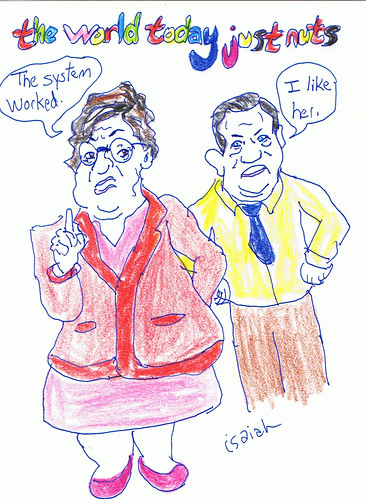
Isaiah's The World Today Just Nuts "The 2010 Plan" from Friday.

Kevin Pina was on KPFA's Flashpoints Radio and was a lot clamer and a lot easier to listen to. He at least tossed in a sentence holding Barack accountable. (On his own. Dennis asked him about Barack specifically later on.)

Catherine Austin Fitts was on before that discussing the economy.

An e-mail came in informing me, "Dorgan is not a liberal. You shouldn't praise him."

That's referring to Byron Dorgan who I wrote about last night. He's announced he's not seeking re-election.

First off, who is the liberal in Congress?

Tell me because I can't find him or her.

I thought it might be Barbara Boxer but I've been with C.I. and Ava in Boxer's office too many times when they've tried to get her to do the right thing on a variety of issues. It's rarely worked.

So who's the big liberal?

C.I. can usually get more done with one or two Republicans to be honest. She can ask and they'll make some tiny motion that they know (and C.I. knows) will get 'bi-partisan' support and pressure Dems to step out a little more than the Republicans.

I don't mean to act like the Dems are evil. But they're not these huge liberals in the Senate. They're are some nice people, to be sure. I loved Joe Biden. If Joe told C.I., "I'll do it." Joe would do it. If Joe said, "Let me think about it," he'd think about it. If Joe said, "I can't do it," he couldn't do it. He never lied. He never shucked and jived. He was always the most honest and upfront. Now, granted, he's known C.I. forever and a day but C.I. says Biden has always been that way. He never promises if he can't go through with it and if he promises, he goes through with it.

So I loved Joe Biden as a senator. He gave you his word on something, he meant it. I'm so tired of all the Dems who give their word and then don't follow up. (And C.I. always knows and will always say when we leave an office or residence, "___ is not going to keep that promise.")

As for Byron Dorgan. I've never met him or been to his office. I believe C.I. and Ava know him to some degree. My call on him was on veterans issues.

I stand by that call. I've been at those hearings.

Byron Dorgan cares and Byron Dorgan works on that issue. I don't think he can be replaced. I think Evan Bayh (who is a nice person when I've spoken to him) is a good advocate but Dorgan really cared to the point that he carried it with him. That might be why he's stepping down. It might just be too much on him. But you never doubted he cared about this issue and if you attended the hearings -- DPC hearings -- you know (a) he knew his stuff, (b) he wanted answers and (c) if he and/or Bayh chaired the Veterans Affairs Senate Committee, they'd accomplish something.

Senator Dorgan was a strong advocate for veterans. He will be missed and I will miss him because I don't see anyone else who fought that hard in the Senate. (If you want the truth, I can think of one person who came close -- came close -- but he's a Republican.)


Closing with C.I.'s "Iraq snapshot:"

Wednesday, January 6, 2009. Chaos and violence continue, a US soldier has died in Iraq, 5 Iraqi women are killed in a collision with the US military, the British deal with 'insurgents' is discussed, and more.

When you make a deal with opposing forces, a cease-fire, it's news.

Committee Member Roderic Lyne: Mr Day, I wonder if I could now turn to the very specific question of the ceasefire by the JAM, which -- I mean a national ceasefire was announced on 29 August by Moqtadr Sadr and I understand that there was a separate ceasefire negotiated locally in Basra. Were there contacts between British Government and the Sadrists in Basra about this?

Jon Day: Yes, I mean, I can confirm that there were contacts between the UK and the Sadrists in Basra from the spring of 2007, and that as a result of this continuing dialogue, a series of -- I think I prefer to use the word "understandings" were reached with core elements of the Sadrist JAM militias in Basra. These understandings ran from mid June 2007 and they therefore pre-dated and were separate from the national JAM ceasefire in late August.

Committee Member Roderic Lyne: Can you say what the motives were for the British Government in talking to the JAM in Basra?

Jon Day: I think the government had a number of motives for authorising this dialogue. First of all, it was part of the coalition's outreach to groups involved in violence consistent with, though separate from, what was happening with Sunni groups further north. Second, we wanted to encourage the mainstream JAM to move from violence towards a commitment to democracy and to demonstrate to them a path to that goal, especially in the context of local government elections, which were then expected in early 2008, although in practice didn't happen until early 2009.

Yes, we're on the Iraq Inquiry taking place in London and never have so many words been used to say so little. The British negotiated a cease-fire in Basra in 2007. Why? What led up to 2007? From the
November 22, 2006 snapshot:

In England,
This Is London reports: "Foreign Secretary Margaret Beckett this afternoon surprised MPs by signalling the countdown to a withdrawal from Iraq. She told the Commons that Basra, where the bulk of the UK's 7,200 personnel are stationed, could be handed over from British military control to Iraqi forces as early as next spring." Basra has been a violent area for British soldiers (and for Iraqis). Earlier this month, on England's Rememberance Sunday, four British troops were killed while on a boat patrol in Basra and three more were wounded. The four killed included Sharron Elliott who was "the second British female servicewoman to die in action." The other three were Jason Hylton, Ben Nowak, and Lee Hopkins. Mortar attacks have been common in Basra and, in August, a British soldier died as a result of wounds received from mortar rounds. In October, a British soldier died in Basra from road traffic. The end of October was also when the British consulate in Basra was evacuated after it was decided it was no longer safe after two months of mortar attacks. (In August, British troops 'evacuated' from their base in Amara due to repeated mortar attacks.)

And to zoom in on their being forced off their base, from the
August 24, 2006 snapshot:

Meanwhile British troops of the Soldiers of the Queen's Royal Hussars are . . . on the move.
Ross Colvin (Reuters) reports a lot of talk about how they're 'stripped-down' and mobile (in Landrovers) but the reality is that they're also homeless -- they've "abandoned their base in Iraq's southern Maysan province on Thursday". Though the base was under "nightly attack" and though it has, indeed, been abandoned, British flack Charlie Burbridge disagrees that "the British had been forced out of Amara".

Why did the British negotiate a cease-fire? Because they were getting their asses kicked and being forced to close consulates and flee their own base. In fact, let's stay with the base a second more because it was such an embarrassing moment and the Inquriy does not appear to be prepared to tackle that issue. From the
August 25, 2006 snapshot, the day fater the British military fled their base:

In other violence, despite the British military flacks that were so eagerly allowed to
spin in this morning's New York Times, Haidar Hani (AP) reports: "Looters ravaged a former British base Friday . . . taking everything from doors and window frames to corrugated roofing and metal pipes". As Ross Colvin (Reuters) reported yesterday, the base, which had come under nightly, heavy attacks, was abandoned. The AP story today notes: "Iraqi authories had complained that the British withdrawal had caught them by surprise" and allows flack Charlie Burbridge to holler Not-true-we-gave-them-24-hours-notice! Well, Charlie, on a rental, you usually have to give a minimum of 30 days notice. But it is good to know that as they packed up everything they could carry, someone did think to make a quick call saying, "Hey, we're about to split. If there's anything you want, better grab it quick, dude!"

Reporting on Day's testimony today,
AP observes, "Britain has been accused of being too passive in the Basra region and leaving it without a proper post-conflict strategy that left it vulnerable to militias." David Brown (Times of London) reports:

There were persistent reports at the time that the British military had struck a deal with the al-Mahdi Army including transferring 60 prisoners to Iraqi custody in return for safe passage out of the palace. The Ministry of Defence at the time denied that there was any deal.
Mr Day said yesterday: "I can confirm that there were contacts between the UK and the Sadrists in Basra from the spring of 2007. As a result of this continuing dialogue I think I prefer to use the word 'understandings' were reached with core elements of the Sadrist JAM militias in Basra.
"These understandings ran from mid-June 2007 and they therefore predated and were separate from the national JAM ceasefire in late August."
Sir John Chilcot, chairman of the inquiry, said on Monday that he would hold a session in private about the British deal with the al-Mahdi Army.

Today the Inquiry heard from
Gen Peter Wall, Mark Lowcock, Christopher Prentice as well as Day (link goes to video and transcript options). While Day was less than truthful, Wall was a bit more truthful. Richard Norton-Taylor (Guardian) reports that Wall declared that British troops were "sitting ducks" and "the focus of the violence." Channel 4 News' Iraq Inquiry Blogger continues to live blog the hearings and we'll note this from one entry:

We aim for at least two entries a day here at the
Iraq inquiry blog but someone much web-savvier than me (which, admittedly, could be almost anyone) recently suggested that less is more when it comes to the quieter days – and this was certainly one of those.

With the exception of Day and Wall, it was a very slow day. If you e-mail to state that something should have been noted on one day's hearings -- feel free to do so -- please note that (a) I can miss something (very easily, very often -- which is why the day after a hearing, most days, the next morning's entries will include some coverage of that hearing), (b) I'm speaking to friends in England about the hearings to make sure we don't miss the 'big talking point' and (c) I'm making a call. My call may or may not be right. And if a friend or friends is/are adament that something is the story, I'll let them overrule my own call. (They insisted John Chilcot's lengthy statement at the end of the last public hearing in December was the story, for example, and we went with that.) But a number of visitors are e-mailing about the US slowing the British withdrawal.
Andrew Hough (Telegraph of London) and David Brown (Times of London) are among those who reported on that development. We didn't lead with it and didn't inlcude it in the snapshot because I made a call that it wasn't news. It may be new to some people but in October 2007, we repeatedly noted Kim Sengupta and Anne Penketh's "US 'delayed' British withdrawal from Basra" (Independent of London) on this issue. That's what the testimony was about -- what the two had already reported. You can disagree with my call and you may very well be right but I did not (and do not) feel that we have to spend time going over points from the hearing that were already established years ago. The only real exception is the NO WMD and that we will go over and over because so many were led to believe that there were or, after the invasion, that they were discovered. There were no WMD in Iraq. But other than that, we'll go for things that are new or at least "newish."

While we're dropping back to
yesterday's snapshot, we noted the latest episode of The Progressive Radio Show where Matthew Rothschild speaks with Sami Rasouli and that Sami Rasouli is with Muslim Peacemakers Team in Iraq and also a part of the Reconciliation Project. I meant to include links to both organizations but forgot. So the links are now there.

Outside of the Iraq Inquiry, we will repeatedly note other topics. Such as the League of Righteous. Dropping back to the
June 9th snapshot:
This morning the New York Times' Alissa J. Rubin and Michael Gordon offered "
U.S. Frees Suspect in Killing of 5 G.I.'s." Martin Chulov (Guardian) covered the same story, Kim Gamel (AP) reported on it, BBC offered "Kidnap hope after Shia's handover" and Deborah Haynes contributed "Hope for British hostages in Iraq after release of Shia militant" (Times of London). The basics of the story are this. 5 British citizens have been hostages since May 29, 2007. The US military had in their custody Laith al-Khazali. He is a member of Asa'ib al-Haq. He is also accused of murdering five US troops. The US military released him and allegedly did so because his organization was not going to release any of the five British hostages until he was released. This is a big story and the US military is attempting to state this is just diplomacy, has nothing to do with the British hostages and, besides, they just released him to Iraq. Sami al-askari told the New York Times, "This is a very sensitive topic because you know the position that the Iraqi government, the U.S. and British governments, and all the governments do not accept the idea of exchanging hostages for prisoners. So we put it in another format, and we told them that if they want to participate in the political process they cannot do so while they are holding hostages. And we mentioned to the American side that they cannot join the political process and release their hostages while their leaders are behind bars or imprisoned." In other words, a prisoner was traded for hostages and they attempted to not only make the trade but to lie to people about it. At the US State Dept, the tired and bored reporters were unable to even broach the subject. Poor declawed tabbies. Pentagon reporters did press the issue and got the standard line from the department's spokesperson, Bryan Whitman, that the US handed the prisoner to Iraq, the US didn't hand him over to any organization -- terrorist or otherwise. What Iraq did, Whitman wanted the press to know, was what Iraq did. A complete lie that really insults the intelligence of the American people. CNN reminds the five US soldiers killed "were: Capt. Brian S. Freeman, 31, of Temecula, California; 1st Lt. Jacob N. Fritz, 25, of Verdon, Nebraska; Spc. Johnathan B. Chism, 22, of Gonzales, Louisiana; Pfc. Shawn P. Falter, 25, of Cortland, New York; and Pfc. Johnathon M. Millican, 20, of Trafford, Alabama." Those are the five from January 2007 that al-Khazali and his brother Qais al-Khazali are supposed to be responsible for the deaths of. Qassim Abdul-Zahra and Robert H. Reid (AP) states that Jonathan B. Chism's father Danny Chism is outraged over the release and has declared, "They freed them? The American military did? Somebody needs to answer for it."

Timothy Williams and John Leland (New York Times) report that Interior Ministry spokesperson Alaa al-Taei states that Qais al-Khazali was "released two days ago" by the Iraqi government (he is the "Iraq accues of being behind the killings in 2007 of five American soldiers"). Ned Parker and Saad Fakhrildeen (Los Angeles Times) add:The release followed the complicated transfer of Khazali and 450 of his supporters from U.S. to Iraqi custody, which began in June when his brother Laith and a senior aide were given their freedom. Since then, the League of the Righteous has handed over to the Iraqi government the corpses of three of the abducted British hostages, and the kidnapping's one known survivor, Peter Moore, a computer technician. Moore was freed last week after the Americans transferred Qais Khazali to Iraqi custody. The fate of the fifth hostage remains unknown, although he is believed to be dead. The U.S. military has backed Iraqi Prime Minister Nouri Maliki's government in its effort to bring Khazali into the political process and has said the League of the Righteous halted its attacks against the Americans early last summer. Khazali had been held since March 2007 in the kidnapping and killing of five U.S. soldiers in the southern city of Karbala in January of that year. His supporters kidnapped the Britons to bargain for his release. At the time, the Americans accused Khazali of working in direct collaboration with Iran's Quds Force of the Revolutionary Guard.

Laura Rozen (Politico) did a brief write up yesterday. To be clear, the British government has every right to ask for help with their hostages -- in fact, as the Iraq Inquiry has demonstrated, if they didn't ask for help constantly, the British government would have no 'plan' when it came to freeing hostages. It is their obligation, not just their right. The British government is supposed to represent their citizens. The United States government is supposed to represent their own citizens' best interests. There will be trade-offs and one-offs and various deals made between governments.

There were no American interests in this trade, there was no benefit to the US in making this trade. The British are already allies, they can't get any closer short of gene-splicing and they can take a "no" as easily as any other country. So it did not win over support from a lukewarm ally or recruit a new ally. No American citizens had been kidnapped and were being freed as a result of the trade, so no benefit arrived that way.

All Barack Obama did was embarrass the United States. 5 US soldiers are killed. The US military has the suspected ringleaders in custody. To force their release, the League of Righteous kidnaps five British hostages. The US allowed itself to be blackmailed into a release that it had no business making. America did not benefit from the release and, in fact, the US suffered and suffers. The US military that is being sent in harm's way now knows that their lives matter very little to their commander in chief and any nut job in the world now knows if you want your leaders freed, kidnap British citizens and the US will cave. There was no benefit and it is a very disgraceful moment. Barack is desparately trying to portray himself as Mr. Security with his never-ending announcements about fighting terrorism but for all the speechifying, he let go two terrorists who are the ring leaders of the group claiming responsibility (bragging about it, not merely claiming) for the deaths of 5 US soldiers in an assault on a US base. It is not a proud moment for Barack Obama, nor is it a proud moment for the United States of America.


Today a US soldier died. Did the newly christened "USF" (United States Forces - Iraq) post a release?
No, that would be actual work. (Note, USF also apparently doesn't plan on posting the briefings the way M-NF did.) David Culter (Reuters) reports 1 US soldier died "while on patrol in Baghdad" -- other than that, we'll wait for the official statement which may or may not include "The incident is under investigation." The death brings to 4373 the number of US service members killed in Iraq since the start of the illegal war.

Violence claimed Iraq lives today.
Anne Tang (Xinhua) reports 5 women are dead and either other Iraqis injured after an accident with a US military vehicle outside Hilla and the bulk "of wounded people were women and children". Hannah Allam (McClatchy Newspapers) reports one of the injured, Badriya Hussein, was "dazed and blood-spattered" and crying, "Why? Why?" and the Iraqi media is reporting the US military vehicle was traveling on the wrong side of the road when it hit the women's mini-van. Reuters notes that three US soldiers were also injured in the accident and they report a Mosul roadside bombing left two police officers wounded and a Mosul bombing reaulted in the deaths of 2 children with a third left injured.

Meanwhile
Uthman al-Mukhtar (Asia Times) reports that al Anbar Province residents are "alarmed" by the recent increase in violence in the province and quotes Noor Saadi stating, "The police can't even protect themselves." The violence is causing her to keep her son at home and not let him attend school while other people are refusing "to return to their businesses or open their shops." To the south east of Anbar Province is Nasiriyah (of Dhi Qar Province) where Katharine Houreld (Scotsman) reports a number of artificats were discovered before they could be carried across the border out of Iraq and sold on the black market.

Also on the move is Nouri al-Maliki, US-installed thug of the occupation, whom
UPI reports journey to Najaf yesterday in order "to discuss election preparations with Grand Ayatollah Ali al-Sistani from whom Nouri was seeking a blessing as evidenced by his trip and groveling. Nouri told the Ayatollah that "his State of Law coalition would join forces with the Shii'te National Alliance slate to compete in March elections." Missy Ryan and Waleed Ibrahim (Reuters) report that Saleh al-Mutlaq, the Iraqi National Movement, calls Nouri's efforts false noting, "It's not possible for a party that has been sectarian from its beginning for dozens of years, to suddenly become nationalist." Tariq Allhomayed (Asharq Alawsat Newspaper) notes Nouri's long, long sildence while Iran occupied an Iraqi oil field last month (Iran denies it) and compares Nouri's remarks when they finally came to a popular saying:

The following popular saying applies to Mr. al Maliki's comments: 'We destroyed a house last year, and its dust came this year,' as he made his comments way after the lines have been drawn and the positions of all Iraqis became apparent. However what's strange is that after the occupation of the Iraqi Fakka oil well by Iranian forces, I, like many others, wrote about the danger of what happened. The article was called 'The Iranians Have Done Good in Iraq,' based on the consideration that the occupation will help Iraqis, or let us say the Iraqi voters, discover who are Tehran's men in Baghdad, because they will not dare say a word about Iran, even if it was occupying an Iraqi oil well. Some comments were made about us in some Iraqi media affiliated to the government that can only be described as insults and accusations, as the media affiliated to the Dawa Party and the Islamic Supreme Council launched a violent attack on me and other colleagues at our newspaper, and they cast the worst accusations against us, as well as insults and instigations, whilst Mr. Nuri al Maliki comes out today to say that Iraq "will not remain silent" in the face of any violations against his land!
The question here is: why the tension, and why the media campaigns when al Maliki is coming out today to defend Iraq, its "land, sea and air," in his own words.
Why are we thought of as sectarian and as traitors? Most importantly, the main, real reason for the recent speech in defense of Iraq, after a long silence, is the fear of the results of the upcoming Iraqi elections -- the preparations for which are in full swing today.

Bernard Gwertzman (Council on Foreign Relations) interviews Jane Arraf (Christian Science Monitor) and the subject of Iraqi elections is raised:

[Bernard Gwertzman]: Talking about politics, the national elections for a new parliament that were originally supposed to take place in January will now take place on March 7. Who are the main contenders for power?

[Jane Arraf]: The most prominent of course is Prime Minister Maliki, who has done quite a lot of things right in the view of people in the streets. After all the suicide bombings, you would think people would be incredibly angry at him. But when you ask people in the street, he doesn't get a lot of the blame. What he hasn't done so well is enforcing his alliances with the political players he needs. He was basically the compromise candidate, and that's how he came to power. Now the Kurds say that he came to power because they decided to back him. That's in part true. Right now, the Kurds are not showing their cards. They're waiting to see, as everyone is waiting to see, who gets the most votes after the elections. That's when we'll see the coalitions forming. Unlike the previous election, when we pretty much knew who was going to head these coalitions, it's still all up in the air. There are even some players from 2003. Former Prime Minister Ayad Allawi, who has been backed by the United States, is back. There are various Shiite candidates who have split from the coalition that Maliki had been part of, so there is a division in the two main Shiite parties, each with competing candidates. But again, that might change after the election results are in. As you know, politics anywhere, especially in the Middle East, are full of surprises so we could see alliances that we hadn't predicted.

[Bernard Gwertzman]: Is this a different kind of election? Will people be voting for individuals or for parties?

[Jane Arraf]: They will be voting for both. For the first time in national elections, Iraqis are able to choose and vote for the candidate of their choice, not just for the party of their choice. This was one of the big debates in Parliament and one of the reasons for the delay in passing the election law. There are a lot of really unpopular members of Parliament. There's a lot of dissatisfaction in the country with Parliament, and a feeling that a lot of these members of Parliament probably won't win this time, so they were pushing for a closed slate where they were running on the coattails of the more popular parties. But in the end, they passed an election law that allows people to actually vote for the candidates themselves as well as the parties, which is seen as somewhat more democratic.

Iraqi refugees have their own opinions about the intended March vote.
Julian Barnes-Dacey (Syria Today) reports on the mood in Syria among the refugee population where a large number appear determined not to vote because they do not feel the 2005 vote made any difference for their lives and and political analyst Fadel al-Rubaie declares, "Not even 10 percent of refugees will vote because of their dissatisfaction with the political process. Today Iraqi refugees feel change is hopeless. They voted in 2005 and it made no difference." UPI reports a large number of Iraqi Parliamentary members are not expected "to run for re-election" and that a huge turnover is being predicted. Meanwhile John Leland (New York Times' At War Blog) reports on the press conference Senators Joe Lieberman and John McCain held in Baghdad in which they never even mentioned the elections and Leland observes Lieberman was "taking stock of an Iraq that has yet to emerge" with statements such as "We have together made history here, but more important than making history, we changed history." Yesterday the White House issued the following statment regarding the elections:

The Vice President [Joe Biden] met today with the U.N. Secretary General's Special Representative for Iraq Ad Melkert, to discuss developments in Iraq. The Vice President offered continued U.S. government support for the indispensable role of the United Nations Assistance Mission in Iraq and thanked Mr. Melkert for his leadership, highlighting his recent support for Iraqi efforts to approve an election law. They discussed preparations for the upcoming national elections and pledged to help the Iraqis resolve outstanding national unity issues. To view a photo of this meeting please click
HERE.

Tuning to the US where little whiners are up in arms over Andrew Tyndall's latest 'study'.
Tiny Eric Deggans (Tampa Bay Tribune) huffs that he can't find a person of color but Andrea Mitchell is "top of that heap" -- Andrea Mitchell's a woman. If, IF, the 'study' is correct and she had the most air time on the network news of any correspondent, good. About damn time. Women make up over half the US population. Deggans is not at all distressed by women's low representation (Andrea's not even in the top 20 for 2009). He just wants to play his Pig Boy games. That includes citing the Ultimate Pig Boy Andrew Tyndall as gospel. Who is Andrew Tyndall? Andrew Scott (AOL's Inside TV -- and Outside Sanity?) is clueless: ". . . Mitchell clocked in the most minutes on camera during the last decade. Her total a staggering 2,416 minutes. Andrew Tyndall, also of NBC, finished in second, with 2,328 minutes." Can we get a reading workshp for Andrew Scott?

Andrew Tyndall is not a reporter and he did not receive 2,328 minutes of time on NBC news or on any news. He is a media 'expert.' He has a stream of data he's releasing (he's still posting it at his bad blog as I dictate this) and no one ever checks it out, they just run with it. They should try checking it out.

Let's address Tyndall's bonafides, shall we?
He explains:

Sawyer's decision to lead ABC's newscast with
Kate Snow's story on the ban on military cancers in the warzone displayed a morning show sensibility. It is the type of story that sparks plenty of debate around the watercooler [. . .] yet affects very few people. Only four cancer diagnosis have occurred in defiance of Cucolo's order; those people have received no punishment more severe than a reprimand; and they have been sent home from the battlefield just as they would have been had cancer not been forbidden.

What? The military's targeting cancer patients? Proposing to possible court-martial them and Tyndall says it's "watercooler" and "affects very few people"?

No, he didn't say that. I've changed pregnancy to cancer. This is why Tyndall's hyped Tyndall Report needs to be ignored (if not called out). He does this all the time -- issuing reports that he claims are objective and they aren't. He did that repeatedly with Katie Couric, labeling something "soft news." That's not "soft news." He didn't care for it -- women were involved -- and he hissed "soft news." (We covered this topic in December. If you're late to the party,
check out this at Feminist Wire Daily. And I will again say thank you to Gen Ray Odierno for eliminating the policy.)

The pregnancy issue? What an idiot Andrew Tyndall is. Tell it to the women in the miltiary e-mailing this site outraged by the policy. Tell it to the 4 US senators lodging a complaint about the policy. The government wants to court-martial for pregnancy -- even, get this, married pregnancies -- and Tyndall says it doesn't matter and is just "watercooler." Tyndall thinks he judges by a "universal" standard. No, he judges by a sexist standard where issues effecting women are "watercooler" and don't matter as much. His crap needs to be called out.

He's released a ton of numbers -- they aren't accurate. They never are. He can't back it up and he knows he won't be checked. There are categories in there on Iraq. When PEW releases a study on media coverage of Iraq? We'll take it seriously as we always have. Andrew Tyndall? We're not interested.
September 2006 at Third we quoted from a Tyndall 'study':

CBS' enthusiasm for features includes Exclusives. Lara Logan's scoop took us behind Taliban lines in Afghanistan's Ghazni Province and David Martin landed a one-on-one with Richard Armitage, the leaker who told columnist Robert Novak that Valerie Plame, wife of diplomat Joe Wilson, was a spy. "I let down the President. I let down the Secretary of State. I let down my department, my family. And I also let down Mr and Mrs Wilson." "Do you feel you owe the Wilsons an apology?" "I think I have just done it."We then explained that 'analyst' Tyndall labels both reports as "features." Lara Logan is doing a report not a feature. Media 'analyst' Andrew Tyndall doesn't know the first thing he's talking about -- as usual. We don't trust him, we don't trust his 'findings' and we don't trust his numbers so we'll ignore the Iraq aspects of his 'study.'

Back here on earth, Francis A. Boyle is an international law expert and a noted professor. We noted that Iraqi members of Parliament may not be running for re-election earlier in the snapshot. Professor Boyle weighs in on the decision in the US by Chris Dodd not to run for re-election to the US Senate:


Contrary to conventional wisdom, Senator Dodd's retirement from the Senate will be no loss for the Irish or this country. During the past two decades, Senator Dodd has sold out the Irish and Irish Americans and Irish America on two separate occasions. In 1986, he sold us out to Margaret Thatcher and her Diplock Courts by means of supporting the U.S.-U.K. Supplementary Extradition Treaty. Then again in 2006 Senator Dodd sold out us Irish to Tony Blair and Britain's still extant Diplock Courts by means of his decisive support for the U.S.-U.K. Extradition Treaty. This first sell-out was because of Dodd's craven capitulation to President Ronald Reagan. The second sell out was because of Dodd's craven capitulation to his own presidential ambitions. As a veteran of both treaty battles, I can assure your readers that Senator Dodd alone could have stopped both treaties if he had really wanted to. Instead Senator Dodd greased the way for the two most totalitarian extradition treaties in the history of this proud American Republic going all the way back to our War for Independence against the British Monarchy. When conjoined with his own financial and banking scandals , Senator Dodd finally decided to throw in the towel on his latest re-election campaign. Bon voyage!

Caro of MakeThemAccountable adds:

"BREAKING: Democrats Hoping To Take Control Of Congress …
… From Republican Minority In 2010"
Why was
that tweet from The Onion so funny?
Because it's so true.
Despite a Democratic president, a Democratic majority in the House, and 60 members of the Senate caucusing with the Democrats, the corporate lobbyists' agenda continually prevails.
If you want to force that situation to "change", if you'll pardon the expression, read on.
(more…)

Lastly Friday night on most PBS stations,
NOW on PBS begins airing (check local listings) and this week's program explores the Afghanistan War:President Obama is sending as many as 30,000 more troops to combat Taliban and al Qaeda forces in Afghanistan this year, but are we missing the true target? On Friday, January 8 at 8:30 pm (check local listings), NOW reports directly from Pakistan's dangerous and pivotal border with Afghanistan, where Pentagon war planners acknowledge many of the enemy fighters and their leaders are based. The U.S. has been relying on Pakistan to act against Taliban militants there, but the Pakistani army's commitment is in question. NOW takes you to the true front lines for an eye-opening, inside lookyou haven't seen before, and won't soon forget.
iraqthe new york timestimothy williamsthe los angeles timesned parkersaad fakhrildeenpoliticolaura rosen
anne penkethkim sengupta
the christian science monitorjane arraf
the times of londondavid brown
the guardianrichard norton-taylor
francis a. boyle
caromakethemaccountable
pbsnow on pbs

Tuesday, January 05, 2010

Not a good day

Brownie approved

Isaiah's The World Today Just Nuts "Brownie Approved" is above and about the only thing that makes me smile today.

KPFA's Flashpoints Radio? A strong report on Honduras in the first half hour and John Ross reporting on what's happening in Mexico, looking back at 2009. It was more than worth listening to (use links if you missed it) but it just pisses me off that this is the show being targeted. With all the crap KFPA serves up daily, this is the show they go after? This is usually the strongest broadcast the station has Mondays through Friday and, many days, it is the only strong broadcast they have.

But that's what they go after. Very telling. Be an inoffensive, do-nothing program, and Lem-Lem will keep you fully staffed so you can continue boring the entire Bay Area (more online) but do a show that actually makes a difference and it's time for Lem-Lem to pull out the knives.

And the news just gets worse. I'm not even touching ObamaCare, I'll just groan loudly. But there's this news from the New York Times:

Senator Byron L. Dorgan, Democrat of North Dakota, announced abruptly on Tuesday that he would not seek re-election this year – a clear sign of the difficulties Democrats will face in defending their large Congressional majorities in the upcoming mid-term election.

Oh good Lord. (Any offended, I'm Catholic and my word of choice would not fit here.) Dorgan's stepping down?

We have the most useless members in the Senate but Dorgan's the one stepping down?

Dorgan who actually makes a difference?

Byron Dorgan who's done more than any other senator to raise awareness of the burn pits and the exposures troops in Iraq and Afghanistan have suffered?

That's who's leaving?

We get to keep Max Baucus and assorted others but we lose Byron Dorgan?

Newsflash, the Democrats can't afford to lose Dorgan. He's one of the hardest working senators.

So that's got me pissed off as well.

It's just not a good day for me.


Closing with C.I.'s "Iraq snapshot:"

Tuesday, January 5, 2009. Chaos and violence continue, Iraqi Christians are again targeted, a British official tells the Iraq Inquiry they did everything but (under questioning) reveals they did damn little, KPFA runs off listeners, and more.

There's confusiong this week regarding Ba'athism as a result of one outlet publishing rabid ravings of a Chalabi. But there's also an easy walk through provided on this week's
The Progressive Radio Show where Matthew Rothschild speaks with Sami Rasouli of Muslim Peacemakers Team in Iraq.

Sami Rasouli: And by the way, Ba'ath means the Arab renasance or a new born Arab and that political party as philosophy and set of values and objectives were founded --was founded by a Christian Syrian philospher scholar named Michel Aflaq in 1947. Main objective of the Ba'ath to unite all Arab countries. 22 countries become just like United States of America, United States of Arabia. That was a wonderful thing to think of of it. And the people were according to the Ba'ath philosophy, they live in a social system and free -- free from outsider's intervention

Matthew Rothschild: But that's not how the regime turned out though?

Sami Rasouli: Well the objectives yes. The objectives, I mean, the-the Ba'ath was -- attracted actually lots of young people. Started in Syria, moved to Iraq, then right now at the moment the Syrian government is run -- embracing that party, Baath political party and also there are Bathis in the parliaments of Lebanon, Jordan, Sudan and the Ba'ath Party is active in Mauritania and other Arab countries excpet in Iraq. In Iraq if you run for political office, public office like the next election in March, in Iraq, you have to submit an affidavit that prove that you are not Ba'ahti you did not work with the previous regime. So there is a harsh actually ban on exercising the Baath as a political party in Iraq today and that goes back when Paul Bremer, the second civil administrator -- American administrator, who run the country after Saddam Hussein fall, he set one of the 100 orders, besides disbanding the army, the order was the de-Ba'athifcation that slaughtered a lot of Iraqis.

Matthew Rothschild: Do you think it's a mistake to ban the Ba'ath Party?

Sami Rasouli: Oh, yeah, because many people embraced that political party willing and others, no, they were forced. But the big dilemma that the Iraqi people are suffering today, 1/5 of the population got displaced and mostly was the educated paople. Now this is just for education, Taliban means the educated people. So the educated people of Iraq -- 1/5 of the popultiaton, one million people were driven first they were kidnapped, imprionsed, killed with many, many, many, I mean 650 Iraqi scientists were assassinated by the Mossad these Israeli intelligence agency in the last six and a half years and this is available as information go Google the State Dept and the Pentagon They don't shy away about it because those scientiest they know about it and the so they are so dangerous and they were not recruitable so they got assassinated. Now many --

Matthew Rothschild: Well that's the first I've heard of that. You're sure about that?

Sami Rasouli: Right you can find that easily, hundreds of articles about this. The Oil experts that were part of those people, the Iraqi educated people, got displaced out of Iraq, in Jordan and Syria and beyond, they left the country the country now has a big vaccum and it became a dead end where the Iraqi oil became privatized.

Matthew Rothschild: Well, and, how is that, that has just begun and for a long time/ I mean, I had a bumper sticker on my car that said: "The Iraq War Is Terrorism For Oil" or something when the war started and now it looks like, low and behold the oil companies are getting in.

Sami Rasouli: On June 30th, the Iraqi government made a big noise sending 100s dancers and musicians on the street to celebrate what? The US forces left the cities and stayed on their bases, military based. and Malii told the Iraqis we just got -- we took the right step towrads our indepencncy our soverntiy so let's be happy and celeertate but he didn't tell the Iraqi pople the other thing that was happening on the very same day, June 30th giant oil company represenatives attended the celebration, another celebiration of submitting their bids to get their shares of the Iraqi treasures Iraqi government silently, secretly auctioned off the Iraqi wealth, the Iraqi oil. And now we know one of the three letters that Ray McGoven when he was asked about the Iraq War, He said it was about three letters O-I--L. O it's about Oil, I it's about Israel, L it's about location or logistics.

Sami Rasouli is with Muslim Peacemakers Team in Iraq and also a part of the Reconciliation Project. In terms of the 630 Iraqi scientists, Al Jazeera reported "
Mossad murdered 530 Iraqi scientists. The Plight of Iraqi Acadmics" May 9, 2006. December 10, 2007, Press TV counted 530 in their "Mossad mission: Murder Iraqi scholars." James Petras' article noting the reports can be found at Al Jazeera and the Palestine Chronicles. And it made the Marxism mailing list. Philip Sherwell (Telegraph of London) reported that Mossad was targeting Iran's scientists (Feb. 16, 2009) and quoted an unnamed source saying it would be like what they did in Iraq. December 3, 2005, David Hoskins (Workers World) reported:

Osama Abed Al-Majeed, the president of the Department for Research and Development at the Iraqi Ministry for Higher Education, has accused the Israeli secret service, Mossad, of perpetuating the violence against Iraqi scientists. A June 2005 report by the Palestine Information Center claims that Mossad, in cooperation with U.S. military forces, was responsible for the assassination of 530 Iraqi scientists and professors in the seven months prior to the report's publication.
Mossad unquestionably has the motive and means to assassinate leading Iraqi intel lectuals. The Israeli intelligence agency contains a Special Operations Division called Metsada which is tasked with conducting assassinations, sabotage and paramilitary projects. Israel has a long history of interference in Iraq, going back to the 1981 bombing of a nuclear energy plant that stood 15 miles outside Baghdad that just before that attack had voluntarily undergone inspection by the Inter national Atomic Energy Agency.
Regardless of who is responsible for the killing of Iraqi scientists and academics, it is clear that the U.S. and Britain, as the leading occupying powers, have the responsibility for the precarious situation in which these intellectuals are forced to live.

In July 2006,
Fakhri Al Qaisi ("assistant dean of the College of Dentistry") told Basil Adas (Gulf News) that, "The assassinations are linked to Israeli Mossad." Adas reported, "He claimed that the Iraqi National Congress Party began abducting physicians and university professors after the US occupation, a time when assassinations increased dramatically and that the party was backed by the Mossad."

Matthew Rothschild devotes The Progressive Review this week to the issue of Iraq. And it can be done. And it used to be done. Which brings us to KPFA's self-serving [PDF format warning] "
KPFA State of the Station 2009." Pledge drives? It's never-ending begging at KPFA these days -- if you've missed it, you haven't been listening. Pledge drive over? Keep hitting up the listeners at the top of the hour. If you just listened, you'd get the impression that (a) KPFA needs money and (b) it wants to raise money. Reality: It needs money. If it wanted to improve the station's financial health the answer's in the paper. No, not in "This is how we get young males to listen to us!" In fact, that crap's so damn pathetic you begin to grasp why KPFA's listenership has CRATERED. Give them an audience and KPFA will run the audience off.

Travel with us through the report: "In 2004, KPFA's overall listenership reached a peak, paralleling the trend of public radio as a whole, in the wake of the US invasion of Iraq." Why would that be the peak? Because of the Iraq War, the report tells you. The report continues, "Times of reaction and war have traditionally increased listenership to Pacifica stations. The fact that we have not broken any lasting new ground in the past eight years is cause for real concern."

Indeed it damn well is. Equally true, PAY ATTENTION KPFA, the fall in listeners coincides with KPFA's drop in war coverage. The Iraq War has not ended. The Iraq War, when it was covered, brought KPFA record high listenership for the decade and what the hell did KPFA do with that?

Not a damn thing.
KPFA's Flashpoints Radio, trivia note, began how? Covering the first Gulf War. In 2003 and 2004, while KPFA was pulling in a record number of listeners, what show did they create to cover the Iraq War? Not one damn show.

Not one damn show.

And when confronted, management would insist it could be covered by the various programs. As we all know, that was either optimistic thinking or a flat out lie. Here's what happened, the end of 2004 (which is when the ratings start to droop -- a factor that is left out of the 'official report'), KPFA drops Iraq to subordinate position. The Iraq War is no longer an issue itself, mind you, it is now a reason: A reason to vote for John Kerry. KPFA lost listeners doing that because it wasn't NPR. See, NPR covers the news. You may not like how they cover it, you may. But NPR isn't telling you who to vote for.

Having failed to use the Iraq War to elect John Kerry president of the United States, KPFA (and the rest of Pacifica) lost interest in Iraq. This is December 2004, January 2005, etc. It's not until Cindy Sheehan stages Camp Casey that Iraq becomes an 'issue' for KPFA. And, no surprise, KPFA's interest was just in time to push the 2006 mid-term elections.

Today the Iraq War doesn't exist on KPFA except for one program, we'll get to it in a minute. You can hear Kris Welch embarrass herself (how sad that this is how the broadcast career ends) doing her bulls**t broadcasts each Thursday and Friday which are nothing but grief therapy for Democrats which end with a group hug and a pledge to forever vote Democrat -- and that crap you can hear all over KPFA. You just can't hear a damn thing that matters.

KPFA walked away from its mission. It refused to provide information and instead worked on get out the vote. That is not Pacifica Radio's function. And that nonsense alienated people who weren't Democrats (Socialists, Greens, Communists, independents, disenchanted Republicans, swing voters, non-voters, etc.) and alienates even Democrats today as they hear Kris Welch and various other liars on the airwaves insisting that Bush did this and Bush did that even though Barack Obama is the President. They're such liars, no one takes them seriously. KPFA is supposed to lead. Not lead in minimizing or lowering expectations.

KPFA failed. The management failed. The first thing you do, if you're KPFA, when the US launches a war, is launch a program to cover it. Anytime Pacifica's done that, the ratings have been there. Anytime. And the funds have been there because it was an alternative to the rah-rah war of the MSM. But they failed. And they continue to fail because the Iraq War continues and the Afghanistan War continues. They could give you Mitch jerking off daily while moaning "Barack! Barack" and call it [Dear Penthouse Forum] Letters From Washington. They've failed to grasp why Pacifica ever mattered, they've confused electoral politics with Lew Hill's mission statement and, in doing so, they've driven off all the listeners they gained in 2004.

In full,
from Indybay Media, this open letter from Dennis Bernstein of KPFA's Flashpoints Radio:
Open Letter to KPFA General Manager, Lemlem Rijio and the KPFA community
by repost from D. Bernstein Thursday Dec 31st, 2009 12:37 PM
Dennis Bernstein replies to a letter sent by KPFA General Manager Lemlem Rijio to the staff list concerning the cuts to Flashpoints
Open Letter to KPFA General Manager, Lemlem Rijio and the KPFA community of Listeners /And A Bold Proposal By Dennis Bernstein, Executive Producer, Flashpoints On December 30th [Response to Rijio letter of 12/30, KPFA Staff: KPFA Open Letter on Budget Reductions, which is not copied here due to a confidentiality notice] KPFA GM, Lemlem Rijio addressed the KPFA Pacifica community in an open letter . . about the current financial crunch at KPFA. While the crunch is real, I would of course disagree with several statements made in the letter by MS Rijio. But let me just shed light on one point, in which she directly addresses Flashpoints, and then I'd like to offer a bold proposal to Management and workers at KPFA, to step up and stand strong for Free Speech Radio. Ms Rijio states in her open letter: "At the current staffing level (after cuts to all programs), Flashpoints has more staffing per hour than all other public affairs programs at KPFA." Really? Under current management, Flashpoints has lost fifty percent of its budget, leaving the show with 80 paid hours for staffing. Currently KPFA news has well over 200 paid hours for staffing, five times the plant space as Flashpoints, and their own broadcast studio. They also have full access to Free speech Radio News which is a major contributor to the news cast. According to the official budget figures for fiscal 2005/2006, the news department budget went up over $50,000 dollars under current management, while the Flashpoints budget was cut. Administration went up over $30,000 dollars in the same period. The trend continued, as MS Rijio expressed her priorities clearly, by continuing to cut (and censor) Flashpoints, while increasing the budgets for the morning show and the news and administration. Statement of Fact: The Flashpoints budget has been slashed in half under current management. Question: Have the budgets for the morning show and the KPFA news gone up or down under the same management? Question: Did current management bust the budget, and are they now using the bust as an excuse to get rid of, or at least marginalize a radical edgy show like Flashpoints? MY Challenge: Ms Rijio writes in her open letter, "program teams, were given the opportunity to voluntarily spread the cuts among themselves, and some staff voluntarily reduced their hours to lessen the impact on their co-workers." Well here's my response to my boss: OK I will volunteer to go on an unpaid six months leave, and work for free, starting immediately if six of my brothers and sisters at the top of the KPFA pay scale will do the same. That would be say the two top managers, and 4 senior members of CWA (let's make room for the next generation). One more thing, it is my understanding that several people were given major increases in their hours, even while others were being cut. Those hours should immediately be returned back to the hour pool and given back to the people who were just laid off. If you agree to this action, in support of KPFA,the people's radio station, Ms Rijio, then I think that it will go a long way to getting us over the financial hump, without hobbling Flashpoints and Hard Knock Radio, which have been hit hardest by the crunch, and which are born under the banner of Pacifica founder, Lew Hill. In closing, Ms Rijio, I do admire your decision to bring this conversation out into the light of day, with your open letter to the KPFA community. I look forward to this frank open dialogue on how to keep KPFA Free Speech, non-corporate radio strong and viable into the 21st Century. In Struggle, Dennis Bernstein Executive Producer, Flashpoints, CWA/KPFA member,
dbernstein [at] igc.org


Today
Flashpoints Radio is the only KPFA program aware that the Iraq War did not end in January 2008 when Barack Obama was sworn in as the new president of the United States so we'll note Dennis' letter in full. KPFA has failed. The management needs to turn in their resignations. They've destroyed the station and they refused to deliver a program on Iraq all these years even though the Iraq War was the only thing, THE ONLY THING, that increased their ratings in the entire decade. (And we can go into pledges and what brought in the dollars -- not noted in the 'report' released but noted in a lengthier report.) KPFA and Pacifica need to get it together real damn quick. For Pacifica coverage from last night, see Marcia's "Hey KPFA, where are the women?," Ann's "The Morning Show's sexism is showing," Ruth's "A sexist broadcast from Women's Media Center," Kat's "Comic, Flashpoints, year end" and Elaine's "The Infantile Norman Solomon."

In London, the
Iraq Inquiry has resumed public hearings today and the witnesses were Gen Nichols Houghton, Simon McDonald, William Patey and Vice Adm Charles Style (link goes to transcript and video options of today's testimony). John Chilcot is the chair of the Inquiry and he noted before Patey offered testimony that the focus would be on examining "developments in Iraq from summer 2005 to summer 2006" and Patey explained, "I was the British Ambassador to Iraq from June 2005 to July 2006." The Press Association reports he told the Inquiry today "that for the first time in his career he had received orders directly from the prime minister." Richard Norton-Taylor (Guardian) adds, "Tony Blair personally briefed Britain's ambassador in Baghdad, with Downing Street calling almost every day as tension grew between political demands at home and reality on the ground in Iraq, the Chilcot inquiry was told today." After offering testimony on that early on, it was a subject Committee Members repeatedly asked about.

Committee Member Martin Gilbert: I would like to ask you about your contact with London. You mentioned your frequent telephone calls direct with Number 10. The instructions you got across the board, were they instructions that you felt were attainable?

William Patey: In the end, we did. I mean, my instructions were: get a constitution, get it agreed, have an election, get a government formed and get some troops out. So I suppose they were, because that's -- by July, when I left, we had done all of those. Handover in Muthanna was just about to happen. Obviously, we would have liked to have got more troops out quicker, but it was always a conditions based approach, and when the conditions were right. We weren't just going to pull troops out for the sake of it. So they were reasonable requests as long as you realised that they weren't in my gift or soley in the gift of the British Government. We were actors in a complex situation where there were other actors and the key for us was to work with the Americans, with the Iraqis, mainly, to try and see a path through. I was always struck by how open Iraqis were to discussions about how democracy worked, and what struck me about it was how little experience they had of it. All politicians had been in exile a while, it was just your own normal experience. I don't regard myself as a constitutional expert, but my everyday understanding of how government works was useful in talkign to Iraqi politicians who were genuinely interested. So there was a process of constant dialogue with individuals, which I think had an impact.

[. . .]

Committee Member Roderic Lyne: I just wonder if I could follow up a bit on the London end. You have talked about getting almost daily phone calls from Number 10. Where were your instructions coming from? Did it seem to you at all odd that you were being managed from 10 Downing Street rather than another department? Did you sense that there was a joined-up policy in Whitehall?

William Patey: No, I didn't find it strange, give the sort of level of interest in the subject, the level of commitment, personal comitment, by the Prime Minister. I didn't get -- I had lots of visitors. Jack Straw was out three or four, maybe five times in the time I was there. The Prime Minister was out two or three times. The Defence Secretary was out, you know, at least as often as that. So I had a lot of direct contact with the Ministers. In a sense, we weren't getting daily instructions. You know, we had -- I had my marching orders, if you like, and a lot of it was left to us. It was one of those -- what they were interested in was updates: what's happening? What's happening on the constitution? Where are we? Where are we on the electroral processes? Where are we on the formation of the government? So a lot of it was an insatiable appetite for information on what was happening, and that was -- in a sense that was the essence of really the Sheinwald call at nine o'clock in the morning. It was a kind of, "I'm going in to see the Prime Minister this morning. He is going to ask about Iraq. What's happening?"

Committee member Usha Prashar raised the issue of the prisoners ("detainees") and William Patey felt the biggest problem wasn't the US (he omitted the British from his response) but was the Ministry Of Interior "detention centers, and some of the horrific things we found there when coalition forces did go into something called the Jadriya bunker, and we also discovered detention centres on the seventh floor of the Ministry of Interiror which led to a whole process of dialogue with the Iraqi Government and agreement on investigation commission and also coalition willingness to inspect -- basically raid detention centres that they were aware of. So there was a determined effort to try and get to the bottom of what the Sunnis called the MOI death squads and politically motivated groups detaining people."

Committee Member Prashar attempted to pursue the issue but Patey repeatedly gave conflicting answers. He insisted he "gave quite a high priority to it" at one point, that he "didn't need London to raise it [the issue] with us" but pressed for what he actually did by Prashar, Patey responded that it was the "Americans [who addressed it[ because they had the forces in Baghdad." But, Patey declared, he did tell the Minister of the Interrior that the MOI death squad "was bad news for the country."

David Brown (Times of London) reports of Simon McDonald's testimony, "British companies have benefited from the award of oil contracts in Iraq because of the decision to help to overthrow Saddam Hussein, Gordon Brown's chief foreign policy adviser told the Chilcot inquiry yesterday." Channel 4 News' Iraq Inquiry Blogger adds these details of McDonald's testimony:

How, purred Sir Roderic, did McDonald think our involvement in Iraq had affected our standing in the Middle East? And with the European Union? And for that matter -- he'd started so he'd finish -- The World? Had it improved or worsened the fight against terrorism? Where exactly had it left our dealings with Iran?
The witness looked, quite frankly, a little astounded; the game had abruptly changed from Simon Says to Roderic Rails. His reply gambit to one question -- a refusal to speculate -- was, frankly, supremely ill-advised.
I'm not asking you to speculate, hissed his inquisitor; I'm asking for your assessment as one of the most senior foreign policy officials in the United Kingdom government. *Ouch*

Between those two testimonies, Vice Adm Charles Style and Gen Nicholas Houghton offered joint-testimony. Here's the key passage:

Committee Member Roderic Lyne: But you said earlier we had got to a situation where we couldn't do much about it. You said that a couple of times.

Vice Adm Charles Style: Absolutely, and not only that but I very much had the view by the first quarter of 2007 that we were starting to become part of the focus -- the target, the cause of much of the violence that was going on in the city.

Committee Member Roderic Lyne: So we then withdraw to Basra Airport and we hang around there for a couple of more years unable to do very much, but not able either decently to hand over in conditions that we regarded as acceptable.

At which point Gen Houghton jumped in to rescue the Vice Adm. The Inquiry continues tomorrow. Ryan Crocker was the US Ambassador to Iraq until April. (Chris Hill is now in that position.) Jefferson
Robbins (Wenatchee World) interviews Crocker on Iraq and other issues.

Turning to Iraq where Iraqi Christians are again being targeted.
AINA reports a Bartilla car bombing outside St. George Church in which twelve people were wounded and property damaged (link has a photo essay). Ethan Cole (Christian Post) provides this background, "The blast occured near St. George Church, which is the same town as the church that was attacked on Christmas morning by a minority ethnic group called Shabak."

Meanwhile Alan McMenemy remains unaccounted for. Five British citizens were kidnapped May 29, 2007 in Iraq and,
Wednesday, one was released: Peter Moore. Moore, Alec Maclachlan, Jason Crewswell, Alan McMenemy and Jason Swindelhurst were kidnapped by the League of Righteous from the Ministry of Finance and, following the US military releasing League of Righteous members from their prisons in Iraq in June, the bodies of Crewswell, Swindelhurts and Maclachlan were slowly turned over to British authorities. The British government announced in July that they believed Alan McMenemy was dead but his family has continued to hold out hope.
From the
June 9th snapshot:
This morning the New York Times' Alissa J. Rubin and Michael Gordon offered "
U.S. Frees Suspect in Killing of 5 G.I.'s." Martin Chulov (Guardian) covered the same story, Kim Gamel (AP) reported on it, BBC offered "Kidnap hope after Shia's handover" and Deborah Haynes contributed "Hope for British hostages in Iraq after release of Shia militant" (Times of London). The basics of the story are this. 5 British citizens have been hostages since May 29, 2007. The US military had in their custody Laith al-Khazali. He is a member of Asa'ib al-Haq. He is also accused of murdering five US troops. The US military released him and allegedly did so because his organization was not going to release any of the five British hostages until he was released. This is a big story and the US military is attempting to state this is just diplomacy, has nothing to do with the British hostages and, besides, they just released him to Iraq. Sami al-askari told the New York Times, "This is a very sensitive topic because you know the position that the Iraqi government, the U.S. and British governments, and all the governments do not accept the idea of exchanging hostages for prisoners. So we put it in another format, and we told them that if they want to participate in the political process they cannot do so while they are holding hostages. And we mentioned to the American side that they cannot join the political process and release their hostages while their leaders are behind bars or imprisoned." In other words, a prisoner was traded for hostages and they attempted to not only make the trade but to lie to people about it. At the US State Dept, the tired and bored reporters were unable to even broach the subject. Poor declawed tabbies. Pentagon reporters did press the issue and got the standard line from the department's spokesperson, Bryan Whitman, that the US handed the prisoner to Iraq, the US didn't hand him over to any organization -- terrorist or otherwise. What Iraq did, Whitman wanted the press to know, was what Iraq did. A complete lie that really insults the intelligence of the American people. CNN reminds the five US soldiers killed "were: Capt. Brian S. Freeman, 31, of Temecula, California; 1st Lt. Jacob N. Fritz, 25, of Verdon, Nebraska; Spc. Johnathan B. Chism, 22, of Gonzales, Louisiana; Pfc. Shawn P. Falter, 25, of Cortland, New York; and Pfc. Johnathon M. Millican, 20, of Trafford, Alabama." Those are the five from January 2007 that al-Khazali and his brother Qais al-Khazali are supposed to be responsible for the deaths of. Qassim Abdul-Zahra and Robert H. Reid (AP) states that Jonathan B. Chism's father Danny Chism is outraged over the release and has declared, "They freed them? The American military did? Somebody needs to answer for it."

Yesterday
Alice Fordham (Times of London) explained, "The release of Mr McMenemy, or his remains, is being linked to the impending freeing of a Shia cleric and leader of Asaib al-Haq (AAH), League of the Righteous, the group that held the five Britons. Qais al-Khazali, the AAH leader, was transferred from US to Iraqi custody shortly before the release of Mr Moore on December 30." Today Waleed Ibrahim, Suadad al-Salhy, Muhanad Mohammed, Jim Loney, Missy Ryan and Jon Hemming (Reuters) report Iraqi officials are stating Qais al-Khazali has been released; however, "several sources familiar with Khazali's Shi'ite militant group denied he had been released and British officials believe the last remaining hostage, Alan McMenemy, is now dead." Yesterday's snapshot included this:

ITN reports that the family of Jason Swindlehurst have stated that Jason is dead because the US refused to act quickly and quote father Russel Swindlehurst stating, "We're very, very glad that Peter's back home safe and sound. But if the only reason he was released was because the Americans have released whover it is [al-Khazal], why couldn't they have done it two years ago so we might have had all five lads coming home instead of just one." As the father, it's a perfectly reasonable question. Stepping back a distance, the US never, NEVER, should have released the ringleaders responsible for the deaths of 5 Americans. And if Barack's administration had thought in the least (their thinking was addressed in Thursday's snapshot), they would have realized that the release would lead to questions such as Swindlehurst. From his point of view, it's a valid question. From the point of view that an American president is supposed to represent and protect American citizens -- Barack was not elected President of the World -- Barack's actions are appalling.

Barack's actions remain appaling but Russell Swindlehurst's actions described above are perfectly normal and would bef ro any parent. However,
Rob Quinn (Newser) reports today that Russell Swindlehurst's feelings were more complicated than described above. He did ask why the Americans didn't release the prisoners sooner but only after he stated, "I believe that you should not negotiate with terrorists, even though it's cost my son his life." And, correction, it's "Russell" not "Russel" as spelled yesterday.

Tom Engelhardt and Nick Turse's "
The Year of the Assassin" (Asia Times):Obama swept into office, in part, on a pledge to end the US war in Iraq. Almost a year after he entered the White House, more than 100,000 US troops are still deployed in that country (about the same number as in February 2004). Still, plans developed at the end of the Bush presidency, and later confirmed by Obama, have set the US on an apparent path of withdrawal. On this the president has been unambiguous. "Let me say this as plainly as I can," he told a military audience in February 2009. "By August 31, 2010, our combat mission in Iraq will end ... I intend to remove all US troops from Iraq by the end of 2011." However, Robert Gates, his secretary of defense, has not been so unequivocal. While recently visiting Iraq, he disclosed that the US Air Force would likely continue to operate in that country well into the future. He also said: "I wouldn't be a bit surprised to see agreements between ourselves and the Iraqis that continues a train, equip and advise role beyond the end of 2011." For 2010, expect platitudes about withdrawal from the president and other administration spokespeople, while Defense Department officials and military commanders offer more "pragmatic" (and realistic) assessments. Keep an eye out for signs this year of a coming non-withdrawal withdrawal in 2011.


iraq
matthew rothschild
kpfaflashpoints radiodennis bernstein
anns mega dublike maria said pazkats kornerruths reportsickofitradlz
channel 4 newsiraq inquiry blogger
the asia timestom engelhardtnick turse
the times of londondavid brown
the guardianrichard norton-taylor