Tuesday, September 29, 2009

Barbra's album out today (get it)

Having trouble viewing this message? Click here | Add to your address book

Barbra Streisand


OFFER

Love Is The Answer In Stores And Online Now!
Love Is The Answer, Barbra's latest collection of jazz standards is now available in stores and online everywhere. The new release features all time favorites like "In The Wee Small Hours of the Morning", "Make Someone Happy", "If You Go Away", "Gentle Rain" and more.

Buy from iTunes | Deluxe
Buy from Amazon | Deluxe
Buy from Barbrastreisand.com

Get More Details


Offer
Village Vanguard Performance
Weren't at the Vanguard?? Here's the next best thing. Five gorgeous videos from Saturday evening. Visit AOL.com now to watch them.

Watch Now »


Can't get enough Barbra Streisand? Visit the official pages:
Facebook Myspace iTunes Amazon Official Site

Barbra's album is out today. It's my Sunday review this Sunday. Be sure to get a copy if you have ever had a favorite Barbra album. This is her all time finest.

This is her 35th studio album so that's really saying a great deal. She's had seven live albums and I'm not counting up soundtracks or compilations. I will say this, she's a boxed retrospective, the four-disc Just For The Record. And it's very rare that an artist gets such a large retrospective and has anything worth saying after. Three discs? Okay, I can think of a few who have still had things to offer. But four discs? And to have been released in 1991? Nearly two decades ago?

Love Is The Answer is her finest album. If you doubt it, you haven't heard "Gentle Rain" on the new album.

I feel your tears
As they fall on my cheek
They are warm
Like a gentle rain
Come, little one,
You've got me and the world

Luiz Bonfa and Matt Dubey wrote the song. It's among the amazing tracks. And get the deluxe. Toss in a few extra dollars and get the deluxe version.


Cindy Adams (New York Post) reports on the fourth Important Dinner for Women which "raises awareness and funds to combat the female mortality rate" and she notes:

At my table: Vera Wang, Duchess of York, Roberta Flack, Bloomberg's lady Diana Taylor. Vera Wang's rhinestone pants outglittered whatever Lady Gaga's behind might've worn. "They're not mine. I don't always wear my own stuff. They're Givenchy. And I paid retail." Roberta Flack's hair was blond and fluffy. I wondered was it a wig. "Is it yours?" I asked. "Well, I paid for it," she said. Sarah Ferguson the Duchess admitted she might go on QVC: "Tommy Hilfiger has a line of clothes he wants me to work with but so far the deal hasn't been set." Diana Taylor was wearing sleeveless. Nice that she still can.
The next table, back to back with me, Nicole Kidman and Naomi Watts, who was there because "I'm very interested in women's issues." . . . Nicole, hair long, parted in the middle, went strapless. The rest of her was inside a tighttighttighttight -- forget pencil-slim, think nail-file slim -- black sheath. She laughed when she saw me: "I know you don't think I can actually even sit down in this, but I can. It's by L'Wren Scott, and she made this out of a stretchy pully fabric so it actually gives when you bend."

I am a huge Roberta Flack fan, as community member Marci remembered, and was thrilled to find an e-mail noting Roberta (Marci's). I also included Nicole Kidman in the excerpt because I have met her (through C.I.) and want to hate yourself? Meet Nicole Kidman face-to-face. Find a flaw. Search and search. The woman's so gorgeous it should be a crime. And she was not made up when I met her. She was in errand mode and came over to say hello to C.I. I didn't know it was Nicole Kidman. As she was approaching, C.I. said, "Nicole" but I had no clue because she had on glasses and had her hair up and looked like any other woman rushing around doing errands. As she got closer, I noticed the woman had incredible skin but only when she took off the glasses did I see it was Nicole Kidman and I'm sure I stared for five minutes thinking, "I hate her, I hate her." When they were handing out good looks, Nicole apparently thought it was a buffet and kept going back for more. There are pretty women, there are beautiful women and then there's Nicole who's in her own world class. (She was also surprisingly funny which I would not have guessed. She and C.I. were joking with each other and it took me a minute to catch on because who expects jokes from Nicole Kidman? When I grasped, I was laughing out loud. So gorgeous and funny. Ugh.) (But nice. Really nice. Which lessens the I-hate-her factor.)

Click here for a picture of Valerie Simpson and Nick Ashford with comedian Mo'Nique from last week. Valerie Simpson always looks so cute. And fragile. You'd never expect that tiny woman to create those pounding riffs in "High Rise," for example. (She and her husband Nick have written more hits that you know than you know you know. "Reach Out and Touch Somebody's Hand," "Ain't No Mountain High Enough," "The Landlord," "The Boss," "Clouds," "I'm Every Woman," "Solid," "Count Your Blessings," "Your Precious Love," "Ain't Nothing Like The Real Thing," . . .)


Closing with C.I.'s "Iraq snapshot:"


Tuesday, September 29, 2009. Chaos and violence continue, a British inquiry hears about abuse of Iraqis by British troops, the IMF gets closer to Iraq, Ehren Watada gears up for Friday's planned discharge and more.

Today in England, the inquiry into the death of Iraqi Baha Mousa (while in British custody) heard from two witnesses. Baha died September 16, 2003, after being beaten so badly that he had at least 93 injuries. His father gave testimony to the inquiry last
Wednesday and stated he believed his son had been killed because he (the father, Daoud Salim Mousa al-Maliki) saw British soldiers breaking into a safe and stealing money, "I believe that my son may have been treated worse than other people because I had made a complaint to Lieutenant Mike that money was being stolen from the hotel safe." D007, an Iraqi also taken into British custody September 14, 2003 testified for the bulk of the day. He explained his ordeal which started when he was driving a Ministry of Education car, with permission from the Ministry, and was car-jacked.

Gerald Elias: Yes. As you were getting to the Ministry, you tell the Inquiry in your statement that something happened. Just tell us briefly what happened please.

D007: As I contacted Mr C006 and I told him that I had dropped the director of the municipality and some of the Ministry of Oil's staff. He asked me to go with the car to the parking lot of the Ministry, which was close to the Ministry, and when I was close to the Ministry I faced that accident.

Gerald Elias: What did you see when you were close to the Ministry?

D007: I saw a car alongside my car that I had been driving and they attacked me at gunpoint. Instead of going to the Ministry, I then went very fast towards the street ahead of me. I got to a crossing in Basra and after that crossing I saw a big truck so I had to wait. I had to stop.

Gerald Elias: What happened then?

D007: In the meantime, they were alongside myself. They got off their car. One of them came to me with a Kalashnikov and put it at my head -- pointed it at my head -- and he ordered me to remain where I was, not to drive on. Two people got into the back seat of my car. The person who had me at gunpoint, next to me, he got into my car in the passenger seat.

Gerald Elias: Just pause there if you will. So there were now three people in the car, two in the back and one in the passenger seat. Is that what you are saying?

D007: Correct.

Gerald Elias: Did you see how many of them had guns?

D007: Yes, they had guns.

Gerald Elias: Each of them had a gun?

D007: Yes, yes, each had a gun.

Gerald Elias: Were they carrying the guns or were the guns slung around their necks or what?

D007: They were hand-carried and the ammunition was on their chests.

Gerald Elias: Hand-carried; the ammunition was on their chests. Do you mean the ammunition was on their chests because it was looped around their necks or what?


[. . .]

Gerald Elias: So, as you told us, you decided to drive faster and not to obey the orders of the armed men in the car. Is that it?

D007: Correct.

Gerald Elias: You took the opportunity to drive the car into a collision because you told the Inquiry that you thought that was the best way for you to escape; is that right?

D007: Correct.

[. . .]

Gerald Elias: So when you crashed the car it stopped, did it?

D007: That is correct and I ran away from the car.

[. . .]

Gerald Elias: I think it's right, isn't it, that shortly after British soldiers arrived on the scene where the crash had occurred?

D007: Yes, they got there.

Gerald Elias: British soldiers went to examine the car that you had been driving, didn't they?

[. . .]

Gerald Elias: It wasn't only the guns that they left in the car, was it? I am just going to tell you what else the soldiers found when they searched the car. These items were found either on the back seats or in the footwell behind the driver's seat, we are told. They found the three rifles; they found eight magazines containing, I think, 240 rounds each; they found one radio antenna, as well as some paperwork, documents, which I will come to in a minute. Had all those things been in the car before these men had come into the car or do you say they brought those things as well?

D007: What I know is that the papers were car papers --

Gerald Elias: Leave aside the papers for the moment. What about the eight magazines of ammunition? Do you say the men had left those as well?

D007: Yes. Yes.

[. . .]

Gerald Elias: Did the attitude of the soldiers change at any time at the police station?

D007: As we got to the police station, one of the soldiers -- the British Council -- the British troops -- he was make a contact. The policeman asked me what had happened and I explained to him. The officer understood English to some extent, so he went on explaining to one of the British soldiers and instantly the treatment changed, the treatment of the British soldiers changed and violence by the British troops started.

Gerald Elias: You say violence started. What was done to you?

D007: They immediately pulled me from behind my collar, took me to British Army vehicle. They got me there and the cars moved. I didn't know where we were going. On the road --

Gerald Elias: Just listen to my questions, if you will. When you left the police station, you say you were dragged by your collar to a vehicle. Was that to a Land Rover?

D007: Yes, it was a Land Rover, and which was close to the centre we were going, which would do, and that was close.

Gerald Elias: Are you sure it was a Land Rover, not a different army vehicle?

D007: I am sure because usually this car would be patrolling the province of Basra.

Gerald Elias: When you were taken to the Land Rover, were you restrained in any way?

D007: At the incident as it happened, I was tied up.

Gerald Elias: In what way were you tied up?

D007: With a plastic band and my hands were tied forward.

[. . .]

Gerald Elias: I want to ask you about that journey in the Land Rover: were you ill-treated in any way on that journey to the detention centre?

D007: I was getting some kicks from the soldiers who were in the back of the vehicle.

Gerald Elias: How many soldiers were in the Land Rover travelling with you?

D007: Two or three.

Gerald Elias: Where were you kicked? To which part of your body?

D007: My right thigh and my left thigh.

[. . .]

Gerald Elias: All right. Now I want to ask you about arriving at the detention centre where you were then kept until the Tuesday. This was the Sunday. You didn't know where you were going, did you, with the soldiers?

D007: I didn't know. I didn't know.

Gerald Elias: When you arrived at the detention centre --

D007: then I knew where I was.

Gerald Elias: You recognized the place, did you?

D007: In the beginning that place was well known in Basra.

Gerald Elias: What did you know it as?

D007: I knew it belonged to the Iraqi Intelligence Service.

Gerald Elias: Were you taken from the Land Rover when you arrived there?

D007: Until we got to the place where I had been put, they didn't get me right into the room immediately.

Gerald Elias: But they took you to a building, did they?

D007: Correct.

[. . .]

D007: When I got into the right-hand-side room, I saw people hooded. Part of those persons were on the right-hand side wall and the others were on the opposite side.

Gerald Elias: Were all the men that you saw hooded?

D007: Yes, all were hooded.

Gerald Elias: Can you remember how many men in total there were in that room hooded?

D007: Between five to six persons.

Gerald Elias: Five or six people. Apart from their heads being hooded, were they restrained in any other way that you see?

D007: I saw them restricted, tied up.

Gerald Elias: What in particular tied up?

D007: With a plastic band.

Gerald Elias: You are indicating your hands together. The wrists were tied with a band, were they?

D007: Yes, yes. [. . .] They were exhausted. Their condition was pitiful. In the beginning anybody would come in and see them, he would instantly recognise that they had been tortured.

Gerald Elias: I want a little bit more help, please, about that. Were any of them making any noise?

D007: It was moaning as a result of torture.

Gerald Elias: It was moaning.

D007: Yes.

He is hooded. His hood was removed only for meals and water (and a British soldier removed it once to give him a cigarette).

D007: They continued to beat me.

Gerald Elias: In what way did they beat you?

D007: On the right-hand side of my body at the kidney and then the right-hand side of my thigh -- on my right thigh. Then, with shoes on my head, they asked me to stand with my hands forward like this. [. . .] The blows were very hard and strong.

Gerald Elias: Do you know, for example, whether you were punched or kicked or hit with some object or don't you know?

D007: Kicks and with a device or a tool.

Gerald Elias: How soon after you were hooded did this beating start?

D007: After a short time.

And on his second night (Monday -- still not at Camp Bucca) he recalled, "Before my hood was lifted off my head, I was still receiving so many kicks -- so many beatings. One of the British soldiers strangled me -- that took around an hour or 20 minutes -- and then they left me. [. . .] His hands were -- thumbs, fingers, in my mouth, and the rest of his hands or palms around my neck with pressure. The second time he lifted my hood up to the middle of my face, to abvoe my eyes, and he also strangled me the same way." During the nearly 48 hours in custody (all before Camp Bucca), British soldiers refused to allow him to sleep, allowed him only one bathroom break, offered food only once. To keep him awake, he was beaten, "No sleep" was shouted in his ear and water was poured over his hood. It was at this detention center that Baha was killed. The witnesses were there at the same time. While he was still in detention (before being moved to Camp Bucca), the car was claimed by the Ministry of Education (the car he had wrecked) and they verified that D007 had permission. Yet D007 was not released. Another witness offering testimony today was brought in at the same time and an owner of the hotel Baha worked at (Baha was at his job when he was hauled off). He is known as D006 and he verified seeing D007 beaten and discussed the beatings he and his adult son received.

D006: As we entered the detenion centre, they had our hands tied up and made us stand toward the wall or by the wall. Then they brought a hood or hoods. Then they made us stand on one leg [. . .] Well, they were beating me all day on my head saying "No sleep, no sleep" -- always, also, hitting me on my side [. . .] they were hitting me with the torch on my head and then there was some beating with the boots.

Gerald Elias: And the beating with the boots, where were the boots

D006: My kidney area.

He and his adult son were beaten. A doctor arrived when he collapsed (CPR was given). He had a prior heart condition and had heart surgery before being taken into British custody. He had not been given his medicine. The doctor instructed that he be given medicine, attempted to have him taken to a hospital (British soldiers refused) and instead demanded he be kept unhooded and allowed to lie down. called his treatment "a crime against humainty. Even Israel wouldn't do such a thing. [Ariel] Sharon is more honourable than the army that did that, the British Army that did that. Sharon is more honourable than what the army did. It was a crime against humanity, a crime. What had we done? Can I be insulted at this age?"

The inquiry continues tomorrow morning. Yesterday the inquiry heard from D001.
BBC News reports that he testified to hearing Baha begging while being beaten: "I knew it was Baha because I had known him for a long time and could recognise his voice. It seemed as if he wasn't that far away from me and the toher detainees. I heard him crying out something like, 'I am very tired, I can tolerate no more, please give me five minutes. Have mercy on me, I'm dying. I'm about to die, help me.' Then after a while I did not hear Baha scream out any more."

The needs of the disabled aren't being heard in Iraq.
Salam Faraj (AFP) reports on the struggle of those wounded by the war to receive care and that "the legacy of disablement, rather than death, is now swinging into focus, as many families struggle to care for relatives who survived murderous attacks but were left with bebilitating, and often life-long injures." AFP calculates the number of wounded Iraqis "to be above 133,000" and notes that's based on reports and many are wounds are never reported.

That's an at-risk community that's emerging (for the press). Other at-risk communities include Iraqi Christians. Sunday
Laith Hammoudi (McClatchy Newspapers) reported Dr. Mehasin Basheer has been released after being kidnapped from her Bartala home. AFP revealed the "Chrisitan doctor [was] abducted by an armed gang overnight from her home" in northern Iraq and quote a police officer stating, "The gang kidnapped the doctor, Mahasin Bashir, in her home late at night, as her children watched." Hammoudi says a ransom was paid. Doctors and Christians have been repeatedly targeted in Iraq and, at this point, it's not known if Dr. Basheer was targeted for either of those reasons or something else. Thursday's snapshot included, "INA reports that Dr. Sameer Gorgees Youssif was released by his kidnappers following his August 18th abduction. The explain the fifty-five year-old man is at least the fourth doctor kidnapped in Kirkuk in the last two years. His family paid $100,000 for his release. His injuries include sever pressure uclers along the right side of his body, 'open wounds around his mouth and wrists' (from being bound and gagged) and bruises all over his body." Like Dr. Basheer, Dr. Youssif is both a medical doctor and a Christian. Jareer Mohammed (Azzaman) notes the kidnapping of Dr. Basheer and that "Basheer serves in a small hospital in the Christian village of Bartella, just a few kilometers to the east of Mosul. More attacks targeting the string of Christian villages to the east and north of Mosul have occurred recently. Christian liquor shops are attacked and owners either kidnapped or killed. The villages have preserved their Christian identity for centuries but the inhabitants now seriously fear for their future." John Pontifex (Aid to the Church in Need) writes:

CHRISTIANS in Iraq are beginning to flee the only place where they thought they were safe -- their ancient homelands in the Nineveh plains. Reports have come in from clergy in the north of the country that in the past few months, a slow but steady emigration has got under-way from the villages and towns close to Mosul city, which trace their heritage back to the earliest Christian centuries. It comes after warnings of another blow to the Church expected in the immediate run-up to the January 2010 general elections. With government ministers publicly expecting a surge in violence as people prepare to go to the polls, Church leaders fear that a new security crisis could spark another mass exodus of Christians, which in some areas may mean the departure of the last remaining faithful. In an interview with the Catholic charity Aid to the Church in Need, leading Iraqi priest Fr Bashar Warda made clear that Christians in the Nineveh region are now beginning to feel threatened by the kind of security problems which have blighted the lives of people in so many other parts of the country.
Speaking from northern Iraq today (Monday, 28th September), Fr Warda told the charity for persecuted and other suffering Christians: "I am sad to say that the emigration of Christian families that we have seen in places like Mosul and Baghdad has now begun to affect the Nineveh area. "We are not seeing -- at least not yet -- a large emigration from places like Alqosh and other [Nineveh] villages but it is definitely happening." Fr Warda said he could not give precise estimates of the number leaving the region but he said that a number of exclusively Christian villages have each been losing 30 or 40 faithful every month, sometimes more. The news has added significance because the many almost completely Christian villages in the region had become a refuge for faithful under threat in other parts of the region.

Mosul's become a targeted region for all.
UPI and Official Wire report that al-Qaida in Mesopotamia has "issued death threats to truck drivers attempting to deliver goods in the northern city of Mosul" according to Ninawa Province leader Ali Malih al-Zawbaie. Nada Bakri (Washington Post) observed this morning that Mosul is "a region where many insurgents are believed to have regrouped after they were driven from Baghdad and other provinces."

Afif Sarhan (IslamOnline.net) reports on another persecuted group in Iraq, Iraqi Blacks who can trace back their history in the region to the seventh century. Ibraheem Abdel-Rassoul tells Sarhan, "After centuries since the first Black community, coming from Africa, arrived in Iraq, discrimination has been part of their daily lives, differening only in the place, or the way used to exclude them from daily social routines. In many schools children suffer discrimination and in the beginning of a new millennium, mixed marriages are still seen with bad eyes by many members of the local socity." A number, such as Jalal Diyab, are seeking official recognition for their minority status. Diyab explains, "Discrimination against Black people is a crime in the majority of countries worldwide but in Iraq there isn't a law that punishes such attitudes. A law should be drafted to prohibit racism in Iraq and a quota created like the existing quota for Christians, Assyrians and other minorities in the country. It won't end all problems but will help to build a new society without discrimination."

Another targeted and at-risk population is Iraq's external refugees. In a surprising development, the
Copenhagen Post reports that Nouri al-Maliki, thug of the occupation, is insisting that Iraqi refugees should not be forced to leave Denmark and return home. al-Maliki also denied any agreement with the Danish government on the issue but the agreement was signed in May, as the Post notes, and the Immigration Minister states that the bilateral agreement remains in force.

Turning to some of today's reported violence.

Bombings?

Mohammed al Dulaimy (McClatchy Newspapers) reports a Baghdad sticky bombing claimed the life of 1 man, a Mosul sticky bombing claimed the life of Basheer al Jahishi ("member of Al Hadbaa the ruling bloc in" Nineveh Province), a Mosul roadside bombing left three police officers wounded and a Baladrouz sticky bombing wounded an Imam and a civilian.

Corpses?
Reuters notes the corpse of a man ("hanged, with the rope still around his neck") was discovered in Mosul.

Meanwhile
Thursday, there was a prison break in Tikrit with sixteen prisoners escaping and, by yesterday, 6 of the 16 were said to have been captured. Saturday CNN reported 2 more escapees were captured this morning during "house-to-house searches" for a total of 8 prisoners now captured. Fang Yang (Xinhua) reports three more have been captured (9 total) and that, with the latest three, all five who were on death row have been captured. Yang notes Col Mohammed Salih Jbara ("head of anti-terrorism department of Salahudin province) has been "sacked" as a result of the prison escape.

In economic news,
Gina Chon (Wall St. Journal) reports Iraq is claiming "sever budget crunch" as the reason why they lag in buying equipment -- military equipment. How very telling that they're never asked why they continue to be unable to deliver basic services such as potable water. For some strange damn reason, no one thinks it's out of bounds for "American commanders" to ask "the U.S. government to give Iraq what is known as 'dependable undertaking' status as part of Washington's Foreign Military Sales program." That would be overstepping their bounds if anyone paid attention. Equally true is that only an idiot would grant such a status to a 'government' which is currently claiming they do not have to pay their debt to Kuwait because that was under another 'regime' that's now 'gone.' Saddam Hussein was run out of power in March of 2003. That's six years ago. So in six years will another 'government' in Iraq attempt to welch on their debts as well? That's crazy and US "commanders" have no business attempting to facilitate the sales of weapons -- not even to prop up the cash-cow that is the weapons industry in an otherwise flat economy. (US economy is what I'm referring to.) They're not trained in economics and they're are supposed to answer to the civilian government. It's not their job and in a real democracy that would explained a long damn time ago. Hassan Hafidh (Dow Jones) reports that Mudher Kasim, Iraq's Central Bank Advisor, declared today that the International Monetary Fund has extended "$1.8 billion to help it emerge from the global downturn." Those hearing the ominous strains of the cello strings aren't cracking up, they just know what follows the $1.8 billion. As repeatedly noted, the Status Of Forces Agreement that replaced the United Nations mandate ended Iraq's "ward of the state" position. That curtailed the current regime from doing many things with their economy. And it also protected them. The protection is gone and the sharks are circling.

Three Americans who were in Iraq are being held by the Iranian government.
CBS News' The Early Show (link has text and video) reports vigils are planned throughout the US tomorrow for Sarah Shourd, Josh Fattal and Shane Bauer who have been held by the Iranian government for two months now. The three were in Iraq, allegedly hiking in the northern region when they allegedly crossed into Iranian terrain. They were detained near the border and then, a little over a week later, moved to Tehran. Maggie Rodriguez interviewed Alex Fattal (brother of Josh), Laura Fattal (mother of Josh) and Nor Shourd (mother of Sarah). Sarah's mother explained, "We worry about their day-to-day, you know, like if they're well and if they're healthy, if they're comfortable, how they're taking it mentally. We just worry about it all the time." Josh's mother explained, "It is very difficult. It is a day-by-day difficult situation. We all know Shane, Sarah and Josh are composed individuals, they're calm indviduals, and we get reassurance from that. But of course we want to hear from them. We want to hear their voices." CNN reported earlier today that the Iranian government agreed to let the Swiss government send represenatives to speak to the three Americans. Stephanie Nebehay and Andrew Dobbie (Reuters) report that Siwss diplmats did visit with the three today.

In peace news, the
Honolulu Star-Bulletin editorializes on the announced discharge of 1st Lt Ehren Watada: "From a legal standpoint, there is no doubt that Watada won. The Army failed in its attempts to court-martial the first U.S. officer to refuse to fight the Iraq war. After a three-year legal battle, the Kalani High School graduate will leave the Army in early October, discharged under 'other than honorable conditions,' as the Army recognizes the insurmountable double jeopardy threat raised by his earlier mistrial." Ehren is the first officer to publicly refuse to deploy to Iraq. He is scheduled to be discharged this Friday (Ehren's pictured above with his father Bob Watada and his step-mother Rosa Sakanishi). Ehren knew the Iraq War was illegal and that put him in an ethical bind as an officer because he would be issuing orders to those serving under him. As 2005 drew to a close, he considered the various options and then made his decision not to deploy. He phoned his mother Carolyn Ho as the new year began to inform her of his decision. When he informed his superior officers of his decision, they gave the impression that they wanted to work something out -- in reality, they just wanted to attempt to keep the matter hush-hush, delay any decisions and hope that when the deployment came in June (2006), Ehren would depart with his unit. After proposing several alternatives -- including resignation as well as deploying to Afghanistan instead, Ehren went public in June 2006. His service contract ended in December 2006 but the US military kept him on to court-martial him. When that was obviously not going well, Judge John Head (aka Judge Toilet) gifted the prosecution with a mistrial over defense objection. Toilet thought that's how the law worked. The Constitution -- and US District Judge Benjamin Settle -- begged to differ. Kim Murphy (Los Angeles Times) quotes Kenneth Kagan, one of Ehren Watada's two civilian attorneys (Jim Lobsenz is the other), "I think the Army came to the conclusion that it was not going to be able to prevail in a prosecution. And I think when the new solicitor general came in, her office had a fresh look at it, and it was not bound by any of the decision that had been made previously, they saw fit to put a stop to the appellate process."

On the checks from the new GI Bill that veterans continue to wait for, we'll again note this mailed to the public account yesterday from the VA:
Secretary of Veterans Affairs Eric K. Shinseki announced the Department of Veterans Affairs (VA) has authorized checks for up to $3,000 to be given to students who have applied for educational benefits and who have not yet received their government payment. The checks will be distributed to eligible students at VA regional benefits offices across the country starting October 2, 2009. More information on
emergency checks. Information on VA regional benefits offices.


Independent journalist
David Bacon (at Political Affairs) reports (photos and text) on the thousand plus people protesting in San Francisco to win health care benefits for hotel workers. David Bacon's latest book is Illegal People -- How Globalization Creates Migration and Criminalizes Immigrants (Beacon Press) which just won the CLR James Award. Bacon can be heard on KPFA's The Morning Show (over the airwaves in the Bay Area, streaming online) each Wednesday morning (begins airing at 7:00 am PST).

iraq
mcclatchy newspaperslaith hammoudi
the washington postnada bakri
xinhuafang yangupi
the wall street journalgina chon
david baconkpfathe morning show
ehren watadathe honolulu star-bulletinthe los angeles timeskim murphy

Monday, September 28, 2009

E-mails, Janis Ian and more

New 'Action' from 'We Forgot Iraq'

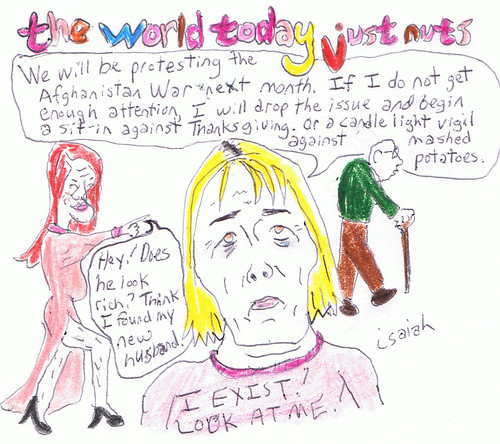
Isaiah's The World Today Just Nuts "New 'Action' from 'We Forgot Iraq'." And funny's not just Isaiah's hilarious cartoon, it's also the e-mails or at least one.

A guy e-mails to tell me I'm lazy because I didn't do an album review Sunday. He says I forgot to do one Sunday.

These are the pieces I've written this year:

Holly Near & emma's revolution
Under The Covers Vol. 2
Cass Elliot's classic album
John Fogerty's White Flight
Elvis Costello Goes Country
Regina Spektor Far
Ben Harper White Lies For Dark Times
Tori Amos Abnormally Attracted to Sin
David Saw Broken Down Figure
Prince LOtUSFLOW3R
Stevie Nicks The Soundstage Sessions
Joshua Radin Simple Beauty
U2 No Line On The Horizon
Charity albums
india.arie
Schuyler Fisk
Tracy Chapman Our Bright Future
Bruce Springsteen Working On a Dream
Best of Janis Ian
Phoebe Snow Live
2008 in Music

I'm counting over 20. How many do I do a year? I only agreed to eleven reviews and one year-in-review. Last year, a very difficult year, I only did 11 and not 12. And people were bothered. And maybe that's fair and maybe it's not. But I have made a point of stating that I only agreed to do one piece a month. Agreed? Try promised.

Now I do plan to have a review next Sunday. And I do plan to do a review at the end of October. And there are two other posibilities. But I may not do the other two. I may do the one next week and the one at the end of October and say "That's all."

I've already done more than my share this year.

I do not do a music review every week. I don't know where the guy got that idea. But that's not what I do. That's not what I imply I do. It's not happening. Sorry.

He also wondered which review I'm proudest of?

I don't go back and re-read them.

Looking at the above list, if I had to pick, I'd say the one about David Saw's album just because I loved it and it got beat up on so bad. So I'm glad I reviewed it and I'm glad I highly praised it. There are songs from that album that I'll be in the shower and just suddenly start singing. It is a very, very strong album. Broken Down Figure. I still recomend it strongly.

Another e-mail noted Michael Gallucci's "Janis Ian Looks Back" (Cleveland Scene) and asked if I could highlight from the article:


About four years ago, singer-songwriter Janis Ian approached the folks at Sony Records about putting together a retrospective of her work. They weren’t interested, so Ian released the compilation, Best of Janis Ian: The Autobiography Collection, on her own Rude Girls Records.
Then, last year, she met Sony Legacy Senior Vice President Steve Berkowitz and suggested Sony reissue the collection as part of its “essential” series. He agreed, particularly since Ian’s tell-all autobiography, Society’s Child, would be coming out in paperback at about the same time. So with new artwork, a new set of liner notes penned by Ian (who starts her essay by writing, "I was born into the crack that split America") and some remastering, the two-disc The Essential Janis Ian has just hit the shelves.
A leftist icon of the ’60s, Ian began writing songs at an early age. At 15, she had a hit with "Society's Child," a tune about an interracial romance that was consequently banned at many radio stations (but got significant airplay in Cleveland). Controversy notwithstanding, Ian went on to have other hits, like the Grammy-winning "At Seventeen." Her autobiography chronicles the singer's coming out, as well as a 10-year period during which she didn't release an album.


Along with Elaine and C.I., I've been highlighting an October 22nd concert Janis Ian is having in Dallas. And a Janis fan found this site while searching Janis online. He also read a review I did of Folk Is The New Black and wondered if I'd consider reviewing Janis' collection? For you, I will. Bingo. I did.

Best of Janis Ian

Janis Ian Folk Is The New Black

Those are the two Janis Ian reviews I've done at TCI. I reviewed the collection at the start of the year. And the e-mailer asked why highlight the Dallas concert?

I'm sure there are numerous reasons. You'd have to ask C.I.'s friend. But the reason he asked C.I. and me to highlight it is that the TCI community has a huge number of Texas community members. So they can get the word out on this concert. And Janis plays Austin (or that's what C.I.'s friend says) but she really doesn't go all over Texas. So this might be one of those "I better catch her now or be prepared to wait ten to fifteen years."

And Janis is a great act. C.I. ended up giving her ticket away (I've told this story in real time and since but as we were getting ready to go to the concert, the guy at the front desk who was so helpful that entire week asked us where we were going and he was a huge Janis fan. C.I. handed him her ticket and told him to go with us. She had stuff to do, she's seen Janis and knows Janis gives a great concert. And she's C.I. Meaning, she'd give you the shirt off her back -- provided she had a bra on underneath!) but the rest of us saw her and she was just so amazing.

The woman's a showwoman. I'm not sure if that word has two "w"s but I'm not going to put the masculine in. It's amazing, after decades of our feminist revolution, how many words are still tied to the masculine. Anyway, she's an entertainer. She's a gifted songwriter and singer but the thing that surprised me was what an entertainer she is. She owns the stage. She commands your attention. So if you can see her -- anywhere -- don't miss the chance.

And don't listen to a bunch of men and women who haven't seen Courtney Cox's new show or didn't pay attention to it but felt they could write about it anyway. Cougar Town is laughout funny and, if you doubt it, go and read Ava and C.I.'s "TV: Cougar Town Roars." I think that's my favorite piece they've done this year -- which is really saying something considering how many great articles they've written. But they're not going to stand by while a woman's beat up for having a funny show that offends someone's delicate tastes.

Closing with C.I.'s "Iraq snapshot:"

Monday, September 28, 2009. Chaos and violence continue, Nouri gets even cozier with his 'friends,' former Ba'athists in Syria get some press attention, Ehren Watada gets some good and long overdue news, and more.

Violence in Iraq today gets attention.
Timothy Williams (New York Times) says 18 dead and fifty-eight injured -- actually the numbers higher -- and that "both Shiite and Sunni areas of the country" were attacked.

Bombings?

Sahar Issa (McClatchy Newspapers) reports two Baghdad roadside bombings which resulted in the deaths of 3 Iraqi soldiers and twenty-nine people wounded, a Saqlawiyah house bombing (home belonged to "an intelligence employee"), a Mosul roadside bombing which claimed the lives of 2 police officers (two more wounded) and an Anbar Province suicide bombing in which a man took his own life and the lives of 6 police officers (eight more wounded). Imad al-Khuzaii, Mohammed Abbas, Missy Ryan, Dominic Evans and David Stamp (Reuters) note the suicide bombing involved "water tanker truck packed with explosives". Xinhua adds, "The bomber rammed his explosive-laden car into the entrance of the police station in the city of Rawa, some 250 km northwest of Baghdad". Reuters notes a Tal Afar bombing in which 2 people died (one person was injured), a Riyadh mortar attack left three people injured and, dropping back to Sunday, a Kirkuk bombing which injured a police officer. Imad al-Khuzaii, Mohammed Abbas, Missy Ryan and Dominic Evans (Reuters) report a minibus sticky bombing has led to 3 deaths and two people injured in Saniya.

Shootings?

Sahar Issa (McClatchy Newspapers) reports 1 elderly man (retired police officer) was shot dead in Mosul. Reuters reports 1 man shot dead in Baghdad (according to Iraqi police) and that Iraqi forces shot dead 2 'suspects'.

Corpses?
Iran's
Press TV reports the corpses of 4 "Kurdish militiamen" were discovered "between Mosul and Tal Afar with gunshot wounds in the head."

Thursday, there was a prison break in Tikrit with sixteen prisoners escaping and, by yesterday, 6 of the 16 were said to have been captured. Saturday CNN reported 2 more escapees were captured this morning during "house-to-house searches" for a total of 8 prisoners now captured. Xinhua reported Saturday that a US military drone crashed in Mosul. Jamal al-Badrani, Mohammed Abbas and Robin Pomeroy (Reuters) added "that the drone struck the local offices of the Iraqi Islamic Party, Iraq's biggest Sunni Arab political group, the military said." Timothy Williams (New York Times) explained, "The American military said it was not clear why the small remotely operated plane fell from the sky in the Ghizlani neighborhood in west Mosul, one of the most violent areas of a multiethnic city contested by various religious and ethnic groups." September 14th, US Air Force announced: "An Air Force MQ-1 Predator unmanned aircraft crashed in central Iraq at approximately 12:45 p.m. Baghdad time on Sept.14. The crash was not due to hostile fire. The crash site has been secured and there were no reports of civilian injuries or damage to civilian property. The aircraft is a medium-altitude, long-endurance, remotely-piloted aircraft. The MQ-1's primary mission is conducting armed reconnaissance. A board will be convened to investigate the incident." Mike noted that in real time. So this is at least the second drone crash this month.

As violence continues, Nouri al-Maliki, thug of the occupation, continues to hold hands with those who traffic in violence.
Friday's snapshot included Anne Tang (Xinhua) report where she quoted Nouri al-Maliki, thug of the occupation, stated of allegedly violent prisoners in Iraqi prisons, "Those people, who had been involved in killing Iraqis must be punished. [. . .] We hear voices calling for release of criminals under claim that they have been defending rights of minorities and (religious) sects, forgetting that those criminals had been behind catastrophes." Nouri's words were laughable then and only more so after the weekend's news. So happily in in bed with the League of Righteous that no only will he sleep in the wet spot, he'll also release them from Iraqi prisons. For those late to the party, the League of Righteous has claimed credit for the deaths of 5 US service members and for the deaths of 4 British citizens (three confirmed dead, four assumed) and they continue to, presumably, hold a fifth. Let's go to the June 9th snapshot:This morning the New York Times' Alissa J. Rubin and Michael Gordon offered "U.S. Frees Suspect in Killing of 5 G.I.'s." Martin Chulov (Guardian) covered the same story, Kim Gamel (AP) reported on it, BBC offered "Kidnap hope after Shia's handover" and Deborah Haynes contributed "Hope for British hostages in Iraq after release of Shia militant" (Times of London). The basics of the story are this. 5 British citizens have been hostages since May 29, 2007. The US military had in their custody Laith al-Khazali. He is a member of Asa'ib al-Haq. He is also accused of murdering five US troops. The US military released him and allegedly did so because his organization was not going to release any of the five British hostages until he was released. This is a big story and the US military is attempting to state this is just diplomacy, has nothing to do with the British hostages and, besides, they just released him to Iraq. Sami al-askari told the New York Times, "This is a very sensitive topic because you know the position that the Iraqi government, the U.S. and British governments, and all the governments do not accept the idea of exchanging hostages for prisoners. So we put it in another format, and we told them that if they want to participate in the political process they cannot do so while they are holding hostages. And we mentioned to the American side that they cannot join the political process and release their hostages while their leaders are behind bars or imprisoned." In other words, a prisoner was traded for hostages and they attempted to not only make the trade but to lie to people about it. At the US State Dept, the tired and bored reporters were unable to even broach the subject. Poor declawed tabbies. Pentagon reporters did press the issue and got the standard line from the department's spokesperson, Bryan Whitman, that the US handed the prisoner to Iraq, the US didn't hand him over to any organization -- terrorist or otherwise. What Iraq did, Whitman wanted the press to know, was what Iraq did. A complete lie that really insults the intelligence of the American people. CNN reminds the five US soldiers killed "were: Capt. Brian S. Freeman, 31, of Temecula, California; 1st Lt. Jacob N. Fritz, 25, of Verdon, Nebraska; Spc. Johnathan B. Chism, 22, of Gonzales, Louisiana; Pfc. Shawn P. Falter, 25, of Cortland, New York; and Pfc. Johnathon M. Millican, 20, of Trafford, Alabama." Those are the five from January 2007 that al-Khazali and his brother Qais al-Khazali are supposed to be responsible for the deaths of. Qassim Abdul-Zahra and Robert H. Reid (AP) states that Jonathan B. Chism's father Danny Chism is outraged over the release and has declared, "They freed them? The American military did? Somebody needs to answer for it."Those are the names of the 5 US service members that the League of Righteous claim credit for killing. Let's name the five British citizens kidnapped in Baghdad May 29, 2007: Alec Maclachlan, Jason Crewswell, Alan McMenemy, Peter Moore and Jason Swindelhurst. All but Alan McMenemy and Peter Moore have been turned over dead. The British government assumes that Alan McMenemy is dead while his loved ones continue to hope otherwise. Peter Moore is considered to be alive at this point by the British government. Today BBC News reports that an inquest has been informed Alec Maclachlan died of "a gunshot wound to the head.""Those people, who had been involved in killing Iraqis must be punished. [. . .] We hear voices calling for release of criminals under claim that they have been defending rights of minorities and (religious) sects, forgetting that those criminals had been behind catastrophes," asserted Nouri. But killing US service members and British citizens is apparently okay? And did we mention that the theory in the British press is that the five British citizens were kidnapped because Peter Moore's work was revealing corruption in Nouri's ministries?Sunday Muhanad Mohammed, Suadad al-Salhy, Mohammed Abbas, Missy Ryan and Sonya Hepinstall (Reuters) reported that more members of the League of Righteous were released from jail this weekend: "Many of a total of around 100 prisoners released in recent days were part of the Shi'ite militant group Asaib al-Haq, or Leagues of Righteousness, said Jassim al-Saedi, a senior member of the group. He said negotiations were ongoing to secure the release of up to 500 more Asaib al-Haq detainees. " He's quoted saying 200 members of the group will be released when they're done but only 97 have been released so far. The group differs over the numbers. AFP quoted League of the Righteous spokesperson Salam al-Maliki who states, "I can confirm the release of a number of our group last night . . . 23 were freed yesterday. Eighty-seven of our group were released last week, and 120 are supposed to be freed this week." He brags about all the "negotiations we are holding with the Iraqi government." Xinhua adds, "Salm Al-Maliki, former Transport Minister, representing al-Sadr's bloc in former Shiite Prime Minister Ibrahim al-Jaafari's government, said the release is 'part of an accord between the group and the current Iraqi government, led by Prime Minister Nuri al-Maliki.' He did not elaborate the accord."

Today
Richard Spencer (Telegraph of London) sums prior events this year, "Earlier this year, there were reports that negotiations linked to attempts to bring the League of Righteousness into the political process might secure the release of some or all of the five men. Three senior figures in the group, including Laith al-Khazali, the brother of its leader, were released by the Americans at the time. Instead, the bodies of three of them were handed over while the fourth security guard, Alan McMenemy, from Glasgow, was also said to be most probably dead by the government."Reached for comment, Brian S. Freeman, Jacob N. Fritz, Johnathan B. Chism, Shawn P. Falter, Johnathon M. Millican, Alec Maclachlan, Jason Crewswell and Jason Swindelhurst said . . . Oh, they can't speak. They're dead. And their governments' alleged 'leaders' have chosen not to speak in defense of them. Instead it's make nice with Nouri and his friends who kill civilians and US service members. That's what happens when the US government decides to install thugs into leadership. And let's not pretend that this move doesn't betray everyone sent over to fight an illegal war in Iraq.

While Nouri rushes to big-tent with members of the League of Righteous, he continues to block efforts at bringing in former Ba'athists. This animosity is at the root of his efforts to create an international incident between his country and Syria where many former Ba'athists have moved to.
Andrew Lee Butters (Time magazine) observes that "Maliki's government has shown little interest in even opening a dialogue with Syria or the former Baathists about their eventual return to Iraq." [Time has video of displaced Iraqis residing in Syria here.] Andrew Lee Butters notes that there are basically "two factions: a hard-line group led by a former vice president in Saddam's government, Izzat Ibrahim al-Douri, and a more moderate but less powerful group led by Muhammad Younis, a former adviser to Saddam's executive council. Younis's group began reaching out to the Iraqi government in 2007, holding a conference to reevaluate the mistakes of the Saddam regime, reject their old Baathist ideology, and adopt more democratic policies. (See pictures of Saddam Hussein.) Following the August bombings in Baghdad, al-Douri's faction has also shown signs of moderating. In an interview with TIME earlier this month, the unofficial spokesman for the group, Nizar Samra'y, said it is more concerned about the growing Iranian influence on Iraq's government than in forcing U.S. troops out of the country." Stephen Starr (Asia Times) quotes scholar and author Fadhil Rubayieh on the assertions by Nouri that the August 19th Baghdad bombings result from former Ba'athists in Syria, "I don't think any Iraqi Ba'athist people were responsible for the bombings -- there's no way they could have pulled off something as big as that. [It was] the biggest [bombing] in Iraq for six years. [. . .] Maliki does not want to see the Ba'athists succeed in regaining any sort of political legitimacy, and as such, blamed them for the bombing." Starr also notes what many avoid: the day before the bombing, Nouri was in Syria and demanding 179 former Ba'athists be handed over. His demand was rebuffed. Immediately after the bombings, Nouri begins insisting former Ba'athists were responsible and floating the laughable notion that the secular Ba'athists were now in partnership with the religious fundamentalists in al Qaeda of Mesopotamia.

Nouri's 'leadership' and other topics were addressed in the most recent episode of
Inside Iraq which Al Jazeera began broadcasting Friday night.

Jasim al-Azzawi: To discuss the UN Commission to Human Development report in Iraq, I'm joined from Baghdad by Mahdi Hafedh -- a former Iraqi planning minister and one of the participants in the Paris roundtable discussions -- and from Washington by Stuart Bowen -- the special inspector general for Iraq reconstruction -- and from London by Sami Ramadani -- a senior lecturer of sociology from the London Metropolitan University. Gentlemen, welcome to Inside Iraq. Mahdi Hafedh, you participated in this UNESCO roundtable discussion in Paris and the word "progress" was repeatedly mentioned by you as well as by other participants as well as the UNDP report. So what is the definition of "progress" when comes to Iraq?

Mahdi al-Hafedh: You see actually it is quite clear now. It is not easy to say this is a progress or not. The only thing I can say is that the report was not only about the sustainable development in Iraq but it was in general about the document itself. That is why I think that this matter has to be defined in a very clear way. This is what I understand from the progress in the report.

Jasim al-Azzawi: If we tackle the political aspect, Mr. Bowen, and you are a seasoned politician, you know this is an election season in Iraq so everybody is trying to say, "Iraq has left the woods, we are out of the tunnel and progress is all over the place." You are a frequent visitor to Iraq. Your organization is sanctioned by the US Congress. You elevate a quarterly report to Congress. From what you have seen, and you were in Iraq recently, can you say progress is at hand?
Stuart Bowen: Well there is progress but it is fragile. I was in Baghdad just over a month ago when the recent car bombings occurred. It reminded me of what I felt and saw in 2006 and 2007. Certainly one of the largest attacks in years in Iraq. Very devastating on the ministries effected. And-and I think it's-it's emblematic of the continuing challenges that the Iraqi security forces are going to face through this fall, through this very volatile election season.

Jasim al-Azzawi: And yet, Sami Ramadani, with two power centers in Iraq -- one in KRG and one in Baghdad -- and the constant tension between the two regions, let alone between the parties, the most critical thing for the Iraqi national reconciliations and yet it is not even on the horizon.

Sami Ramadani: Doesn't look like it. In fact, it's receding into the distance even further. And the two centers of power you mentioned are the two main centers of power. You could talk about even more centers of power. If you take the state of the country in general you'll find really practically there is no such thing as a proper central government in Iraq which has tremendous influence in the various regions. There is a state of disintegration in the country, I feel, administratively which reflects itself on the economic, political, social levels. There is a degree of chaos which is escalating rather than improving the country in general, Jasim.

Jasim al-Azzawi: And yet, Mahdi Hafedh, this period between now and the January election, when there is a general election, as well as when American forces start pulling en mass perhaps by summer of next year, is the most critical in the history of Iraq after 2003. As a politician and a member of the Iraqi list and a member of Parliament, do you see Iraqi politicians and power leaders and elites coming together to solve the issues?

Mahdi al-Hafedh: I don't think so because of all the problems in the country is depending upon how the other forces be able to cooperate with the others. For the time being, I feel that there is a bigger problem now and that's why I think it is still at the beginning and I feel that this will not be suddenly happen unless there is something to-to create those who are well understand each other.

Jasim al-Azzawi: Stuart Bowen, what is needed to break this deadlock that Madhi Hafedh alludes to?

Stuart Bowen: Well there are four issues that are confronting Iraq. They're not new ones but there very serious and they -- and they threaten the state. And they threaten -- they impede progress. Security, services, corruption and the Kurdish-Arab problem. On-on security, the August attack is-is just the most serious evidence of what has been a gradually increasing spate of attacks. Especially around Mosul and in the Kirkuk area in recent weeks. On services, I met with Deputy Prime Minister [Rafi al] Issawi during my August trip and he said that services, in his view, he's the -- he's the director of services for the Iraqi government, are worse now than they've been since 2003. That's a very serious concern for the Iraqis across the country, especially regarding access to electricity. He said in Baghdad, it's one to two, three hours a day. It's difficult to manage your business --

Jasim al-Azzawi: It makes you wonder whether it's lack of money, it's incompetence or, as you termed it once, this corruption which is eating the very fabric of Iraqi society as --

Stuart Bowen: Yes.

Jasim al-Azzawi: -- the second insurgency.


Stuart Bowen: That is the third issue, corruption. And -- and uh-uh-uh, Mr. Isawwi told me, as well as the members of the Council of Representatives who I met with on the Integrity Committee, those that work in the corruption fighting organizations in Iraq, that corruption is endemic, it effects every ministry and as Minister [Ali Gahlib] Baban the Minister of Planning told me at the end of last year, it's getting worse. And is certainly worse now than it has ever been. Uh, that coupled together with Kurdish-Arab conflicts in Iraq -- I went to Sulamaniyah [Province] during this August trip. I saw really an other Iraq. All the signs in Kurdish, Kurdish flags flying. For an Arab Iraqi to travel to Kurdistan, [they] have to show papers at the Green Line. These are little known facts that are evidence of, I think, a deep fissure that needs reconciliation and-and uh as-as was just said, reconciliation is slow in coming.

Jasim al-Azzawi: Sami Ramadani, listening to the two gentlemen, that must send shudders into your back.

Sami Ramadani: Well I think they're underestimating the problems in fact, Jassim. I think they're even worse. I mean, Stuart Bowen, for example, called them four-four problems. I see them as consequences. They might be problems in themselves now and they are obviously the four or five or six or seven main reasons for what is going on but ultimately all of these problems -- and Stuart alluded to some of them -- are consequences and they are consequences of the sanctions regime, thirteen years of sanctions, and the occupation of Iraq. The United States, having failed to control Iraq, relied on all manner of politicians who are self-seeking. Their political forces do not have genuine popular base in the country. And they rely on clans, on cliques and nepotism as a consequence as well. Corruption becomes a parallel. Corruption runs parallel to the fact that the United States increasingly relied on political figures and political forces which acquiesced with the occupation. And, by the way, Jasim, when we talk about services, we're talking about clean water. Clean water doesn't exist for most of the population now. Open sewers in the streets. I don't know if Stuart managed to visit some of the streets in Baghdad or the provinces. He would see the level of misery is unbelievable. The unemployment. Half of Iraq's doctors --

Jasim al-Azzawi: As a matter of fact, Sami Ramadani, --

Sami Ramadani: -- have left the country.

Jasim al-Azzawi: -- some of the people though have visited Iraq recently. I don't know whether it's their exaggeration but the way that they termed it, they said that it's "hell on earth." But Madhi Hafedh, would -- let me go on a limb and let me point a finger at perhaps the very cause of all this and correct me if I'm wrong. Is it the sectarian quota system that is ruling Iraq under the facade of democracy, is the mother of all problems?

Madhi al-Hafedh: Yes, it is. One of the reasons for that is that sectarianism has . . . [played the growth?]. And, in my opinion, this was one of the reason for this. I think that unless there is some measures to be taken, the problem will continue and then, in the meantime --

Jasim al-Azzawi: What measures? Like what?

Madhi al-Hafedh: I believe --

Jasim al-Azzawi: Like what? The Iraqi government including the Prime Minister is impotent in throwing anybody behind bars for stealing billions of dollars, so what is it -- what is it needed? I mean, al-Maliki himself says, "I cannot prosecute anybody."

Madhi al-Hafedh: Yes, this is true. I mean, al-Maliki is one person, although he is the most important person in the government, but there are several powers inside the government. You cannot speak anything now about Kurdistan. You cannot speak anything about the ministries where the other ministers from this or that group are ruling. In my opinion, that this has to be taken into consideration and this cannot be solved until the election takes place in January next year.

Meanwhile
Steven Lee Myers (New York Times) reports continued problems luring foreign businesses to 'safe' Iraq: "A deal to lure $60 million in foreign capital -- one of only a handful of foreign investments in Iraq's state-owned industries -- collapsed. The American government recently gave the company $2.5 million to keep its main production line operating and its workers out of penury and, perhaps, insurgency." This as the International Business Times reports, "Oil and gas explorer Petrel Resources says its Subba and Luhais oilfield development in Iraq is at a standstill. Petrel generated no revenue in the six months to June 2009, against 8m in H1 2008. The company reported an interim loss of 0.228m, down from 0.417m." RTE Business quotes Petral's chair John Teeling stating, "Petrel is determined to stay in Iraq to participate in the growth."

Turning to peace news, Saturday
Gregg K. Kakesako (Honolulu Star-Bulletin) reported that 1st Lt Ehren Watada will not "seek a second court-martial" and that they've "accepted the resignation of" Ehren and quotes Ehren stating, "The actual outcome is different from the outcome that I envisioned in the first place, but I am grateful of the outcome."In June 2006, Ehren Watada became the first officer to publicly refuse to deploy to the illegal war in Iraq. June 22, 2006, his unit deployed at 6:45 am and, as he had stated, he refused to deploy. For perspective, that was also the day the US Senate voted to end the illegal war by July 2007 -- a proposal made by US Senators Russ Feingold and John Kerry. Only 13 US senators voted to pull all troops by July of 2007.Back then, the death toll for US service members in Iraq stood at 2512. It currently stands at 4346 and, no, the Iraq War has not ended.In August 2006, an Article 32 hearing was held. Watada's defense called three witnesses, Francis A. Boyle of the University of Illinois' College of Law, Champagne; Denis Halliday, the former Assistant Secretary General of the UN; and retired Colonel Ann Wright. These three witnesses addressed the issue of the war, it's legality, and the responsibilities of a service member to disobey any order that they believed was unlawful. The testimony was necessary because Watada's refusing to participate in the illegal war due to the fact that he feels it is (a) illegal and (b) immoral. Many weeks and weeks later, the finding was released: the military would proceed with a court-martial.On Monday, February 5, 2007, Watada's court-martial began. It continued on Tuesday when the prosecution argued their case. Wednesday, Watada was to take the stand in his semi-defense. Judge Toilet (John Head) presided and when the prosecution was losing, Toilet decided to flush the lost by declaring a mistrial over defense objection in his attempt to give the prosecution a do-over. Head was insisting then that a court-martial would begin against Watada in a few weeks when no court-martial could begin.January 4, 2007, Head oversaw a pre-trial hearing. Head also oversaw a stipulation that the prosecution prepared and Watada signed. Head waived the stipulation through. Then the court-martial begins and Ehren's clearly winning. The prosecution's own military witnesses are becoming a problem for the prosecution. It's Wednesday and Watada's finally going to take the stand. Head suddenly starts insisting there's a problem with the stipulation. Watada states he has no problem with it. Well the prosecution has a problem with it and may move to a mistrial, Judge Toilet declares. The prosecution prepared the stipulation and they're confused by Head's actions but state they're not calling for a mistrial or lodging an objection. That's on the record. Head then keeps pushing for a mistrial and the prosecution finally gets that Head is attempting to give them a do-over, at which point, they call for a mistrial.The case has already started. Witnesses have been heard from. Double-jeopardy has attached. The defense isn't calling for a mistrial and Head rules a mistrial over defense objection and attempts to immediately schedule a new trial.He's ignoring the US Constitution which forbids double-jeopardy. He thought he could give the prosectution a do-over. That's not how the justice system works in the US, double-jeopardy is banned. In November of 2007, US District Judge Benjamin Settle ruled, "The same Fifth Amendment protections are in place for military service members as are afforded to civilians. There is a strong public interest in maintaing these rights inviolate." The military stated then that they would appeal. October 22, 2008, Judge Settle ruled there could be no retrial on the charges of missing deployment, participating in a news conference or participating in the Veterans for Peace conference. That left two charges up in the air which were questionable because the strongest charge was always going to be "missing deployment."Watada was kept in the military all this time. His service ended in December 2006. Or should have. He was kept in the service to prosecute him. He was kept in the service and kept in limbo. His service contract expired in December of 2006 and instead of discharging him then, the military wasted his time and countless US tax payer dollars to conduct a nearly three-year assault on him. Audrey Mcavoy (Breaking News 24/7) reports that October 2nd is when the US military will discharge Ehren. At which point, Ehren can finally get on with his life. Michael Tsai (Honolulu Advertiser) quotes Kenneth Kagan, one of Ehren's two civilian attorneys, stating, "When the Army realized they could not beat him in court, they threw up their hands and looked for some way to handle the situation quickly and quietly." Iraq Veterans Against the War's T.J. Buonomo reflects on Ehren's news:

I am moved beyond words to hear of the imminent release of Ehren Watada from the Army. Ehren's exemplary moral courage was a great inspiration to me as a young Army officer struggling with how to respond to the Bush administration's abuses of power- from their manipulation of prewar intelligence and deception of Congress to their sanctioning of torture to their efforts to subjugate the Iraqi people under foreign multinational corporations and financial institutions.
I recall signing a petition in support of Ehren while still an Army officer -- a document that later ended up in my personnel file while under investigation for exercising my First Amendment rights. Five months later I was involuntarily discharged from the Army and joined Iraq Veterans Against the War. I have since followed Ehren's case and was elated to read that a federal court had intervened on his behalf, reaffirming his constitutional right not to be held in double jeopardy.

From news of a service member to veterans news,
Friday, the VA was in the news cycle for still, STILL, not sending the checks to veterans participating in the education programs under the new GI Bill. These checks would cover tuition, would cover books, would cover living expenses. The news media ran with the month of September but, in fact, as e-mails have reminded, for some universities, the fall semester started in August. At one point early in the day Friday, the VA was attempting to lie that they were waiting for adds and drops. That was a lie. First off, many veterans are having to take out emergency students loans at their universities. These are short term loans and, no, this was not planned. Second of all, drops don't end this week. Many universities allow people to drop throughout October and into November. The VA is not doing its job and has attempted to spin. The VA notes the following in a release sent to the public e-mail:

Secretary of Veterans Affairs Eric K. Shinseki announced the Department of Veterans Affairs (VA) has authorized checks for up to $3,000 to be given to students who have applied for educational benefits and who have not yet received their government payment. The checks will be distributed to eligible students at VA regional benefits offices across the country starting October 2, 2009. More information on
emergency checks. Information on VA regional benefits offices. Meanwhile Cynthia Henry (Philadelphia Inquirer) quotes Robeen Billings who is among the veterans who have not received their payments, "The GI Bill is a mess. I'm struggling because my first semester is not paid. I'm commuting from Newark to Camden, living off my credit card." Who's going to pay the interest on the debt that Billings and others are having to run up because the VA dropped the ball? Henry reports:Former Marine James Hambley, 25, of Maple Shade, has been caught short by the delay. Between his savings and GI Bill living allowance, he figured he could quit his job and attend CCC full time. Without the benefits coming in, Hambley has applied for a two-month deferment on his car and personal loans. He looked into a government student loan, but that money wouldn't be available until November, he said.College advisers have told him that he shouldn't work more than 20 hours a week while taking 14 credits toward his engineering-science degree, Hambley said, but "that's not going to cut it" until the first check arrives -- in November, the government now tells him. He's out looking for work.

iraqbbc news
muhanad mohammedsuadad al-salhymohammed abbasmissy ryansonya hepinstallreuters
the telegraph of london
al jazeerainside iraqjasim al-azzawi
stephen starrthe asia timesimad al-khuzaiidominic evansdavid stamp
the new york timessteven lee myersthe international business times
ehren watadagregg k. kakesakothe honolulu star-bulletinaudrey mcavoy
mcclatchy newspaperssahar issa
timothy williams
the philadelphia inquirercynthia henry