Tuesday, July 14, 2015

Cypher

I've noted before that I love thrillers and especially spy thrillers or conspiracy thriller or political thrillers.

There aren't a lot of good ones made lately.

Sadly.

But Carrie e-mailed asking if I'd seen Cypher which you can stream on Netflix.

Yes and I do enjoy it.

It stars Lucy Liu and Jeremy Northam and is about corporate espionage and a great deal more.

It has twists and turns and Lucy Liu has all a film noir femme could ever want.

If you have Netflix, make a point to stream the movie if you haven't already.


Closing with C.I.'s "Iraq snapshot:"


Tuesday, July 14, 2015.  Chaos and violence continue, Sunni civilians in Falluja remain targeted, barrel bombs are dropped on Falluja, Antiwar.com ignores that but rushes to repeat the lies of a government ministry with a long history of lying -- way to go, Antiwar.com, another proud moment for you, Nouri al-Maliki appears to plot a coup, and much more.


Nouri al-Maliki did his part to destroy Iraq and then some.

The Iraqi Parliament wanted Ibrahim al-Jaafari to be prime minister following the December 2005 elections but the Bully Boy Bush administration opposed his being prime minister (for a second time) and instead installed Nouri al-Maliki in the spring of 2006.

The CIA profile on Nouri suggested he would be a good fit for the job due to his paranoia which the US government could use to sway and to control him.

It was his paranoia that marked his first time.

Otherwise, he had no accomplishments to speak of.

It was one failure after another for Nouri.

For example, he promised the Iraqi people that the Bremer walls/blast walls the US put up around Baghdad in the summer of 2006 would come down immediately.

That did not happen.

For example, in 2007, he agreed to the White House's benchmarks for measuring success/progress in Iraq and then failed to complete the list.

In the lead up to the 2010 elections, he had Shi'ite rivals kicked out of the election, he barred various Sunnis from running and he bribed and bribed again.

His State of Law still lost to Ayad Allawi's Iraqiya.

And Ayad should have been the next Prime Minister of Iraq.

But Barack Obama played Supreme Court and turned Allawi into the new Al Gore as Barack installed the loser Nouri into a second term as prime minister.

And then things really grew rotten.

Despite repeatedly lying and insisting he would, Nouri wanted no power-sharing government and began demonizing all opponents.

He then went after the people insisting peaceful protesters staging sit-ins were "terrorists."

No one was safe in Nouri's second term and he unleashed his goons on the peaceful protesters (as well as on Members of Parliament) resulting in one violent incident after another.


In 2010, the Iraqi people saw their votes overturned by US President Barack Obama.

The Iraqi people saw their leaders attempt to create a representative government and fail. (Largely due to interference on the part of Barack Obama -- such as when the Parliament attempted to hold a vote of confidence on Nouri but the White House prevented it.)

The Iraqi people then took to the streets to protest.

For over a year, they protested -- with little attention from the world media.

And Nouri responded by burning down the areas they gathered in.

This is what gave rise to the Islamic State.

A people who had been stripped of their votes, whose leaders were unable to protect them and who had attempted protest were denied every avenue of redress in a democracy.

As the raving lunatic Nouri got more and more despotic,  even Barack had to step away.

Which is how, in the fall of 2014, Haider al-Abadi became the new prime minister of Iraq after Nouri was forced out.

But he wasn't forced too far.

He became one of Iraq's three vice presidents and, in a typical Nouri narcissistic move,  Nouri declared himself the premier vice president.

As usual, some idiots in the press corps went along with that lie.

As we've noted before, Nouri will never stop attempting to destroy Iraq until he's six feet under.

And he's used his time out of the post of prime minister (while remaining in the home of the prime minister, please note) to plot his return.


This month, Ali Mamouri (Al-Monitor) reports on the latest developments in Nouri's possible efforts to take back the post of prime minister:


During his rule, Maliki’s policy was characterized by its sectarian and divisive tone and was a key reason behind the recent military defeats in Mosul and Ramadi. Now Maliki is urging people to back away from the national reconciliation policy initiated by Prime Minister Haider al-Abadi when he took office. Proof of this is that during a tribal gathering June 13 in Karbala, Maliki said that the Anbar province’s tribes were protesting against him. He accused the rival political parties of supporting the objections against his rule when he was prime minister, which he called illegal. Finally, he described the fall of the Sunni areas at the hands of the Islamic State (IS) as “a Sunni sectarian revolution against the Shiites.”
In his speech, Maliki used three forms of extremist thought to incite to sectarian conflict. First, regional division, by generalizing and accusing the tribes of a particular area of being all against the Iraqi government; second, deepening the political dispute by accusing his rivals of standing with the terrorists; and third, describing the dispute in Iraq as religious and sectarian.
All three points contradict reality. There were tribes — such as the Sunni Albo tribe — in Anbar that were always against the protests and the ensuing developments, and the opposition parties to Maliki called for the peaceful resolution of the sit-ins and did not back those up. Finally, the Sunnis who were killed and displaced by IS exceed those from other communities; therefore, what happened cannot be described as a Sunni revolution against the Shiites.
In another speech, on the anniversary of the Popular Mobilization Units June 13, Maliki seemed to have a strong belief in the conspiracy theory that the fall of Mosul at the hands of IS was brought about by internal parties — such as the Kurds and the Mosul Provincial Council — to overthrow his government. He clearly said that the denial of the conspiracy is a conspiracy in itself.


This month has also seen Ibrahim Saleh (Niqash) report on what is seen as an effort to return Nouri al-Maliki to power:


Recently there have been calls for major changes to the Iraqi political system, moving it from a parliamentary system to a presidential one. This would mean that rather than elected MPs in Baghdad choosing the country's President, voters would choose the President, who could then work somewhat separately from the also-elected Parliament. For example, the US is a presidential system. Iraq currently has a parliamentary system.
However politicians in Iraq are concerned that if this comes any closer to happening that it will be a way for former Prime Minister Nouri al-Maliki to slip back into power, but this time through a legal back door. They are also concerned that while it may not be something that can happen immediately, there is potential for some changes to occur during the next elections.
The call for these changes were started by one of the Shiite Muslim militias involved in the fight against the extremist group known as the Islamic State. The group, League of the Righteous, or Asaib Ahl al-Haq in Arabic, is known to be closely linked with al-Maliki. It is also known to be one of the more hard line and extremist of the Shiite militias.

Which is why many local politicians saw this as a call to bring al-Maliki, who is currently somewhat sidelined as one of Iraq's three Vice Presidents, back to power. Al-Maliki's divisive policies and attempts to centralise power have taken a fair share of the blame for the country's current security crisis and, although his party was successful in the last elections, al-Maliki lost the post of Prime Minister to colleague, Haider al-Abadi late last year.


While Haider remains in power, he uses his time to seek "revenge" (his term) on the Islamic State.  The problem with seeking "revenge" (as opposed to seeking peace)?  You leave a lot of collateral damage in your wake.


So it's no surprise that, yet again, the Sunni population of Falluja is the one to suffer.

Anadolu Agency reports:

At least 21 civilians were killed on Tuesday – and another 24 injured – when Iraqi government warplanes carried out several “barrel bomb” attacks on the Daesh-held city of Fallujah, according to local medical sources.
Casualties included a number of women and children, the sources said, while the injured were taken to the city’s main hospital.
Iraqi politicians and prominent local figures have recently accused Iraqi military forces of targeting civilian parts of the city with barrel bombs.

Barrel bombs are improvised explosive devices typically consisting of barrels filled with combustible material and shrapnel. They are usually dropped from army helicopters.


It was under Nouri, in January 2014, that the Sunni civilians in Falluja were first targeted by the Iraqi military who bombed and shelled their homes.  This has continued under Haider despite Haider's September 13, 2014 announcement that he was discontinuing those bombings immediately.

For over 18 months now, the Iraqi military has attacked the civilian population in Falluja in a manner which meets the legal definition of War Crime (see collective punishment).  And yet much of the world has chosen to join the White House in looking the other way.

News of the use of the barrel bombs today was preceded yesterday by concerns over this very targeting of civilians in Falluja.  Rudaw reported Monday:

As Iraqi Shiite militia intensify their attacks on Fallujah, a prominent Sunni tribal chief said Monday that civilians fear indiscriminate shelling and the “actions” of the militia forces.


“The only fear of the people of Anbar and especially Fallujah is the Shiite militia because their actions are not less in scale than those of ISIS towards the people of Anbar,” Sheikh Yahya al-Sunbul told Rudaw.


“The proof is the continuous and indiscriminate bombardment of Fallujah, the looting and destruction that will take place after ISIS leaves as we saw in Tikrit,” Sunbul added.


Meanwhile, US Vice President Joe Biden (below) couldn't look the other way today when a heavily made up Barack Obama addressed the American people and the world looking like the Mary Kay in Chief as he announced a deal or 'deal' with the goverment of Iran..
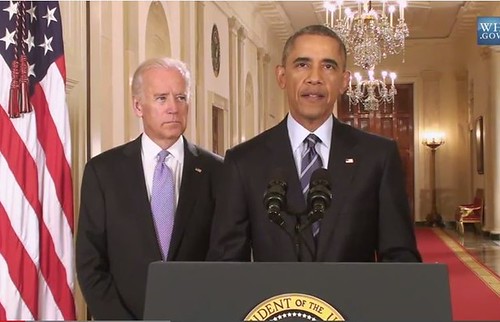


baracksmantan


Barack barely had time to take some cold cream to his face before Andrew deGrandpre and Andrew Tilghman (Military Times) were reporting:


At least 500 U.S. military deaths in Iraq and Afghanistan were directly linked to Iran and its support for anti-American militants, a newly disclosed statistic that offers grim context for the Obama administration's diplomatic deal with the Iranian regime aimed at curtailing the rogue nation's nuclear ambitions.
That figure underscores the controversy surrounding Washington's deal with Tehran, a long-sought goal for the president -- but one that is fiercely opposed by many Republicans in Congress and other critics.


One critic is Senator Johnny Isakson,  the Chair of the Senate Veterans Affairs Committee.  His office issued the following today:


 FOR IMMEDIATE RELEASE
Tuesday, July 14, 2015

Contact: Amanda Maddox, 202-224-7777
Marie Gordon, 770-661-0999
 
Isakson Statement on Announcement of Nuclear Agreement with Iran
“I will not be part of any agreement that allows the Iranians to develop a nuclear weapon that could harm the state of Israel, the country of the United States of America or any other peace-loving country in the world.”
 
 
WASHINGTON – U.S. Senator Johnny Isakson, R-Ga., today released the following statement on the announcement of a final agreement reached in nuclear negotiations with Iran:
 
“As a member of the United States Senate, and of the Senate Foreign Relations Committee, I have a critical role in judgment over the deal that’s been made by the president of the United States and the Iranian government.
 
“Iranians have never proven to be a trustworthy negotiator, nor have they been trustworthy in their actions with the United States. Iran has said that we are their stated enemy.
 
“I will study the deal closely, I will do my responsibility, I will read the appendices and I’ll go to all the briefings, both the secure and unsecure. But I will promise you this: I will not be part of any agreement that allows the Iranians to develop a nuclear weapon that could harm the state of Israel, the country of the United States of America or any other peace-loving country in the world.
 
“This vote may be the most important vote I ever cast as a member of the Senate or the Congress. This vote is about the future of our country, peace in the Middle East, the sanctity of our country, peace for our children and peace for our grandchildren. This is a vote which I will take seriously and I will make sure I do the right thing for the American people.”
 
###


Description: Description: cid:image001.gif@01CB9C61.36E8FA70
AMANDA MADDOX
Press Secretary
OFFICE OF UNITED STATES SENATOR JOHNNY ISAKSON
131 Russell Senate Office Building | Washington, DC 20510
phone: 202.224.3643 | fax: 202.228.0724
Visit Johnny’s website to learn more about his work in the Senate and to sign up for his newsletter.


Margaret Griffis (Antiwar.com) counts 180 people killed across Iraq today.

She also stupidly -- and I mean stupidly -- repeats claims by Iraq's so called Human Rights commission as fact.

Oh, Maggie.

As Rod Stewart once sang, "The morning sun when it's in your face really shows your age."


It's cute how she rushes to run their propaganda while ignoring the Iraqi military's use of barrel bombs on Falluja.

Earlier this year, the Washington Post's Ishaan Tharoor expressed dismay over the use of barrel bombs . . . in Syria:

Human rights organizations, witness testimony and foreign governments all point to the Syrian government's frequent use of barrel bombs in densely packed urban areas, including a suspected attack last week in a devastated suburb of Damascus. The fact that it's a deliberately indiscriminate weapon of war makes the Assad regime liable for war crimes.

Like whether or not Ishaan will ever find a comb (and use it on that hair), whether or not he'll ever zoom in on the use of barrel bombs in Iraq remains a mystery.

In May of 2014, the Iraqi government was caught (but denied) using barrel bombs on Falluja.  AFP reported on it at the time and included the following analysis from Human Rights Watch's Erin Evers:

"In terms of what ISIL has taken responsibility for ... (they) have committed horrible crimes," said HRW's Iraq Researcher Erin Evers, pointing to the group's claims of having carried out suicide and car bomb attacks and summary executions.
"But to equate them with the crimes of a government that has rescinded responsibility for protecting its civilian population and ... rescinded responsibility for respecting its own laws and international law, there is no way the two can be equated."


Margaret Griffis misses all of this but does find time for the propaganda of a government ministry -- so much for "Antiwar.com," right?  Just one more outpost uncritically repeating the statements of a government -- one known to attack its own people.


Again, the morning sun, when it's in her face, really shows her age.


The Cranky Reaction

Cranky Clinton wants to be president.

But I can't stop think about the Iowa focus group -- of Hillary supporters.

They were asked to name an accomplishment of Cranky's as Secretary of State.

And no one could.

I was reminded of that again when I read this about her 'big' speech on the economy:

Hillary Clinton gave a big economics speech here on Monday, and the snap reaction among Wall Street investors, economists and ardent financial reformers who thrill to the soak-the-rich rhetoric of Bernie Sanders was a collective: “Meh. What’s next?”
 
Poor Cranky Clinton.  It's the story of her life.


Closing with C.I.'s "Iraq snapshot:"


Monday, July 13, 2015.  Chaos and violence continue, a new UN report notes that the violence against civilians in Iraq is being carried out by terrorists and by the Iraqi forces, Donald Trump offers a silly and idiotic proposal and that causes outrage -- that causes outrage,  Haider al-Abadi again tries to retake Anbar Province, and much more.


Let's start with some reality.

Donald Trump wants to be the Republican Party's presidential nominee.

Whether that will happen or not remains to be seen.

But all the bottom feeders are out attacking him.


(I know Donald.  I do not like Donald.)


David Letterman came out of his retirement to attack Trump.


Jon Stewart's made his final days on Comedy Central all about Trump.


One of the things Donald Trump is being ridiculed for is declaring that the US should bomb Iraq's oil fields.


Now I'm not for bombing anything.


But the gasping and the clutching of the pearls over the remark, the proposal?


If you think you look educated or humane, think again.


The Iraqi military has shelled Falluja General Hospital.

Not once or twice.

And we're not talking about the 2004 siege of Falluja.

We're talking about in the last twelve months.

It's taken place mulitple times.

All of you hypocrites  -- and, sadly, that is what you are -- who are hollering about how ridiculous Donald Trump is for calling for the bombing of Iraq's oil fields?

He's making a strange argument, but it's just words at this point.

If you really gave a damn about Iraq, you would have been screaming your head off when the Iraqi military was bombing Falluja General in the last 12 months.


In May of last year, Human Rights Watch noted:

Iraqi government forces battling armed groups in the western province of Anbar since January 2014 have repeatedly struck Fallujah General Hospital with mortar shells and other munitions, Human Rights Watch said today. The recurring strikes on the main hospital, including with direct fire weapons, strongly suggest that Iraqi forces have targeted it, which would constitute a serious violation of the laws of war.

Since early May, government forces have also dropped barrel bombs on residential neighborhoods of Fallujah and surrounding areas, part of an intensified campaign against armed opposition groups, including the Islamic State of Iraq and the Sham (ISIS). These indiscriminate attacks have caused civilian casualties and forced thousands of residents to flee.

“The government has been firing wildly into Fallujah’s residential neighborhoods for more than four months, and ramped up its attacks in May,” said Fred Abrahams, special adviser at Human Rights Watch. “This reckless disregard for civilians is deadly for people caught between government forces and opposition groups.”


Hairy fur ball Jon Stewart didn't give a damn about that.

That's why he's not news, why he has never been news.

What he's become is a bully and a bore.

The bombing of Falluja General?

A War Crime.

It's not a theoretical being floated by Donald Trump.

The Iraqi military targeting civilians in Falluja?

Also a War Crime.

Today, the United Nations released "Report on the Protection of Civilians in the Armed Conflict in Iraq" which notes of the attacks by the Iraqi government on civilians and civilian targets such as hospitals:


According to applicable rules of international humanitarian law, civilian infrastructure and property is protected from attack unless and only for such time as it is used by a party to the conflict for military objectives . UNAMI/OHCHR has nonetheless continued to receive reports of Government-associated forces apparently deliberately destroying civilian infrastructure or failing to take adequate precautions in the planning and execution of their operations. Incident reports have increased in tandem with the reclaiming of territory from ISIL control


July 5th, Al Jazeera reported:


At least 73 people have been killed in the the western Iraqi cities of Ramadi and Fallujah, as the Iraqi government stepped up air strikes and artillery fire against the Islamic State of Iraq and the Levant (ISIL) armed group, sources told Al Jazeera. 
An air strike on a sports field in Ramadi shortly after midnight on Sunday killed at least 50 people and left more than 30 people injured. At least 23 people were killed and around 40 wounded after shelling north of Fallujah. 


And from Saturday's snapshot:

Meanwhile the Iraqi military continues its year and a half long bombing of civilians and civilian homes in Falluja.  Amre Sarhan (Iraqi News) reports a medical source told them that Saturday "Fallujah General Hospital received the bodies of 25 people, including three children and four women, and 23 wounded, including five women and six children, as victims after their homes were subjected to mortar fire in different areas of Fallujah."  In addition, Iraqi Spring MC reports that the Iraqi military bombed civilian areas of Ramadi today.


You may think Donald Trump's idea is crazy (I do).

But it's an idea.

It's not been implemented.

For 16 months, the civilians of Falluja have been under attack.  The attacks have been carried out by the Iraqi military.

This isn't an idea floated by Donald Trump, it's actual War Crimes.

And apparently it doesn't matter.

To those who want to whine about Donald Trump's proposal while ignoring War Crimes?

How are you any better than Bully Boy Bush and others who focused on the oil in Iraq while ignoring the people?

Answer: You're not.


Today, Iraqi Prime Minister Haider al-Abadi staged his latest attempt at taking (a part of) Anbar Province away from the Islamic State.  As Sinan Salaheddin (AP) observes:


This is not the first time the Iraqi government has announced an operation to retake Anbar — where several key towns, including the provincial capital Ramadi, remain under IS control. In May, authorities announced an operation to retake Ramadi, but there has not been any major progress on the ground since then.


Dominic Evans (Reuters) explains, "The sprawling Sunni Muslim province extends hundreds of kilometers west of Baghdad. Many of the towns and cities that line the banks of the Euphrates, snaking down from the Syrian border, are Islamic State strongholds.Islamic State's capture of Ramadi two months ago marked the biggest defeat for the Baghdad government since the militants swept through the north of the country last June and declared a caliphate in parts of Syria and Iraq straddling the border."

AP has also noted that the announcement was made on Iraqi TV by Yahya Rasool who is the spokesperson for the Joint Operations Command but that he failed to "clarify whether the U.S.-led international coalition is taking part, mentioning only government forces and allied Shiite and Sunni paramilitary troops."  Failed to clarify or failed to credit?


Al Jazeera's Imran Khan offered:

We are hearing the province will be surrounded on three sides going up to the border with Syria. They have announced operations like this one in the past particularly in Ramadi when it was taken by ISIL forces in mid-May. And that's a battle that's still ongoing. It is likely that this operation will concentrate on the second city in Anbar province, Fallujah, and move further west. While this is going on, we have also heard coalition airstrikes have hit an ISIL media and radio station in Anbar province.


What are they fighting for in Iraq?

Freedom?

Or the ability to carry out their own killings?

Mitchell Prothero (McClatchy Newspapers) reports:


Iraqi officials have been candid that the brunt of the fighting about to engulf the city will be borne by an umbrella group of Shiite militia groups formed under the supervision of the Iranian Revolutionary Guard Corps, the elite of Shiite Iran. That’s raised dire concerns from American advisers that these sectarian groups – overtly hostile to both Americans and Sunni Muslims – will break the already deeply frayed relationship between the Shiite government in Baghdad and the Sunni tribes that dominate the large swaths of Iraq currently under the Islamic State’s control.

Read more here: http://www.mcclatchydc.com/news/nation-world/world/article27167848.html#storylink=cpy
The government claims that Sunni tribal fighters and local policemen from Anbar will join the militia-led assault. But many remain skeptical that Sunnis have joined in sufficient numbers to avoid the impression of a Shiite pogrom against Sunnis in Fallujah.

Read more here: http://www.mcclatchydc.com/news/nation-world/world/article27167848.html#storylink=cpy


At the US State Dept press briefing today, spokesperson John Kirby spun wildly.


QUESTION: Slightly Iran-related. In relation to Fallujah, wondering if the United States detects any evidence of Iranian involvement or direction of Shiite militia trying to take back Fallujah?


MR KIRBY: I would point you to the Iraqi Government – this is an Iraqi-led operation – to speak to the participation of these Popular Mobilization Forces and certainly Tehran for the degree that they are or are not facilitating. I do think it’s important to remember a couple of things. This is an Iraqi-led operation, as it should be. And so we’re going to let them speak to the progress of it. And then on the Popular Mobilization Forces, and I mentioned this a week or so ago but I think it bears repeating: About 80 percent of these Popular Mobilization Forces, or Shia militia as they are otherwise known, are not at all connected to Tehran or the Iranian regime. They’re Iraqi citizens proud of their country and wanting to chip in and fight. And what we’ve said from the very beginning is that all the forces arrayed on the ground against ISIL in Iraq need to be under the command and control of the Iraqi Government. And that’s what we’ve seen with the vast majority of these Shia militiamen.

So I think it’s just important to keep a little context in here. When we talk about Shia militia fighting here or fighting there, there’s this automatic sort of connection drawn to Tehran, and that’s just not the case mathematically.


The assault on Anbar comes as the United Nations News Centre reports:


The ongoing conflict in Iraq continues to exact a “terrible” and deadly toll on the country’s civilians, particularly in the areas still under control by the so-called Islamic State in Iraq and the Levant (ISIL), according to a new report released today by the United Nations.
The report – a joint effort compiled by the Office of the UN High Commissioner for Human Rights (OHCHR) and the UN Assistance Mission for Iraq (UNAMI) – notes that the situation facing civilians in ISIL-controlled territory remains dire with many of those perceived to be opposed to the extremist group’s ideology being murdered, often in “grim public spectacles.”
Members of ethnic and religious communities, for instance, continue to be persecuted with as many as 3,500 members of the Yezidi community remaining under ISIL captivity enduring physical and sexual violence.
Others, meanwhile, are apparently being persecuted based on their perceived sexual orientation. On 8 March, the report says, ISIL beheaded two individuals accused of homosexuality and a third for blasphemy in the Bab al-Toob area of Mosul.
[. . .]
Although the report widely focuses on the crimes perpetrated by ISIL extremists, it also documents violations committed by the Iraqi Security Forces and affiliated forces, including indiscriminate airstrikes and shelling as well as actions of reprisal against civilians. 


Meanwhile Margaret Griffis (Antiwar.com) counts 90 violent deaths across Iraq today.


Her count comes as the UN announced 15,000 deaths in the last 18 months.


  • CHPSRE: RT KenRoth: Iraq civilian toll in past 18 months: 15,000 dead, 30,000 injured--UN report. …


  • Sunday, July 12, 2015

    Carly's book set to be released in November

    The Boston Globe reports Carly Simon's autobiography is due out in November.


    But, it turns out, BG didn't report it.  They just ran an ABC Radio report (from the day prior) and didn't credit it properly.

    Oh, BG offered a new opening but compare the two and you will see that they ripped off ABC Radio.

    Apparently, since being purchased by the New York Times, the Boston Globe lost any and all standards.

    But at least we know Carly's autobiography is coming out.

    Closing with C.I.'s "Iraq snapshot:"


    Saturday, July 11, 2015.  Chaos and violence continue, Congress and Gen Dempsey discuss more US troops in Iraq,  Senator Tim Kaine ignores the topic of troops in Iraq, Haider al-Abadi talks 'success,' War Crimes continue against the civilians in Falluja, and much more.


    US Senator Tim Kaine led a delegation to Iraq last week and today he offers a column at the Richmond Times-Dispatch on the trip at which includes:


    The next two days were in Iraq, beginning in Irbil, the capital of the Kurdish Regional Government. President Masoud Barzani, whose Kurdish peshmerga fighters have battled valiantly against ISIL and achieved significant success, thanked us for strong American support, saying, “If your president had not started a bombing campaign against ISIL last August in our region, we might not be here today.”
    Local forces are the best “boots on the ground” we have against ISIL and the close coordination of our airstrikes with Kurdish ground activity has dramatically reversed ISIL’s gains.
    But the progress in Kurdistan is not seen everywhere in Iraq. Prime Minister Haider al-Abadi is still struggling to build confidence among Shiites, Sunnis and Kurds after former Prime Minister Nouri al-Maliki’s disastrous course that marginalized Sunnis and Kurds. The divisions were so sharp that when ISIL began gaining traction in 2014, Sunni areas in western Iraq would not join the government to battle the threat because of past mistreatment.

    Abadi has gotten high marks in his first year, but his good intent remains to be translated into real unification of the country, which is ultimately critical to military success against ISIL. Thus in Iraq, the progress against ISIL is mixed — with notable successes in the northern Kurdish areas and eastern communities such as Diyala and Tikrit, but much less success in Sunni regions. This includes on the governance front, where greater reconciliation with Sunnis is necessary.


    In his column, he argues for Congress authorizing Barack's latest stage of war on Iraq and authorizing the payment for it.

    He doesn't say much more though, does he?

    He doesn't talk about US forces on the ground in Iraq.

    In fact, he doesn't even note them in his column even though the delegation met with US forces.  How very sad and sick of Tim Kaine.

    But he doesn't want you to think about them or think about step two that would follow the authorization he wants: Even more boots on the ground.


    Kaine serves on the Senate Armed Services Committee.  Tuesday's the Committee held a hearing on Iraq.  The Committee Chair is Senator John McCain and the Ranking Member is Senator Jack Reed.  Appearing before the Committee were Gen Martin Dempsey (Chair of the Joint Chiefs) and Secretary of Defense Ash Carter.

    We've noted Senators Joe Donnelly, Kelly Ayotte and Joe Manchin in Wednesday's snapshot.   In Friday's snapshot, we noted questioning from Senator Martin Heinrich and Joni Ernst.

    We're going to note a key exchange today.


    Senator Mike Rounds: You know, General, we pride ourselves and we point out fthe fact  that we truly do have the greatest fighting force the world has ever seen and yet right now we find ourselves -- as the President stated sometime ago, he called ISIS the jv [junior varsity] team.  Clearly, I do not think that's the position the administration would take today.  We've identified that they are clearly a threat.  We've identified a nine point plan, Mr. Secretary, in which you've identified all the things that have to happen including the defense of our country from these individuals.


    There have been a number of plans regarding the Islamic State.  I'm unaware of what 9 point plan Rounds is speaking of but in his Monday speech, US President Barack Obama was emphasizing what the White House has dubbed "the four pillars" for the fight against the Islamic State.


      The Four Pillars of the U.S Strategy Against ISIL

    1. A systematic campaign of airstrikes against ISIL
    Working with the Iraqi government, the U.S. is expanding our efforts beyond protecting Americans and humanitarian missions, so that we're hitting ISIL targets as Iraqi forces go on the offense. We are pursuing terrorists wherever they are, which means the President will not hesitate to take action against ISIL in Syria as well as Iraq. As he has said, "If you threaten America, you will find no safe haven." As of today, we've launched more than 5,000 airstrikes against ISIL. 
    2. Increased support to forces fighting ISIL on the ground
    The U.S. has sent a small contingent of service members to support Iraqi forces, including Kurdish fighters, with training, intelligence, and equipment. These American forces do not have a combat mission, but are providing the support needed for Iraqi forces to go on the offense. In Syria, we have ramped up our military assistance to the Syrian opposition, while pursuing the political solution necessary to solve Syria's crisis once and for all. 
    3. Drawing on our substantial counterterrorism capabilities to prevent ISIL attacks
    Working with our partners, we are redoubling our efforts to cut off ISIL's funding, improve our intelligence, strengthen our defenses, counter ISIL's warped ideology, and stem the flow of foreign fighters into and out of the Middle East. 
    4. Providing humanitarian assistance to innocent civilians displaced by ISIL

    We cannot allow innocent communities to be driven from their homelands. The U.S. continues to provide much-needed assistance to Sunni and Shia Muslims who are at grave risk, as well as tens of thousands of Christians and other religious minorities.


    Back to the hearing.


    Senator Mike Rounds: At what point during this three year time frame or what is the possibility during this three year time frame that the patience that you've shown, General, and that the Secretary has alluded to here to build this up, what is the probability that this -- that this time frame gets away from us?  What -- Are we in a position to make this thing last for three years without literally upping on our own point to defend ourselves?  At what point does it look like we're going to have to amp this thing up  using our own resources to a greater degree than we have today?


    Gen Martin Dempsey:  I said three years for Iraq.  ISIL -- and I've also described ISIL in general as a "generational problem." because of it's allure in notably the Sunni sect of Islam.  Look, we just have to have a Sunni partner in order to address this challenge of ISIL.  And so, although I've said three years for Iraq, it's more like a generation which I suppose is loosely defined as 20 years to address the violent extremist allure of ISIL in the Sunni world. And that allure will only be stripped away when someone takes care of them and governs them. But to your question.  Are there points at which we would and should consider the introduction of US military combat capabilities?  The answer is yes   I think you've seen us do that in the -- in the raid that we conducted into Syria to capture and kill the group associated with Abu Sayyaf -- the financial network of ISIL.  And I think we're always on the alert or on the lookout for those opportunities and can use our capabilities as necessary to deal with those.

    Senator Mike Rounds: You feel that you're in a politically appropriate position that you would have the backing to step in when needed to take care of the problem when the time is right?  

    Gen Martin Dempsey:  I -- If you're asking -- I can't answer what answer I would receive.  I have the confidence that my recommendation would be accepted and uh-uh debated in the context of everything else we're doing.

    Secretary Ash Carter (stepping over Rounds): Senator, let me step in here and help out if I may.  Senator, I-I think that part of our strategy is to look for opportunities to do more in the sense of creating capable ground forces that we can --


    And we'll stop there.  Before Carter jumped in -- and spoke over Rounds -- Dempsey and Rounds were talking about US forces and their being sent into fighting in Iraq.


    That is what was taking place.

    It may have been a little too vague for some to follow.

    Clearly, the press appeared to miss it.

    But that's what Rounds was calling for, what Dempsey was more or less agreeing to and what Ash Carter rushed in to divert attention from.


    If you doubt that, Rounds made it very clear after Carter's long and distracting response.


    Senator Mike Rounds:   Mr. Chairman, my time has expired, but I would make one comment and that is that it appears to me that if our strategy is waiting on other people to get their stuff in order, it doesn't seem to be as practical as taking advantage of and literally going out and proactively taking care of the problem if need be.  And we've got the greatest fighting force in the world and the last thing in the world I want to see is to have them engage boots on the ground but if it means boots on the ground or additional folks there fighting there as opposed to having a successful attack on this homeland then I think we all agree on what we ought to be doing. And I just hope that this strategy includes that as a possibility.


    Again, that is what was being discussed.

    On the boots on the ground issue (which we oppose), Senator John McCain feels that forward air controllers on the ground are needed.

    We're opposed to boots on the ground.  That doesn't mean we don't note Senate or House discussions on the topic.  I was asked if I was going to note McCain's exchange with Carter?

    No.  That sentence above is about it.

    Not because I disagree with him but because it was too technical.  He and Carter were both hiding behind jargon.


    But I will note McCain's opening statement in full.


    Washington, D.C. ­– U.S. Senator John McCain (R-AZ), Chairman of the Senate Armed Services Committee, delivered the following opening statement today at a hearing on U.S. strategy to counter the Islamic State of Iraq and the Levant (ISIL):
    “The Senate Armed Services Committee meets today to receive testimony on U.S. strategy to counter the Islamic State of Iraq and the Levant, or ISIL. I am grateful to our distinguished witnesses for appearing before us today.
    “The risk posed by ISIL must be seen in the context of what many of America’s most accomplished leaders and foreign policy experts have described as the most complex and uncertain international environment since the end of World War II. All across the globe, America’s interests in security and stability are at risk. 
    “As part of a broader strategy to dominate eastern Europe, Vladimir Putin’s Russia continues its onslaught in Ukraine, with Russian troops and equipment leading an asymmetric campaign to undermine Ukraine’s government and independence as the United States has refused weapons for its defense.
    “China’s destabilizing behavior also poses a growing challenge to U.S. national interests—its reclamation and militarization of vast land features in the South China Sea, its continued military build-up, and of course, its blatant and undeterred cyber-attacks against the United States.
    “Iran is expanding its malign activities and hegemonic ambitions across the Middle East—as we see clearly in Lebanon, Syria, Iraq, and Yemen, and elsewhere—and yet some in the Administration seem to be operating under the delusion that a nuclear agreement could lead to a new modus vivendi with the Islamic Republic.
    “And in Syria, Bashar Assad’s slaughter of his own people, which has been the single greatest contributor to the rise and continued success of ISIL, goes on, and on, and on—aided by Russia, Iran, and Hezbollah. For four years, the President has said Assad must go as part of a political transition in Syria, but conditions on the ground have never allowed it. Tragically, that remains true today.
    “What each of these growing threats has in common is a failure of deterrence, brought on by a dangerous perception of American weakness and lack of resolve, which our adversaries have taken as a provocative invitation for hostility.
    “When it comes to ISIL, President Obama’s comments yesterday at the Pentagon reveal the disturbing degree of self-delusion that characterizes the Administration’s thinking. It is right but ultimately irrelevant to point out, as the President did, that we have conducted thousands of air strikes, taken out many ISIL fighters and much equipment, and pushed it out of some territory. None of the so-called progress that the President cited suggests that we are on a path to success.
    “Since U.S. and coalition airstrikes began last year, ISIL has continued to enjoy battlefield successes, including taking Ramadi and other key terrain in Iraq, holding over half the territory in Syria, and controlling every border post between Iraq and Syria.  Moreover, the longer ISIL remains undefeated in Iraq and Syria, the more potent its message is to those around the world who may be radicalized and inspired to join the group and spread violence and mayhem on its behalf. 
    “It is not that we are doing nothing; it is that there is no compelling reason to believe that anything we are currently doing will be sufficient to achieve the President’s stated goal of degrading and ultimately destroying ISIL—either in the short-term or the long-term. Our means and our current level of effort are not aligned with our ends. That suggests we are not winning, and when you are not winning in war, you are losing.
    “The reality today is that ISIL continues to gain territory in Iraq and Syria, while expanding its influence and presence across the Middle East, Africa, and Central Asia. There is no responsible ground force in either Iraq or Syria that is both willing and able to take territory away from ISIL and hold it, and none of our current training efforts of moderate Syrians, Sunni tribes, or Iraqi Security Forces are as yet capable of producing such a ground force. It is unclear why the latest gradual escalation of effort, the deployment of a few hundred additional advisers to Anbar, will make the difference that our previous efforts failed to achieve.
    “While our coalition may own the skies, as the President said yesterday, our air campaign against ISIL continues to be limited significantly by overly restrictive rules of engagement and a lack of ground intelligence, which only gets worse as ISIL moves into urban areas to avoid coalition bombing. Pilots will tell you that they are only as good as the targets they receive, and when three-quarters of our air missions against ISIL still return to base without dropping weapons, that is indicative of a fundamental problem with our air campaign.
    “What’s worse, none of our efforts against ISIL in Iraq can succeed while the conflict in Syria continues, and with it the conditions for ISIL’s continued growth, recruitment, and radicalization of Muslims across the world. As published media reports indicate, our Syrian train and equip program is anemic and struggling because our stated goal does not include going after Assad and his regime forces, and we still do not provide the forces we are training with the enabling capabilities to succeed in any engagement they may face inside Syria.
    “Given the poor numbers of recruited and trained Syrian fighters thus far, I am doubtful we can achieve our goal of training a few thousand this year.  But even if the program achieves its goal, it is doubtful that it will make a strategic difference on the battlefield. Yes, we need a political solution in Syria. But no such solution is possible with Bashar Assad still in power. Unless and until the United States leads a coalition effort to put far greater battlefield pressure on Assad, a political solution will never be within reach, the conflict will grind on, and ISIL will thrive.
    “The lack of a coherent strategy has resulted in the spread of ISIL around the world—to Libya, Egypt, Nigeria, and even to Afghanistan, where I visited last weekend. Afghanistan is certainly not Iraq, but the parallels are eerily familiar. As in Iraq, the United States is contemplating a drastic reduction in force presence that places at risk the hard-won gains of the last decade. While Afghanistan’s security forces are improving in quality, they are still missing the same set of key capabilities the Iraqis were missing when the U.S. withdrew in 2011, including intelligence, aviation, special operations, and logistics capabilities.  At the current pace, our military commanders know these capabilities will remain critically underdeveloped at the end of 2016, when President Obama has announced that U.S. and coalition forces will dramatically downsize to a presence solely in Kabul.
    “We have seen this movie before. And if we make the same mistakes, we should expect similarly tragic results. I do not want to attend another hearing like this with your successors trying to figure out a strategy to clean up after avoidable mistakes.  What that means is that the President must provide our commanders on the ground with necessary forces, capabilities, and the authorities to help our Afghan partners in continuing to secure their country and defeat our terrorist enemies together.
    “ISIL is not ten feet tall. It can be, and must be, defeated. But that will never happen if we continue to delude ourselves about our current campaign. The President is fond of the truism that there is no military solution to ISIL or any other problem. What he has so often failed to realize is that there is sometimes a major military dimension to achieving a political solution. This was the critical lesson that the United States learned in the Iraq surge, and we must learn again: security on the ground is a precondition to political reconciliation, not the other way around.
    “The unfortunate irony is that a president elected in opposition to the war in Iraq is repeating some of its worst strategic mistakes. And what’s worse, despite obvious indications that the current strategy against ISIL is failing, he has yet to find the courage of his predecessor to admit mistakes and choose a new direction. This needs to happen sooner rather than later, or the disaster the next president will inherit—in the Middle East, but also far beyond it—will be overwhelming.
    “It is clear we are living in a time of unprecedented turmoil.  We see it on our television screens everyday:  ISIL’s spread across the Middle East, Russia’s invasion of Ukraine, and China’s maritime expansion in Asia. 
    “Once again I thank our witnesses and look forward to your testimony.”
    ###


    What's the White House's main goal today?


    Secretary Ash Cater:  What we need from the Iraqi government is the enrollment of Sunnis in the Iraq security forces and the commitment of the Iraqi government to pay them, to, uh, equip them with our help, which we provide, and then, to get back to the Chairman's question about direct support to them, when we have effective ground forces under the control of the Iraqi government, we are prepared to do more to support them but we need to have those effective ground forces because local forces on the ground, we know from experience, is the only way to create a lasting defeat of ISIL and that's what the strategy is all about. 


    And the biggest understatement of the hearing probably came from Gen Martin Dempsey, "As the Secretary mentioned, the good intentions of Prime Minister Abadi have not always been met with activity in the echelons or bureaucracy beneath him."


    And let's note the numbers.  During a tense exchange with Senator Jeff Sessions, Gen Dempsey declared, "We've got 1600 pilots flying over Iraq and Syria today.  We've got 3500 boots on the ground doing train and assist."


    Moving over to the US State Dept, we'll note this from Friday's briefing moderated by Mark Toner:


    QUESTION: One more on – there is a Stabilization Working Group – I believe Brett McGurk is part of that – to return the stability of the regions being liberated from ISIS in Iraq like Tikrit and Diyala. There are report talking about that only 20 percent of those people could – able to return to the area. Some of the problem is security issues; the others is because of the international coalition and the working – the Stabilization Working Group has not been able to provide the assistance they promised to do. Is there any update on that, on Tikrit --


    MR TONER: Specifically what you’re – yeah, I’m sorry.


    QUESTION: Yeah. Especially on Tikrit and Diyala, that there is still problem that the people fled from Tikrit and from Diyala, they have not been able to go back to their cities. Some of them is because of the militias threatening them and the others is because of lack of service that this Stabilization Working Group, which Brett McGurk is part of that --


    MR TONER: Right.


    QUESTION: -- was meant to solve this problem.


    MR TONER: I don’t have any updates on people returning to those cities today. I mean, I know that – I can just speak broadly about the efforts of the group and within – working in Iraq and Syria, but I don’t have any specifically thing to add to it.


    QUESTION: But that’s still going on, these efforts, around the --


    MR TONER: These (inaudible) efforts --


    QUESTION: Yeah.

    MR TONER: But specifically, what are you talking about? In terms of returning --


    QUESTION: Returning the residents and also providing the security for them and handing over is what was part of the kind of the bible for the group.


    MR TONER: Yeah, right, right.


    QUESTION: That – returning that order.

    MR TONER: Yeah, no, those efforts continue, absolutely. Yeah.


    On the topic of refugees in Iraq, MWC reports:


    Aid groups say dozens of families are stranded on the Anbar side of the Bzebiz bridge after Iraqi officials closed it.
    Iraqi authorities have shut down a bridge between Anbar and Baghdad used by people displaced because of fighting between security forces and the Islamic State of Iraq and the Levant (ISIL) group.
    Aid agencies said the Bzebiz bridge between the town of Amariyat al-Fallujah and the capital was shut down on Wednesday, leaving dozens of families stranded on the Anbar side and prompting demands from provincial officials to reopen the crossing.


    As Kat noted earlier today:

    Where does the voice of international community come in condemning this?
    Haider al-Abadi is dooming thousands of Iraqis by closing this bridge.
    Where's the outcry?


    Meanwhile the Iraqi military continues its year and a half long bombing of civilians and civilian homes in Falluja.  Amre Sarhan (Iraqi News) reports a medical source told them that Saturday "Fallujah General Hospital received the bodies of 25 people, including three children and four women, and 23 wounded, including five women and six children, as victims after their homes were subjected to mortar fire in different areas of Fallujah."  In addition, Iraqi Spring MC reports that the Iraqi military bombed civilian areas of Ramadi today.


    Lastly, we'll note this from the office of Iraq's Prime Minister.


    استقبل السيد رئيس مجلس الوزراء الدكتور حيدر العبادي في مكتبه اليوم الخميس السيد بريت مكورك مساعد وزير الخارجية الامريكية.
    وجرى خلال اللقاء الاشادة بالانتصارات المتحققة على عصابات داعش الارهابية وتدريب وتسليح القوات المسلحة العراقية واعادة النازحين والتحديات الاقتصادية التي تواجه البلد ومستجدات الاوضاع السياسية والامنية في العراق والمنطقة.
    وثمن مكورك جهود الحكومة العراقية لاعادة النازحين في محافظة صلاح الدين وبقية المدن واعادة اعمار المناطق المحررة واستمرار الدعم الدولي للحكومة العراقية والقوات الامنية في مواجهة عصابات داعش الارهابية.


    Prime Minister Haider al-Abadi met with Brett McGurk of the US State Dept on the 7th to
    discuss Iraq's 'victories' in the battle against the Islamic State.  It must have been a very
    brief meeting.