Tuesday, September 07, 2010

Cher and the Rock and Roll Hall of Fame

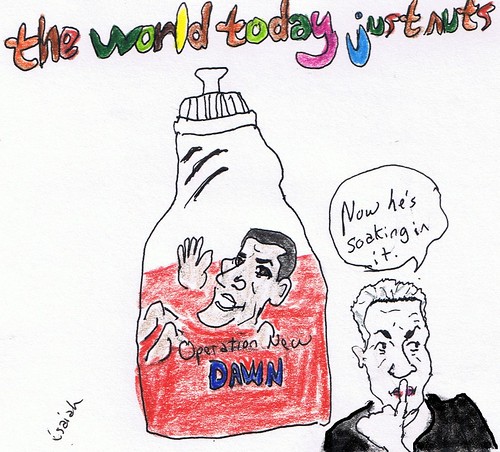
Now he's soaking in it

Above is Isaiah's The World Today Just Nuts "Now He's Soaking In It" from yesterday and yesterday I did post two music reviews as promised: "Kat's Korner: Last Decade's Buried Treasure" and "Kat's Korner: The exclusion of Cher." I actually could have done a third. Why didn't I? Dona pointed out that I should do it this weekend which would take some pressure off C.I. So, hopefully, I will have another album review going up this weekend -- probably Sunday. It was a lot of fun writing the Cher piece and, as I noted at the end of it, that's one of a series of pieces. I'll be doing Cher in the seventies either later this month or in October. I'm honestly having a problem with that. Why? It's difficult to find a good 70s collection. You can find a mix of 70s and 80s very easily -- and several really good ones -- but to find one that just focuses on the 70s? It's not easy.

And by the way, Cher's recording a new album right now -- in addition to having already done some singing on the Burlesque album (the film Burlesque comes out in November).

I find it outrageous that Cher isn't in the Rock and Roll Hall of Fame. I find it outrageous that they've inducted over 70 male solo artists since the mid-80s but only 11 female solo artists. Cher belongs in the Hall. She's a pioneer, she's a legend and she's rocked it hard all these years. In the sixties piece that went up yesterday, I argue on her admission based upon her creating a new female persona with her 60s solo work.

And I want to thank everyone who e-mailed on the reviews. The Cher review's garnering the most e-mails but that's because (a) people can't believe she's not in the Rock and Roll Hall of Fame and (b) they can't believe how few women are.


Closing with C.I.'s "Iraq snapshot:"


Tuesday, September 7, 2010. Chaos and violence continue, 2 US service members are shot dead in Iraq, another journalist is killed in Iraq, the "combat operations" are not over as a Sunday Baghdad attack demonstrated, the political stalemate continues, and more.

Liz Sly (Los Angeles Times) reports, "Two American soldiers were killed and nine injured Tuesday when a man wearing an Iraqi army uniform opened fire on them inside an Iraqi commando compound in the province of Salahuddin, highlighting the continued danger to U.S. troops in Iraq despite the formal end of combat operations announced by President Obamalas week." BBC News adds, "The US military says they were shot by a gunman dressed in Iraqi army uniform near the town of Tuz Khormato, 210km (130 miles) north of Baghdad." Barack declared "combat operations" over last Tuesday. Apparently not everyone got the memo . . . or else Barack was wrong. Sam Dagher (Wall St. Journal) observes: "But Tuesday's attack -- like a sophisticated assault on Iraqi facilities in central Baghdad on Sunday that American soldiers helped repel -- underscored what U.S. military commanders on the ground in Iraq have been saying for weeks: A change of mission doesn't mean the threats are over for the estimated 50,000 U.S. soldiers that remain in the country." Sunday attack in Baghdad?

Leila Fadel and Jinana Hussein (Washington Post) reported, "Just five days after the United States declared the end of its combat mission in Iraq, U.S. soldiers opened fire Sunday morning on suicide bombers who snuck into an Iraqi army base in Baghdad, a U.S. military spokesman said." Steven Lee Myers and Duraid Adnan (New York Times) observed, "Insurgents mounted a coordinated attack on one of the main military commands in Baghdad on Sunday, briefly drawing fire from American soldiers, an event that underscored the ambiguity of the American military's role in Iraq." NBC Nightly News with Brian Williams Sunday had Lester Holt anchoring and he noted, "Oversees now to Iraq and another suicide bombing. This one targeting one of the main Iraqi military commands in Baghdad. Twelve people were killed and thirty-six wounded when terrorists detonated a van filled with explosives, then stormed the base. American soldiers returned fire, helping to repel the attack." On The KPFA Evening News Sunday, David Landau explained:


In the Middle East today, American soldiers helped Iraqi troops battle insurgents in downtown Baghdad earlier today, repelling a major attack in the capital five days after President Obama had declared an end to US combat operations there. At least 18 people were killed and 39 injured when a group of suicide bombers and gunmen attempted to storm the army's east Baghdad headquarters located in a former ministry of defense building in a busy market district along the Tigris River. No Americans were among the casualties, according to a US military spokesman, but US soldiers did join in the fighting alongside Iraqis to repel the assailants, two of whom managed to enter the army compound. The US military also dispatched helicopters, bomb disposal experts, unmanned aerial drones and other unspecified intelligence, surveillance and reconassiance assistance to the scene of the downtown battle, the US military spokesman said. According to an Iraqi official, speaking anonymously, the Iraqi security forces had requested American help in the battle and US soldiers shot 2 snipers who had taken up position in nearby buildings. It was the first significant attack in Baghdad since President Obama's address to the nation on Tuesday in which he told Americans that US combat operations were over and said it was time to "turn the page" on Iraq.

Two correspondents for the New York Times -- Anthony Shadid and Michael R. Gordon -- were on PRI's The Takeaway Monday addressing the attack.


John Hockenberry: It's safe to say it's a new dawn in Iraq but it's partly cloudly.


Celeste Headless: That's -- that's a pretty good weather forecast. Accurate but not pretty.


John Hockenberry: Exactly. The lack of clarity over what the "new dawn" and the end of combat operations in Iraq actually means for US forces was demonstrated over the weekend. And, you know, less than a week after combat operations ended, US forces were reportedly called in to repel a coordinated attack on an Iraqi military. No American casualties there -- or at least none killed. But in the bombing and the shooting that came after at least 12 Iraqis were killed and more than 20 were wounded. Iraqi forces were also involved in this firefight as well. Iraqi Defense Spokesperson Maj - Gen Mohammed al-Askari denied though that US troops had been involved.


Maj - Gen Mohammed al-Askari: [Translated by PRI] This is not true. We didn't call the American troops. The Iraqi troops did it, foiling the attackers. And we wouldn't use American troops in this kind of operation. I don't think only six attackers represents a threat to Iraqi national security. I'm in direct contact with the operation room and the Defense Minister and we never used the Americans in this incident.


John Hockenberry: But a US military spokesman, Lt Col Eric Bloom, said the Iraqi military had requested help from helicopters, drones and explosive experts. The details in this incident? Well we're going to go to two reporters with our partner the New York Times: Anthony Shadid, a foreign correspondent for the New York Times based in Baghdad -- we welcome him back -- he won the Pulitzer Prize for international reporting this year and in 2004 for his coverage of the Iraq War and he joins us from Baghdad and Michael Gordon, New York Times military correspondent and author of The Generals of War: The Inside Story of the Conflict in the Gulf and Cobra II. He joins us from northern Virginia. Anthony, since there's a delay on your line, let me just start with you. What are the details and the truth as we know it about this incident that took place over the weekend?


Anthony Shadid: You might be able to reconcile those two accounts, actually. I don't think the Americans were called in to the base, they were actually already in the base as part of what they consider these partnership programs. And American soldiers were there. Now what role they exactly played is still a little unclear. The way the American military portrays it, they did what they call suppressive fire. But the actual raid on where these two insurgents were holed up, that was done by Iraqi troops. Now when you look at this raid itself, the general, the Iraqi general may have been dismissive of six people posing a challenge, but we have to consider that this is one of the division commands in Baghdad and an operation of just six men managed to breach the security and actually enter the base -- only two of them managed to get inside. I think it is a blow in some ways to the perceived Iraqi security forces that the insurgents were able to pull off this attack. It lasted a few hours, it was a very loud scene, as-as you reported there were American helicopters involved along with drones. It's something that's going to be remembered here for a little while, I think.


John Hockenberry: Anthony Shadid, foreign correspondent for the New York Times reporting from Baghdad. Michael Gordon, in a situation where combat operations are said to have ended, what are we to -- How are we to characterize this incident? Is this purely defensive combat? There's going to be a lot of this over the next year or so, right?


Michael R. Gordon: Well I was just in Baghdad last week with Vice President [Joe] Biden and I've been at that particular base that was attacked. I was embedded there in '08. I think it's not the case that combat operations have truly ended. The way I put it is: The combat phase is over but the fighting goes on. When you read the fine print of what the administration is talking about, it's clear that offensive American combat operations in partnership with Iraqi forces will continue in the realm of Special Operations. It's called "partnered counter-terrorism" but what it means is Special Operation Forces will hunt for al Qaeda -- Iraqi and American. And also American conventional forces retain the right to defend themselves either with the Iraqis or without them.

Liz Sly and Riyadh Mohammed (Los Angeles Times) added, "An official with the Interior Ministry, speaking on condition of anonymity, said that the Iraqi security forces requested American help to defeat the insurgents, and that it was U.S. soldiers who shot two snipers who had taken up position in nearby buildings." As Hurriyet noted, Barack's claim of the end of combat operations "should be taken with a grain of salt". "American soldiers were rushing to the aid of the Iraqi army," In an intro to her slide show at wowOwow, Julie Dermansky observes, "On August 31, 2010, Obama declared it is "time to turn the page" on Iraq, yet he didn't declare the war is over. The page may be turned but the story is not over. A visit to Arlington West illustrates the open book as more casualties are added to the records, and more markers are added in the sand." The slide show is on the crosses put up for the fallen at Arlington West. Over the weekend, the Fort Worth Star-Telegram editorial board opined, "Claiming credit for the end of the combat mission means Obama will own whatever happens after the war he was so virulently against as a U.S. senator and a campaigner for the White House. He won't be able to point a finger at the war's architect, former President George W. Bush, any longer." Atul Aneja (The Hindu) points out:

Under cover of darkness, hundreds of armoured vehicles rumbled across the Iraqi border into Kuwait, marking the much-touted withdrawal of American combat forces. Dominant sections of the international media interpreted the August 19 pullout as a political statement -- the fulfilment of a commitment by President Barack Obama to bring home troops entrapped by the Bush administration in the Iraqi military quagmire. In short, the American public was made to believe that the pullout by the fourth Stryker Brigade was leading to the end of the U.S. occupation. On August 31, Mr. Obama formally declared in a televised address that all American combat operations in Iraq had ceased. The spin-doctors in the American establishment and their willing accomplices in the media have indeed done a marvellous job. An extraordinary task -- of dressing up a new phase of Iraqi occupation as the beginning of its end -- has been accomplished.
However, many questions arise in the wake of the withdrawal. How should the pullout be interpreted, if not as the occupation entering its terminal phase? What are the facts on the ground, and what prospects do they hold for the future of Iraqis?
There are three significant markers that the Iraqi occupation is not ending and is being merely repackaged. First, the suggestion that the U.S. combat operations are ending is just not true. The nomenclature, however, has changed significantly. Instead of being called "combat operations," the act of chasing militants, joint raids by U.S. Special Forces and their Iraqi counterparts on militant strongholds, and other offensive military tasks will henceforth be called "stability operations."


On the most recent broadcast of Inside Iraq (Al Jazeera, began airing Friday), guest host Teymoor Nabili spoke with Professor Sami Ramadani (London Metropolitan University), Mustafa al-Hiti (Iraqi National Alliance) and Saad al-Muttalibi (State of Law).

Teymoor Nabili: If I may begin in London with Sami Ramadani, I suppose you are the most distant from the process in a number of ways. So let me try and get just a broad baseline from you on what's going on. President Obama said that we have met our responsiblities in Iraq. Is he right in doing that? But particularly in saying that, particularly given that there is no government and that the process of democracy that Americans spent so much time trying to build appears to have yielded nothing.

Sami Ramadani: Absolutely and one could also add to your list the fact that Iraq is in such a mess. The population's daily lives have been reduced to a -- to a level which is equal to the worst in the world -- including Somolia and the like. The daily lives of the people who are there -- whether it is to do with health, with electricity, the essential services, unemployment, the condition of women, the -- not to mention the security situation, the death of over a million Iraqis.

Teymoor Nabili: Alright.

Sami Ramadani: The situation in terms of the -- I mean, the country is in ruins so I don't know what Mr. Obama or President Obama was talking about when he said 'fulfilling our responsibilities.'

Teymoor Nabili: Saad al-Muttalibi in Baghdad was laughing when you said that. This is not a country you recognize from those terms, apparently?

Saad al-Muttalibi: Well I thought this was a serious political program, not a comedian stand up program. Because, really what I'm hearing, has nothing to relate to. What he's saying -- Probably he's representing a political view that has gone with the past. I mean the Ba'ath Party is trying to show that Iraq is in dire straights and in a desperate position but that is the Ba'ath Party speaking and I suspect that the kind gentleman in London probably is somehow related to the Ba'ath Party.

If you don't grasp why Iraq's in gridlock, it's right ther with the ass Saad al-Muttalibi. Not only is he in Nouri's political slate (also in Nouri's political party) he is an adviser to Iraq's Ministry of Dialogue and Reconciliation. He damn well knows that the Ba'ath Party is illegal in Iraq (since the start of the Iraq War) and he damn well knows that you sideline opponents with that charge/smear. Brought on to discuss Iraq, he can't do it.

He immediately trashes the man he disagrees with as a stand up comic before making the deadliest accusation an Iraqi can make: "Ba'ath Party member!" This is not the first time Saad al-Muttalibi has pulled that stunt or even the first time on Inside Iraq. He is a thug. For some reason, he's a thug that gets on TV. But he's crooked, he's a liar and he's part of the problem that will refuse to let Iraq move forward. And if you're not getting it, the ministry he advises? They were supposed to have met a benchmark in 2007 (never did) of bringing former Ba'ath Party members back into Iraqi society and government. That's the 'reconcilaition' and people like Saad al-Muttalibi are the reason that there has been no reconciliation.

Gabriel Gatehouse (BBC News) reports that Nouri al-Maliki's ally Hussein al-Shahristani is arguing that the political stalemate is encouraging the violence such as the attacks Sunday on the Iraqi military base while "a small group of activists and politicians gathered outside the Iraqi parliament" today to register their objection to the stalemate. March 7th, Iraq concluded Parliamentary elections. The Guardian's editorial board notes, "These elections were hailed prematurely by Mr Obama as a success, but everything that has happened since has surely doused that optimism in a cold shower of reality." 163 seats are needed to form the executive government (prime minister and council of ministers). When no single slate wins 163 seats (or possibly higher -- 163 is the number today but the Parliament added seats this election and, in four more years, they may add more which could increase the number of seats needed to form the executive government), power-sharing coalitions must be formed with other slates, parties and/or individual candidates. (Eight Parliament seats were awarded, for example, to minority candidates who represent various religious minorities in Iraq.) Ayad Allawi is the head of Iraqiya which won 91 seats in the Parliament making it the biggest seat holder. Second place went to State Of Law which Nouri al-Maliki, the current prime minister, heads. They won 89 seats. Nouri made a big show of lodging complaints and issuing allegations to distract and delay the certification of the initial results while he formed a power-sharing coalition with third place winner Iraqi National Alliance -- this coalition still does not give them 163 seats. They are claiming they have the right to form the government. In 2005, Iraq took four months and seven days to pick a prime minister. It's now 5 months and 30 days. Phil Sands (National Newspaper) notes that if the stalemate continues through September 8th, it will then be a half a year since Iraqis voted. Khalid al-Ansary, Serena Chaudhry, Michael Christie and Samia Nakhoul (Reuters) report that Allwi is stating that, "I hope in Ocotber some time, late October (things will be sorted out)." Allawi also states that he is fine with someone else from Iraqiya becoming prime minister.


Alsumaria TV reports, "Allawi pointed out to two main pending points in coalition talks namely the position of prime minister and the question of who had the right to form the next government. Allawi said it was important to divide power amongst all political blocs in Iraq's fledgling democracy." Today Caroline Alexander (Bloomberg News) reports that news from the Aswat al-Iraq outlet states that Nouri al-Maliki refuses to step aside as candidate for prime minister for State of Law and that the Iraqi National Alliance is standing behind (current Shi'ite vice president) Adel Abdel Mahdi but the two groups, allegedly, have agreed to take a vote and go with whichever candidate receives 65% of the vote. Not addressed is what happens if no one receives 65%. Going into the March elections, for those who've forgotten, Nouri insisted he would win by a huge margin. He did not win. By any margin. Despite having many in the press call the election for him before the votes were even counted (for example, Quil Lawrence of NPR). Meanwhile Alsumaria TV notes that some members of the Iraqi National Alliance was at the home of Ahmed Chalabi addressing the issue of the stalemate and that the meeting stressed the need "to preserve unity within the national alliance." Michael Christie (Reuters) adds, "Shi'ite Iran, which exerts considerable influence over many Iraqi Shi'ite leaders after housing them for years when they were exiled under Saddam, is also pushing for a united front." Assad Abboud (AFP) reports that Iraqi politicians are stating that Nouri has the backing of both the US and Iran and that various blocs are currently scurrying to get behind Nouri.

Reuters reports a Samarra home invasion in which 3 family members were murdered "execution style," and, dropping back to Monday night, 2 corpses discovered in Kirkuk and 2 police officers injured in a Baghdad shooting. Alsumaria TV reports, "Religious programs anchor on Al Iraqiya Satellite TV network and head of Al Sheala District Riyad Al Saray was killed by unknown gunmen in central Baghdad."

In other news, Phil Bronstein (San Francisco Chronicle) and Eliott C. McLaughlin (CNN) both report (with text and video) on pranks being played in Iraq on Iraqis by Iraqis in the style of the MTV show Punk'd. And while that might make you grin, roll your eyes, groan or any variety of response, Oliver Pickup (Daily Mail) reports another aspect that should not be happening. Pickup reports on a group interjecting themselves into these antics: US soldiers. Pickup emphasizes a 'prank' a US soldier played on Iraqi by planting "a live grenade in an Iraqi's car". The scroll across the US video: "This is my partner and I working at a Traffic control point in Iraq. We decided to scare one of the locals a bit by placing a grenade in his trunk while he wasn't looking. This was all in fun and never in any intent to harm anyone." The US soldiers taking part in that need to be disciplined. There's no excuse for it and it shouldn't be happening.

There is the obvious fact that a live grenade could explode and, if and when that happens during a prank, it will not be, "Oh, those funny Americans!" That's just one problem. Equally true is that this is how rumors get started. US soldiers today having 'fun' by planting grenades and other weapons are encouraging a belief in Iraq that US soldiers planted and planned the violence. How so? Iraqis are outraged by the violence that has plagued and continues to plauge their country -- rightly so. They are outraged and have blamed everyone possible for the violence -- including their own governmental leaders, including US service members, everyone. When videos exist showing Americans doing these 'stunts' for 'fun' it's only a matter of time before a few people start saying, "See, it was the Americans." That belief then spreads and it becomes, at best, an urban legend that never goes away and, at worst, a reason to attack US service members. It's not cute, it's not funny and it needs to stop immediately. Maybe the US military brass needs to worry less what civilians in the US do and start focusing on the problems taking place under their command? (That's in reference to Petraeus' hectoring of some church in the US and their plan to burn the Koran -- which they can do as American citizens. I don't support book burnings of any type but they are a legal form of protest and they really aren't the US military's business. In fact, the US military needs to be told to butt the hell out of civilian life in the United States. Civilian groups in the US have and are weighing in and that's what happens in a democracy -- though the fear card shouldn't be played -- but military brass has no say in what US citizens do or do not do as they exercise their Constitutional rights to free speech. Fear card shouldn't be played? Though both the Republican and Democratic parties love to play the fear card -- and pretend they don't -- it has no place in this debate. It had no place in 2003 when it was used to attack the Dixie Chicks and how their 'remarks' would effect the world. This is a democracy, people will do what they want. If the burning isn't wise -- again, I support no book burnings -- then there should be valid arguments for it not taking place. Fear of what might happen OH NO WHAT MIGHT HAPPEN is bulls**t. You better find a better reason and stop trying to scare America. Shame on anyone who does that and shame on anyone who silently goes along with that.)


This is Workers World's editorial "Iraq's resistance stands up:"


From the point of view of the U.S. government and the Pentagon, the U.S. has begun to wind down its military occupation of Iraq, now in the middle of its eighth year. But Washington intends to keep control of Iraq's oil and foreign policy with a string of military bases, a supersized embassy complete with its own mercenary army, and a puppet government dependent on U.S. military, economic and diplomatic backing.


In the meantime these seven-plus years of occupation have destroyed much of Iraq, slaughtering its people and devastating its culture and its scientific and technical leadership. The occupation has divided Iraq along ethnic and sectarian fault lines as never before, and it left the city of Falluja poisoned with cancer-producing substances.


That the U.S. invasion has brought much pain and suffering to Iraq is indisputable. What is missing from the above picture, however, is one essential thing: the indomitable determination of the Iraqi people and nation to regain their sovereignty.


With U.S. troops leaving the country or staying safely within their well-protected bases, elements apparently from the Iraqi resistance launched 34 attacks in 16 cities on Aug. 25. Some 31 of the 55 people killed were members of the puppet police and security forces. It was clear that the Iraqi resistance that had prevented the U.S. from a clean takeover of Iraq is still around, still a force on the ground. More cities were hit at the same time than had ever been hit before, with police headquarters, checkpoints and government offices being the main targets.


Soon after the initial U.S.-British occupation in April 2003, George Bush claimed "mission accomplished." The fighting seemed over, but soon this illusion became a nightmare. Former army officers and many others grouped fighters around themselves who began to make life hell for the occupation army. The vast majority of Iraqis would simply not submit to imperialist rule.


President Barack Obama, who was elected partly based on his promise to leave Iraq, is on the verge of making a speech on Aug. 31 to the county explaining the withdrawal. The early word on Obama's speech is that the president will avoid the triumphant tone that got Bush into trouble. But no amount of intelligent words can cover up a policy of military aggression that has left the U.S. with only enemies and ineffective puppets in Iraq.


Articles copyright 1995-2010 Workers World. Verbatim copying and distribution of this entire article is permitted in any medium without royalty provided this notice is preserved.

Workers World, 55 W. 17 St., NY, NY 10011
Email: ww@workers.org
Subscribe
wwnews-subscribe@workersworld.net
Support independent news
DONATE


Friday Ashish Kumar Sen (Washington Times) reported, "The United Nations' refugee agency is expressing concern that Western European countries are forcibly deporting Iraqi citizens back to Iraq. Sixty-one people, most of them Iraqis living in Sweden, Norway, Denmark and Britain, were flown back to Baghdad this week." The UN Refugee Agency (UNHCR) released the following:

GENEVA, September 3 (UNHCR) -- The UN refugee agency on Friday objected to the continuing forced returns of Iraqi citizens from Western European countries soon after 61 people were flown back to Baghdad.
Spokesman Adrian Edwards told journalists in Geneva that UNHCR was "very concerned' about the returns. The 61 on Wednesday's chartered flight were mainly Iraqis who had been residing in Sweden, Norway, Denmark and the United Kingdom. UNHCR has not been able to confirm reports that three Iranians were among those on board.
UNHCR's guidelines for Iraq ask governments not to forcibly return people originating from the governorates of Baghdad, Diyala, Kirkuk, Ninewa and Salah Al-din, in view of the serious human rights violations and continuing security incidents in these areas.
"Our position is that Iraqi asylum applicants originating from these five governorates should benefit from international protection in the form of refugee status under the 1951 Refugee Convention or an alternative form of protection," Edwards said in Geneva's Palais des Nations.
UNHCR considers that serious risks, including indiscriminate threats to life, physical integrity or freedom resulting from violence or events seriously disturbing public order, are valid reasons for international protection.
Some of the individuals among the group returned on Wednesday may be destined for safer areas such as the Kurdistan Region in the north, others may have elected to return voluntarily.
"Nonetheless, of the 11 individuals we were able to interview on arrival, some originated from Baghdad and at least one person was a Christian from Mosul, in the governorate of Ninewa," Edwards said, adding: "The security situation in that governorate remains extremely volatile."
Similarly in the Baghdad governorate, the security situation remains unstable with increased attacks and several recent major security incidents. On August 25, for example, a series of coordinated attacks throughout the country, including suicide bombs, left 62 people dead and 250 wounded. Car explosions, roadside bombs, mortar attacks and kidnapping remain daily threats for Iraqis.
"We strongly urge European governments to provide Iraqis with protection until the situation in their areas of origin in Iraq allows for safe and voluntary returns. In this critical time of transition, we also encourage all efforts to develop conditions in Iraq that are conducive to sustainable and voluntary return," Edwards said.
The continuing violence in Iraq has resulted in large-scale internal and external displacement of the Iraqi population. More than 1.5 million people remain displaced within the country while hundreds of thousands of others have found refuge in neighbouring countries, mainly in Syria and Jordan.
UNHCR is concerned about the signal that forced returns from Western Europe could give to Iraq's neighbours, which, despite a score of national priorities, are hosting large numbers of Iraqi refugees.

Saturday
Rob Hastings (Independent of London) reported that Iraqis Ahmed Hussein Saeed and Mohammed Abdullah escaped the Oxfordshire detention center they were being held on Thursday night and were hunted down "by police using dogs and a helicopter" and adds, "Fifteen Iraqi refugees have been flown to Baghdad this month, of which several were Kurds. British officials tried to send their flight on to Kurdistan but were told by the KRG that this was not acceptable. A spokesman for the Coalition to Stop Deportations to Iraq told The Independent that British authorities now simply left Kurdish refugees in Baghdad with $100 and a hotel room for the night, and instructed them to make their own way back home to Kurdistan from there."


Saturday in Dublin, a War Hawk was held accountable. AP reports that Tony Blair showed up to sign his memoir I Helped Kill Millions But Found Love In Bush and was pelted with shoes and eggs. There were no reports of injuries so apparently all the eggs and shoes hit Blair in the head. The War Hawk is attemping to garner press -- revisionary press -- while on his book tour. CNN reported Monday that Tones Blair has canceled a book-signing in London out of fear of protests. In a statement, Blair attempts to spin the animosity the world feels towards him insisting that "I have decided not to go ahead with the signing as I don't want the public to be incovenienced by the inevitable hassle caused by protesters." AFP quotes the War Hawk whining to Sky News, "I think it's sad if you can't sign a book without people trying to physically prevent you, and as we saw in Dublin there were hundreds more who wanted to come and have their book signed than wanted to protest." Tony's also running from the revelations that his "I will give all royalties to wounded British soldiers" was another of his Iraq War lies because his huge advance means there will be few (if any) profits from the book and he's not handing over any of that six-figure advance to wounded soldiers. UK's Stop The War notes:

Tony Blair has cancelled his book-signing at Waterstone's bookshop. He knows he cannot appear in public without being confronted by protests over his war crimes. He is running scared but he cannot hide. Stop the War has called a protest at Tate Modern gallery at 5.30pm on Wednesday September when Blair is hosting a book launch party, which will no doubt also be attended by Alistair Campbell, Jack Straw, Peter Mandelson and other war criminals.
Protest when Blair hosts book launch party Wednesday 8 September 5.30pm
Tate Modern Gallery, Park Street, Bankside, London SE1 9TG Tube: Mansion House
Q. Who said: "You've got to put in prison those who deserve to be there"? A. Tony Blair, 6 September 2010


iraq


the wall st. journal
sam dagher


Friday, September 03, 2010

Music

"Kat," an e-mail from yesterday states, "don't you forget that you promised us two reviews over this long Labor Day weekend. Don't you dare try to wimp out." The e-mail serves to prove how thin the line between fan and stalker is. (That was a joke.)

Yes, I plan to have two reviews up at The Common Ills this weekend. (Most likely Sunday and Monday or just Monday.)

If I don't? Blame Stan.

Last week, Stan got DSL at his home.

Net tips
  • Calling it quits with AOL
  • Kryptonite

  • You can read those posts for more on that topic. Stan's excited and who can blame him?

    But he's finding all this great stuff and a lot of silly stuff and he'll tell me about it on the phone or in an e-mail and I'll be on the computer hunting it down.

    It's almost like being new to the net myself because his excitement is so catching. I've watched music videos, animated clips and you name it. Stan finds some really great stuff.

    But on music, this is from D.R. Scott's "Amy Winehouse: Will she be on the short list with Joni Mitchell, Tina Turner, Ani DiFranco . . . Janis Joplin?" (Culture Mob):

    Here’s the list:

    Joni Mitchell.

    Tina Turner.

    Kate Bush.

    Ani DiFranco.

    Patti Smith.

    Janis Joplin.

    These women were real singers, not one-hit wonders who cashed in their fifteen minutes of fame and disappeared. They were giants who left behind landmark songs that cast long shadows: The Hissing of Summer Lawns (Joni), Private Dancer (Tina), Hounds of Love (Kate), Not a Pretty Girl (Ani), Horses (Patti), and I Got Dem Ole Kosmic Blues Again, Mama! (Janis.)

    It’s a short list, and you have to earn the right to belong on it. You have to be a visionary. Unique, stubborn, brave, opinionated, and willing to challenge your audience.

    I’m sorry, Rhianna. Uh-uh, Ke$ha. Go away, Lady Gaga.

    Amy? Amy Winehouse?

    Hmmm. Maybe.

    So what do you think? (And read the whole column, that's just the opening.) I don't know about the list offered. Tina? Sure. Joni? Absolutely. Janis? Uh-huh, right on. But I'm soured on Patti Smith for her refusal to stand up for Ralph Nader in 2008. She really wimped out and acted like a little bitch in my opinion. I haven't listened to her since the summer of 2008 and I may never listen to her music again. Ava and C.I., at Third, pointed out that her support for Barack because he could win (she said) could be turned back on her and in 1977 record buyers could have said, "Let's buy Hasten Down The Wind and not Horses because Linda Ronstadt can really sell records!" For someone like that, someone like Patti, to hop on the popularity train is just disgusting. She's supposed to be the rebel, the outsider. Ani?

    Ani's double disc 'hits' began my separation with her. The 'maverick' and her refusal to call out Barack and his drone attacks makes it very difficult for me to listen to her anymore.

    Maybe they belong on the list. Maybe they don't? I would put Cass Elliot on the list. I would put Carly Simon on there, Stevie Nicks and a few others. I'm sure that there are people you would place on the list.

    But be sure to look at the column because there's a real point to it.

    Closing with C.I.'s "Iraq snapshot:"

    Friday September 3, 2010. Chaos and violence continue, Tony Blair lies to the world about donating 'royalties' (that will most likely not exist) to wounded British soldiers, AP takes a stand for the facts, the political stalemate continues, Iraqis weigh in on Tuesday's speech by Barack Obama, and more.


    Today Poynter publishes an internal AP memo written by Tom Kent, the AP's Deputy Managing Editor for Standards and Production,

    Whatever the subject, we should be correct and consistent in our description of what the situation in Iraq is. This guidance summarizes the situation and suggests wording to use and avoid.
    To begin with, combat in Iraq is not over, and we should not uncritically repeat suggestions that it is, even if they come from senior officials. The situation on the ground in Iraq is no different today than it has been for some months. Iraqi security forces are still fighting Sunni and al-Qaida insurgents. Many Iraqis remain very concerned for their country's future despite a dramatic improvement in security, the economy and living conditions in many areas.
    As for U.S. involvement, it also goes too far to say that the U.S. part in the conflict in Iraq is over. President Obama said Monday night that "the American combat mission in Iraq has ended. Operation Iraqi Freedom is over, and the Iraqi people now have lead responsibility for the security of their country."
    However, 50,000 American troops remain in country. Our own reporting on the ground confirms that some of these troops, especially some 4,500 special operations forces, continue to be directly engaged in military operations. These troops are accompanying Iraqi soldiers into battle with militant groups and may well fire and be fired on.
    In addition, although administration spokesmen say we are now at the tail end of American involvement and all troops will be gone by the end of 2011, there is no guarantee that this will be the case.
    Our stories about Iraq should make clear that U.S. troops remain involved in combat operations alongside Iraqi forces, although U.S. officials say the American combat mission has formally ended. We can also say the United States has ended its major combat role in Iraq, or that it has transferred military authority to Iraqi forces. We can add that beyond U.S. boots on the ground, Iraq is expected to need U.S. air power and other military support for years to control its own air space and to deter possible attack from abroad.
    Unless there is balancing language, our content should not refer to the end of combat in Iraq, or the end of U.S. military involvement. Nor should it say flat-out (since we can't predict the future) that the United States is at the end of its military role.
    We're opening with that because it is news and it is important. To be clear, not every journalist has jumped on the Iraq War over ball. For every idiot on MSNBC or John Nichols, there have been cautious voices who have refused to play along. Diane Rehm has repeatedly noted that 50,000 troops and the claim of an end make no sense, Michael R. Gordon has offered perspective as well, as has Steve Inskeep, Matthew Rothschild, Chris Floyd, Sonali Kolhatkar, Jane Arraf, Margaret Warner, Scott Horton, Jason Ditz, and Kelley B. Vlahos among others. But they have been the exception. (Scott Horton is the journalist, not the attorney. To be clear on which one, he gets a link.) More commonly, American news consumers have been repeatedly greeted with blind repetition of White House spin and, especially for so-called 'independent' media (Katrina, we're especially talking about The Nation, the magazine you've ruined), a desire not to contradict Blessed Barack.
    We wanted an independent media -- in terms of the advertising-backed as well as the donation dependant -- when the build up to the Iraq War was beginning. We attacked and bemoaned corporate media but where has Panhandle Media been the last two years? They've had no independence. Let's not kid that you can be part of Journolist and be independent. Let's not kid that you can be exposed as a part of Journolist -- as the bulk of The Nation writers were -- and get away without issuing a public statement of apology to your readers. It doesn't matter that you're an "opinion writer" -- in fact that's even worse because people reading Katha Pollitt, Chris Hayes, Eric Alterman, Richard Kim and the other Nation writers who were on Journolist thought they were reading independent thinkers, unaware that they joined with other like-minded writers to determine what to cover (Chris Hayes and Spencer Ackerman issued the edict not to cover Jeremiah Wright -- even to object to him -- because it could hurt Barack). Whores. That's who staffs independent media and that's only demonstrated all the more when they refuse to apologize for their backroom dealings, their hidden agreements and instead carp about Tucker Carlson and the outlet (Daily Journal) which exposed them.
    The other reason is that Tom Kent notes that the media can't "predict" the future. We've noted that here for nearly two years as outlets have repeatedly insisted that the SOFA means the Iraq War ends at the end of 2011 when it doesn't mean that at all. Tom Kent and AP deserve serious applause for doing what we say we want to see: An independent media that questions, an independent media which doesn't just repeat the spin of government officials.
    Today on the second hour of The Diane Rehm Show (NPR), Diane spoke about Iraq with Youchi Dreazen (National Journal), Adberrahim Foukara (Al Jazeera) and Kevin Whitelaw (Congressional Quarterly).
    Diane Rehm: Let's talk about the president's comments on the US combat mission in Iraq officially over. Kevin, what does that mean for the role of the remaining 50,000?
    Kevin Whitelaw: Well that's right. The-the combat phase of the war is over according to-to the Pentagon and according to President Obama. That doesn't mean that US troops will not engage in any combat anymore. We still have a-a sizeable portion, ten, fifteen percent of the force, that really is part of a Special Forces component that is stationed in Iraq. Still, remember, 50,000 troops. So you take about ten, fifteen percent of that. These are troops that will still go out on missions here and there to captue and kill --
    Diane Rehm: With Iraqis?
    Kevin Whitelaw: In most cases. We don't know for sure, keep in mind, whether or not there might still be some unilateral missions but in most cases that's correct, they'll go out with Iraqis to-to do certain targeted missions and they'll also -- in the various training mission, the larger training mission -- there will be US troops that accompany Iraqis on various missions and you can expect that if they find themselves under fire they will certainly defend themselves. So there is still combat capability with this force that is in place. Having said that, what it does mean is that the Iraqis are-are, you know, in the front lines, they're the ones that are expected to do-to do the bulk of the security work and to make the bulk of the security decisions about where to target, where to go, how to defend and how to proceed.
    Diane Rehm: What about NATO forces still in Iraq, Abderrahim?
    Abderrahim Foukara: Well, I mean, if I may comment on the - the broader issue first of all?
    Diane Rehm: Sure.
    Adberrahim Foukara: It all harks back to democracy obvivously. In a democracy, when you make a pledge, you have to live up to it. President Obama made the pledge that, you know, he would get the US forces out of Iraq and obviously now that we uh-uh-uh closing up to-to the November election, he has to be seen as living up to his word. Now leaving -- withdrawing 50,000 combat troops and leaving several thousands more in Iraq at this time when there isn't even a government in place in Iraq, when despite all pronouncements to the contrary, security forces -- the Iraqi security forces are still not up to snuff, it is -- It may be a little controversial calling this phase, combat phase, over because, it seems to me that, US forces will remain in Iraq, will continue to be combat forces, in one kind or another, in one situation or another. So I hark back to my opening statement in this show which is that in the same way that it is managing the crisis situation between the Israelis and the Palestinians, Iraq will remain a crisis and the United States will keep on managing that crisis for a long time to come.
    Diane Rehm: Youchi.
    Youchi Dreazen: You know the war in Iraq has been a war of semantics from the very beginning. "The Coalition of the Willing" which didn't exist. I mean, there was a coalition of the US and a small number of allies, in some cases absurdly small. The one Icelandic female soldier who I met who was, excuse me, who was Iceland's entire military contingent in Iraq. You had five Dutch. You had a Costa Rican bomb dismanteling team who didn't want to leave any of its bases so, if the bomb was brought to them, they would dismantle it but otherwise they wouldn't go. So you had the "Coalition of the Willing" which of course didn't exist, you had "Shock and Awe" which neither "shocked" nor "awed." Now you have this transition from combat mission over to advise-and-assist mission beginning and the previous points were exactly right. You have 50,000 troops which is a considerable number. They are still having the same equipment they had before. They still have the same armored vehicles. They will still be out on patrol. It's a semantic difference but that's been the case with Iraq from the very beginning. The key difference to my mind is there's no government. The second key difference from what the president said, the president's speech sounded very much like "We are out the door." The feeling within the Pentagon is that this will be renegotiated and that, by the end of next year, there will still be troops there.
    Diane Rehm: David Ignatius wrote in the Washington Post yesterday that, "One of the mysteries of U.S. policy is why Washington keeps pushing a formula that will allow Prime Minister Nouri al-Maliki to keep his job (or another top post) at a time when he is rejected by nearly all Iraqi political parties. America's silent ally in this peculiar gambit is Iran. After so much pain, Iraqis deserve better." Youchi?
    Youchi Dreazen: There is a very short and simple answer to the first part of the question. It's that American officials have come to like Nouri al-Maliki and to trust him which is remarkable if you remember a memo leaked out a few years ago, which had been written by Stephen Hadley who was then the National Security Advisor for the Bush administration, raising questions about Maliki and making clear that, if you read the memo carefully enough, that he was under some sort of American surveillance because they didn't trust him. Now they do. And the reason why there willing to keep him in power -- even as a caretaker, let alone post as a caretaker -- is that there's a feeling that he's a person you can do business with, a person you can trust and who has some measure of control with the security forces.
    Diane Rehm: But how much trust is there, Kevin, that they can finally get a government put together?
    Kevin Whitelaw: You know, we've been down this road. Every time there has been one of these elections, there's been a lengthy transition. This one's been even longer than the other ones but all the other ones did result in a government that was able to exercise some amount of control. At this point, it has dragged out even more, it's a sign of how little trust still exists between the parties over there and I think you also have a sense of while, while, there's a lot of Iraqis who are not big fans of Prime Minister Maliki, he's still something of a known entity to them whereas any new member -- any new potential leader , particularly from a different party will be a gamble, a roll of the dice. And so you have a real difficult question there for these Iraqi politicians to decide: Do you go with -- Which guy do you go with? The devil you know? The devil you once knew, which is a former prime minister Ayad Allawi, whose party, whose coalition did well in the election? Or do you bring in yet again somebody else? And then, obviously, all of the political jockeying below that level. It's-it's --
    Diane Rehm: And considering all of that, how realistic is it that the US will pull out at the end of 2011?
    Adberrahim Foukara: I think militarily they will. My sense is the President Obama will be able to live up to his pledge to get all or most of the military out of - out of Iraq and by the end of 2011. Now what will that remain for the role of the United States in Iraq? I think the role of Iraq in the United States will, in different ways, continue to be very strong, for different reasons. One of them is obviously the fear although [US Vice President] Joe Biden actually trashed it but the fear that the Iranians are playing an increasing role and therefore for the United States to handover, if you will, Iraq to the Iranians or to anybody else, for that matter, in the region, it's not going to happen. Having said that, there's nothing that the United States, I think, they current state of play being what it is in Iraq, there's nothing that the United States can do in Iraq to actually increase its influence beyond what the -- beyond the influence that's actually attributed to-to the Iranians. You have to remember that the United States, the Americans have built a huge embassy, it's probably one of the largest embassies in the world in terms of its physical size and in terms of its staffing and that gives you an indication as to the transformation of the role of the United States in Iraq post-2011. But there's no doubt that the United States has lost influence in Iraq.
    Diane Rehm: There is also transformation of opinion about the United States as a result of the war in Iraq. Youchi?
    Youchi Dreazen: Well that was something that President Obama tried to address in his speech earlier this week. You know the multiple facets of that, obviously, the war began in tremendous, tremendous controversy which has never really gone away. It was a measure of original sin in many ways. It was seen as illegitimate, it was seen as under false pretenses. In Iraq, you've seen opinion on the United States really vary, almost like on a sign [sound?]wave. There was the initial, what Gen [David] Petraeus referred to as "the man on the moon" feeling of "Hey, US, you put a man on the moon. Why can't you restore our electricity? Why can't you restore our water or our sewage?" Then during the civil war, there was the feeling of the US is at least less of an evil than the Shi'ite death squads or the Sunni death squads. Now again, there's a feeling of -- my Iraqi staff are e-mailing from Iraqi daily, my fromer Iraqi staff when I was at the Wall St. Journal, there's still no power, it's a 125 [degrees] and they have three hours of electricity a day. So there's again the feeling of, 'We know you spent all this money, we know that it enriched a lot of corrupt officials, but why can't you fix these very, very basic issues?' One point on the speech that I thought was very interesting, if you think back to how politicized this war has been from the start -- Did Bush lie? Did Bush tell the truth? Was Saddam containable? Etc. I thought it was remarkable that, on the end, in the speech, that basically was our "We're departing" -- President Obama couched the cost of the war primarily as an economic issue. I mean, in his reasoning for why it's good we're getting out, he paid tribute to the troops, he paid tribute to the sacrifice and then said, 'We need to spend that money here at home.' And I just found it very interesting that a war that began with so much high level debate about honesty and lying and torture and deception and all these grand issues, in the end, comes down to 'we can't afford it.'
    The conversation continued. We'll stop there. If Adberrahim Foukara crotch nuzzling of Barack got on your nerves, Marcia's addressing that tonight at her site. Again, FYI, Diane has a new book that was just released today Life With Maxie -- Maxie is her chichuahua and the book's being called a must for dog and pet lovers.
    Before we go to any other topics, let's go to some Iraqi voices. Thursday Leila Fadel (Washington Post) offered the views of some Iraqis:

    Outside the heavily fortified Green Zone, where many of Biden's meetings took place, Iraqis expressed fear and frustration.
    "We wanted change, and nothing's changed," said Mohammed Imad, 21, leaning against a wall covered with old election posters.
    [. . .]
    "Whose celebration is this?" said Ibrahim Abdul Wahab, 57, a resident of Haifa Street in downtown Baghdad, where Sunni insurgents were in control more than two years ago. "It's his, not Iraq's. Where are the promises of the planned democracy?"
    Yahiya Haji: I did not hear the speech and do not care about it. It is all a lie. The American troops will stay in Iraq without a withdrawal, and who knows whether 50,000 or 1,000 soldiers will remain. No one can tell, not a security agreement or the prime minister. They will keep a force ready in case there are any security problems."
    Qasim Daoud, 44, Engineer: "Why should I listen to him? What will he say? All the words are known and have been said before. This is all a lie, the talk about withdrawal. Yesterday, there was a U.S. patrol in my neighborhood. Withdrawing, and leaving 50,000 soldiers?"
    Muhammed al-Shaliji, 43: " I did not hear the speech and I am not interested in what he said."
    Ayad Muhammed, 52, Unemployed: "I did not hear the speech because I do not think that the U.S. will ever leave us alone."
    Omar Walid, 40, Unemployed: "Half the speech was a lie, because they will not leave Iraq. If they were going to leave us why did they build 93 military bases. As for what he said -- that they will stick with the security agreement and be responsible for Iraq' borders -- say to him, 'here were you when the Iranian forces attacked Iraq? Where were you when the Iranians took over Faka oil field? Where were you when the Turkish forces attacked us?'"
    McClatchy Newspapers' Iraqi correspondents offer the views of some Iraqis. Army Officer Qaswar Abu Tariq states: "People have a right to be afraid. It (what the US has done in Iraq) is not a job well done. No one in his right mind, only perhaps a politician would like to see occupation forces extend their presence. But look around you – what do you see? The country's borders are open on all sides, open for any who wish to enter and do their will inside Iraq, whether Iran, Syria or any other of the neighbouring countries. Was the decision to withdraw come at a time when they (US) left a force able to secure our borders? No. There is no such thing - whatever the politicians say.. Believe me, if we were able to secure our borders the terrorist attacks would fall to one half – at least. So they (US) failed to provide Iraq with secure borders. And how sovereign can a country be if it needs the air-force of the U.S to protect it's air-space? In seven years, why have no steps been taken to revive our air-force? " 70-year-old, retired school teacher and grandmother of seven, Widad Hameed is interviewed:
    (Will violence escalate when the USF pull out??) (Long pause..) "I am torn between two considerations answering this question. Firstly -- I am strongly opposed to the presence of foreign troops on Iraqi sovereign soil -- and therefore hope to see them leave as quickly as possible -- This is on principle. But on the other hand, I am afraid of what might happen after they leave. I have no great faith in the abilities of the ISF and feel that the chaos in our political situation will be reflected upon the security scene as the politicians slug it out and violence will rise and the people will pay. As for the Americans -- The chaos we are witnessing is a result of their failed plans, and I don't think there is anything they could do at this late date to make a difference. Had they wanted to achieve better results, they should have been more serious about training and arming the ISF -- commanders and ranks alike – Seven years should have been long enough".

    (Should the USF interfere if violence rose to unbearable levels?) "Though I hate to say it -- But, yes, they should interfere. They have a moral duty to the citizens of Iraq. It was because of their intervention (the occupation) that security has disappeared from our lives. The chaos now present in Iraq is their doing – and they must protect us from the dangers that they brought with them when they invaded Iraq. They must protect us from al Qaida, the militias and the political violence. It is their moral duty.
    Leila Fadel (Washington Post) continued to report on Iraqis reactions today and noted the Kurds:

    "They decided to finish it, but they know it's not over," Othman said Thursday. "War with terrorism is here, and Iranian intervention is here. They are lying to tell their people that they left behind a government that is capable and Iraqi security forces that are capable. . . . There is no government, the people don't have confidence in the Iraqi security forces, and Iraqi suffering is increasing."
    Many people here say that they did not expect Obama's declaration to sound so final or that Defense Secretary Robert M. Gates would acknowledge that the war is over, albeit "clouded" by its start in a U.S.-led invasion based on a false premise.
    "I'm disappointed by this new administration," Othman said. "They want to run away from Iraq."
    He also criticized Vice President Biden's trip to Baghdad this week to mark the end of the U.S. combat mission, questioning why Biden did not hold a news conference while he was here. "This is America - it's supposed to be transparent," he said.

    Arab News also reports
    on Iraq reactions: "Biden called on Iraqi leaders to speed up the process of forming a government. 'They said they have withdrawn, but they are still controlling us. They are the ones who make the decisions in Iraq,' Um Ahmed, a 42-year-old housewife, said."
    The political stalemate was noted by Diane and her guests. March 7th, Iraq concluded Parliamentary elections. The Guardian's editorial board notes, "These elections were hailed prematurely by Mr Obama as a success, but everything that has happened since has surely doused that optimism in a cold shower of reality." 163 seats are needed to form the executive government (prime minister and council of ministers). When no single slate wins 163 seats (or possibly higher -- 163 is the number today but the Parliament added seats this election and, in four more years, they may add more which could increase the number of seats needed to form the executive government), power-sharing coalitions must be formed with other slates, parties and/or individual candidates. (Eight Parliament seats were awarded, for example, to minority candidates who represent various religious minorities in Iraq.) Ayad Allawi is the head of Iraqiya which won 91 seats in the Parliament making it the biggest seat holder. Second place went to State Of Law which Nouri al-Maliki, the current prime minister, heads. They won 89 seats. Nouri made a big show of lodging complaints and issuing allegations to distract and delay the certification of the initial results while he formed a power-sharing coalition with third place winner Iraqi National Alliance -- this coalition still does not give them 163 seats. They are claiming they have the right to form the government. In 2005, Iraq took four months and seven days to pick a prime minister. It's now 5 months and 27 days. Phil Sands (National Newspaper) notes that if the stalemate continues through September 8th, it will then be a half a year since Iraqis voted.
    Today Qassim Abdul-Zahra (AP) reports that Adel Abdul-Mahdi's name has been officially tossed into the ring by the Iraqi National Alliance. He is currently Iraq's Shi'ite vice president and the INA has long pushed him for the post. ICG's Joost Hiltermann tells AP, "This is all really an attempt by INA to put pressure on State of Law to throw al-Maliki under the bus. That will only happen when State of Law has no other choice."
    Sahar Issa (McClatchy Newspapers) reports a Baghdad roadside bombing which targeted security forces (Iraqi police and Sahwa) and injured four bystanders, 2 Sahwa and 1 police officer, 1 corpse (Christian male) discovered in Mosul, a Mosul roadside bombing which claimed 1 life and left another person wounded and, dropping back to Thursday night, a Baghdad sticky bombing targeting police Lt Col Mohammed Riyadh which left him injured and claimed the life of his brother and a Baghdad roadside bombing which wounded three Iraqi sodliers.
    I'm Matt Rotschild the editor of The Progressive magazine with my Progressive Point of View which you can also grab at our website at Progressive.org. Yeah, I watched Obama's speech on Iraq and I can't say I was bold over or blown away. First of all, to refer to the US invasion and occupation as "this remarkable chapter in the history of the United States and Iraq," as Obama did, is to really cake on the make up. And was it "a war to disarm a state," as he asserted, or was it instead a war to secure oil, or a war to project US power, or a war not of necessity and not of choice but of therapy for George Bush to overcome his little Oedipal complex? By the way, I could have lived without Obama's saluting of his hapless and criminal predecessor, couldn't you? And I know every president, every politician and now, it seems, every citizen must bow down to all the soldiers who serve in our military, but was it accurate of Obama to say that "at every turn, America's men and women in uniform have served with courage and resolve"? I'm sure the vast majority did but what about those who followed Rumsfeld's brutal interrogation orders? What about Abu Ghraib? What about the two dozens or more Iraqis our soldiers murdered in detention? I'm glad Obama is ending combat operation sin Iraq and getting most of our troops out of there. But he didn't need to rewrite history in the process. I'm Matt Rothschild and that's how I see it.
    You can read Matthew's commentary in text form here. He leaves out one aspect in terms of crimes -- there are many, he had to select which to note -- that we are going to tackle at Third so I'll bite my tongue. The only War Crimes resulting in any real convictions. And if you're a TCI community member, you're already saying the name and know what I'm referring to.
    Barack is the Ghost of Illegal War Present and Future. Bush is the Ghost of Illegal War Past. He's far from the only illegal war past ghost popping up.
    In an effort to rehabilitate himself and land a big advance for his next book, one-time British prime minister Tony Blair's promoting his latest book Go Down Tones: Confessions Of A War Hawk. And as he attempts to make like the giddiest Gabor but comes off more like a dazed and disoriented Dame Edith, Blair described to Steve Inskeep (Morning Edition, NPR) yesterday a chapter of his book which must be entitled: "At Least She Died In A 'Democracy'."

    Tony Blair: Yes. This is someone who came to see me before the Iraqi conflict. And I remember sitting in Downing Street, up in the drawing room in Downing Street, and her explaining to me how her family had been tortured and killed by Saddam and how the country was crying out for release from Saddam. And then, after May 2003, when Saddam was toppled, she went back to Iraq, and then a few months later sectarians killed her.

    If you think/hope this led Blair to examine his War Hawk motives and actions, you don't know Tony Blair. Instead, he obsesses over what she might say now ("What would she say now?" he repeatedly asks like a Dane in a Shakespeare play) and wondering what a dead person might say is probably a great deal easier on the mind than taking accoutability for the death you caused. He's also obsessed with comparisons to Communism and the USSR (read or listen to the interview, you'll see it) so apparently the dead woman's a variation, in Tony's mind, of "Better dead than Red." Regrets, he has a few. But the illegal invasion isn't among them.
    Robert Marquand (Christian Science Monitor) explains Blair would gladly do the illegal war again; however, he would consider giving Gordon Brown the axe. (Gordon Brown is not pleased.) Not everyone is taking Blair's multitude of claims at face value. Alexander Chancellor (Guardian) observes:

    Tony Blair says in his memoir that the bloody chaos that followed the invasion of Iraq in 2003 came as a complete surprise to him. "I can say that never did I guess the nightmare that unfolded," he writes. "The truth is we did not anticipate the role of al-Qaida." Odd that, when all and sundry were warning him about it, including former president of France Jacques Chirac and Eliza Manningham-Buller, former head of MI5, who only a few weeks ago testified to that effect to the Chilcot inquiry. She said she had warned the government that an invasion would increase the terrorist threat to Britain and pave the way for an al-Qaida jihad in Iraq. That Blair should have imagined that all would go smoothly after the overthrow of Saddam Hussein suggests both a remarkable lack of foresight and a stubborn resistance to any unwelcome advice.

    While some offer reality, the Miss Hathaway to Tony's Milburn Drysdale, John Rentoul attempts yet again to rewrite history and deny that Tony is a War Hawk. John's not just a spinner, he's demented. Back in October 2009, it wasn't that he was wrong (it was already over for Labour -- as their own polling demonstrated, Gordon Brown needed to step down by Labor Day 2009), it was that he spun the polls intentionally. He intentionally deceived the public. And who benefited? No one. Those who bothered to believe John Rentoul never saw the Liberal-Democrat and Conservative wins coming. But it was all there in the polling, John just ignored it to continue to serve Tony. Robert Fisk (Independent of London) isn't falling for it or spit-shining Tony's knob:

    Has this wretched man learned nothing? On and on, it went during his BBC interview: "I would absolutely...","I definitely...", "I believed absolutely clearly...", "It was very, very clear that this changed everything" – "this" being 11 September 2001 – "Let me state clearly and unequivocally", "The Intelligence picture was clear...", "legal justification was quite clear", "We said completely accurately... "Because I believed strongly, then and now...", "My definitive view in the end is..." You would have thought we won the war in Iraq, that we were winning the war in Afghanistan, that we were going to win the next war in Iran. And why not, if Lord Blair of Kut al-Amara says so.

    At The Progreesive, Amitabh Pal takes on Tony and his bad book:
    He glibly asserts that "the full array of experts were consulted" before he made his decision, blithely omitting how his government distorted the input. But then, the honesty and/or judgment of a man is seriously in doubt when he lists George W. Bush "near the top" of any list of political leaders with the "most integrity."
    Speaking of whom, it will be interesting to see how the less eloquent of the pair handles the Iraq fiasco in his memoir, coming to a bookstore near you in November. Unwilling to wait that long, Republican leaders are already engaged in a rewriting of history. John McCain, John Boehner and Mitch McConnell all criticized President Obama for allegedly not giving Bush credit enough in his recent Iraq speech for the supposed success of the surge.
    No amount of memoir writing or bloviating will nullify the central truth about the Iraq War: It was a folly based on deceit and lies that brought about unconscionable suffering. Blair, Bush and their supporters can spin all they want.
    Okay, Pal repeats one error that the media's glommed on and it needs to be corrected. Tony Blair can't sell books. Tony Blair is hated in England. As well as around the world. As he realized how hated he was -- when his literary agent was attempting to shop Tony's next book -- a p.r. campaign was begun: Tony would donate his ROYALTIES from the book sales to help the British soldiers injured in Iraq.
    Pay attention, that's BULLS**T. Tony's gotten some favorable comments from some idiots who either don't know what they're talking about (one British soldier) or lackeys who don't care about the truth (a number in the press). Pal doesn't praise Blair for that announcement but does repeat it.
    It's a LIE. The book isn't expected to sell in big numbers. It's hoped that it will have a run on the bestseller list (four to six weeks is the big expectation). That hope would allow Tony to pocket a big advance for his next book -- which, his outline explains, will be on the peace process between the Israelies and the Palestinians (something he might need to tell participants engaged in it currently since he's planning to write about all of them). The sales for this book will determine furture advances.
    Now, PAY ATTENTION, Tony's offered to donate royalties from the sales of the books. Tony's not offering anything from the huge advance he got for writing this book. The HUGE ADVANCE, PAY ATTENTION, means that the book must be on the best seller list for six months for any royalties of any real significance to be credited to Tony. In other words, he pocketed at least six figures (some say seven) for this book and will keep that advance. He's not donating it. That huge advance means that there is little chance of a profit (even before you add in how unpopular he is) and the royalties are profits from the book sales after the publishing company, AFTER, deduct the costs of printing, promoting and, yes, his advance. There will probably be little-to-no royalties from this book. Also in the air is where the 'promise' applies. Tony's American publishing company states they're unaware of any alteration in the contract they signed before Tony made his current promise to donate royalties.
    It's a scam. Tony The Liar Blair is lying again. He's using the wounded British soldiers in an attempt to sell his bad book. He's hiding behind them. He is not handing over that big advance to them. He's not donating that to them. This should have been explained from the very start when the spin began that Tony was being charitable. You've got a lot of whores in the press who are not doing their job. (I'm not calling Pal a whore. This should have been explained in the British press.)
    To include that (and thank you to friends at Blair's British publishing house for their input), we have to pull out other things; however, that's really important because he's being declared "Saint Tony" for doing nothing. We can't note this article by Atul Aneja because we don't have the room. or Cindy Sheehan's commentary We'll pick it up tomorrow. I don't like liars and pressure needs to be put on Blair to turn that advance he pocketed for the book over to the British soldiers because, otherwise, they're not getting any money of significance (as he's well aware).
    TV notes. On PBS' Washington Week, Dan Balz (Washington Post), John Dickerson (CBS News, Slate), Doyle McManus (Los Angeles Times) and Deborah Solomon (Wall St. Journal) join Gwen around the table. Gwen now has a weekly column at Washington Week and the current one is "Why We Love It When the President Goes Away." This week, Bonnie Erbe will sit down with Karen Czarnecki, Cari Dominguez, Melinda Henneberger and Eleanor Holmes Norton on the latest broadcast of PBS' To The Contrary to discuss the week's events. And this week's To The Contrary online extra is about gay Republicans coming out of the closet. Need To Know is PBS' new program covering current events. This week's hour long broadcast airs Fridays on most PBS stations -- but check local listings -- and it explores the money behind and in the 2010 mid-term elections. And turning to broadcast TV, Sunday CBS' 60 Minutes offers:
    The $60 Billion Fraud
    Medicare and Medicaid fraudsters are beating U.S. taxpayers out of an estimated $90 billion a year - $60 billion of it from Medicare - using a billing scam that is surprisingly easy to execute. Steve Kroft investigates Medicare.
    Watch Video

    The SEED School
    There's a unique school that's giving kids from an inner-city neighborhood that only graduates 33 percent of its high school students a shot at college they never had before. Byron Pitts reports on SEED School, the first urban, public boarding school.
    Watch Video

    Tennis Twins
    Pro tennis' leading doubles champions are identical twins who are so coordinated on the court that their opponents actually suspect they have twin telepathy. Lesley Stahl reports.
    Watch Video

    60 Minutes, Sunday, Sept. 5, at 7 p.m. ET/PT.