Monday, October 31, 2011

Review

the projection message


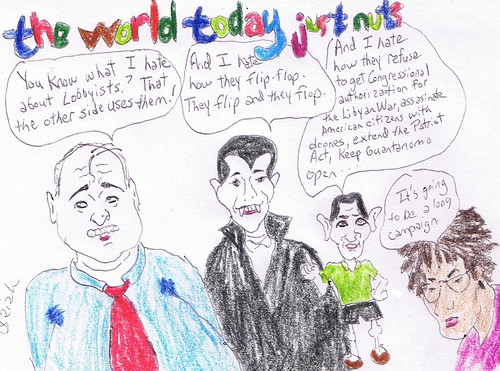
Above is Isaiah's The World Today Just Nuts "The Projection Message" and I love it.

A number of e-mails ask me why I didn't do a review this week? For a second, I was scratching my head. Then I remembered last week noting an album I wanted to review.

But I never came back and said, "It's . . . and I'll be reviewing it."

And the reason is, no one knows what it is. I thought C.I.'s friend, a music label head, had brought it over. I was describing the sound to him and telling him the cover was a drawing, not a photograph and that it was black and white and something like writing on a barn door. He said he would gladly send me copies of any of the albums he brought over but that he didn't bring anything like that.

So I have no idea what it was.

I went to C.I.'s stack of albums people drop off or send and it wasn't there which may mean someone grabbed it already.

I even asked C.I. and she told me she never looked at any of the covers and only heard them in the background but if it was important to me, she'd try to figure out what it was. I told her not to worry about it and forgot about it.

And then the e-mails came in today. I'm sorry. I'll see if there's something I can review for this weekend. If there is, I will say so here before the end of the week.

Happy Halloween!


Closing with C.I.'s "Iraq snapshot:"


Monday, October 31, 2011. Chaos and violence continue, one year ago today Our Lady of Salvation Church in Baghdad was attacked, US plans to use Kuwait as a stating area finally get serious attention from the US mainstream media, Nouri's screaming "Ba'athists!" again, and more.


Today Mark Thompson (Time magazine) observers, "Just like clockwork, the Administration lets the New York Times know that it's planning to leave a big force in Iraq's 'hood to keep an eye on troublemakers in Tehran, Baghdad and elsewhere." What's he referring to? Saturday (online, Sunday in print) Thom Shanker and Steven Lee Myers (New York Times) reported, "The Obama administration plans to bolster the American military presence in the Persian Gulf after it withdraws the remaining troops from Iraq this year, according to officials and diplomats. That repositioning could include new combat forces in Kuwait able to respond to a collapse of security in Iraq or a military confrontation with Iran." Good for them for noting it, but why didn't anyone note it two Fridays ago (or the Saturday after) when covering Barack's assertions about 'all' troops coming 'home'? As Shanker and Myers note, this has been known for "months." We noted it two Fridays ago. And while it has been known for months, it's funny how so many outlets ignored it that day (the day Barack gave his speech) and in all the days that followed. When criticism got too much for the administration, as Mark Thompson notes, they ran to the New York Times which only then 'found' the story. (See Third's editorial, "Editorial: US press doesn't give a damn about Iraq.") Dar Addustour reports that DC is in negotiations to boost US troops in Kuwait to use it as a staging platform as well beef up its presence in Saudi Arabia, Bahrain, Qatar and the UAE. Al Mada notes Kuwait has been discussed for months but now has "urgency" as the year ends and might end without the US securing 'trainers' in Iraq. The paper notes that this is among the alternative solutions being sought. Mark Thompson explains, "The betting here is that thousands of U.S. troops in Kuwait and elsewhere around the Gulf will keep the lid on any Iraq explosion -- at least until after next year's U.S. presidential eleciton."

It was so very nice of the New York Times to play dumb on this subject until the White House gave them approval to write about it. We're dropping back to a Third feature from November 4, 2007:

Presidential candidate and US Senator Barack Obama who is perceived as an 'anti-war' candidate by some announced that he would not commit to a withdrawal, declared that he was comfortable sending US troops back into Iraq after a withdrawal started and lacked clarity on exactly what a withdrawal under a President Obama would mean.

Declaring that "there are no good options in Iraq," Senator Obama went on to explain that even with his 16 month plan for withdrawal, he would continue to keep US troops in Iraq, agreeing that he would "leave behind residual force" even after what he is billing as a "troop withdrawal."
"Even something as simple as protecting our embassy is going to be dependent on what is the security environment in Baghdad. If there is some sense of security, then that means one level of force. If you continue to have significant sectarian conflict, that means another, but this is an area where Senator Clinton and I do have a significant contrast," Senator Obama offered contrasting himself with his chief opponent for the Democratic presidential nomination. "I do think it is important for us not only to protect our embassy, but also to engage in counter-terrorism activities. We've seen progress against AQI [Al Qaeda in Iraq], but they are a resilient group and there's the possibility that they might try to set up new bases. I think that we should have some strike capability. But that is a very narrow mission, that we get in the business of counter terrorism as opposed to counter insurgency and even on the training and logistics front, what I have said is, if we have not seen progress politically, then our training approach should be greatly circumscribed or eliminated."

The Senator insisted, "I want to be absolutely clear about this, because this has come up in a series of debates: I will remove all our combat troops, we will have troops there to protect our embassies and our civilian forces and we will engage in counter terrorism activities. How large that force is, whether it's located inside Iraq or as an over the horizon force is going to depend on what our military situation is."


That's pretty clear. We wrote it at Third using the transcript of the interview conducted by Michael Gordon and Jeff Zeleny. As we pointed out in the November 2, 2007 snapshot:

On the subject of Iran, Barack Obama appears on the front page of this morning's New York Times.
War pornographer Michael Gordon and Jeff Zeleny who lied in print (click here, here and here -- the paper finally retracted Zeleny's falsehood that should have never appeared) present a view of Barack Obama that's hardly pleasing. Among the many problems with the article is Obama as portrayed in the article -- and his campaign has issued no statement clarifying. The Times has the transcript online and from it, Barack Obama does mildly push the unproven claim that the Iranian government is supporting resistance in Iraq. Gordo's pushed that unproven claim repeatedly for over a year now. But Obama's remarks appear more of a reply and partial points in lengthy sentences -- not the sort of thing a functioning hard news reporter would lead with in an opening paragraph, touch on again in the third paragraph, in the fourth paragraph, in . . . But though this isn't the main emphasis of Obama's statements (at any time -- to be clear, when it pops up, it is a fleeting statement in an overly long, multi-sentenced paragraphs), it does go to the fact that Obama is once again reinforcing unproven claims of the right wing. In the transcript, he comes off as obsessed with Hillary Clinton. After her, he attempts to get a few jabs in at John Edwards and one in at Bill Richardson. Here is what real reporters should have made the lede of the front page: "Presidential candidate and US Senator Barack Obama who is perceived as an 'anti-war' candidate by some announced that he would not commit to a withdrawal, declared that he was comfortable sending US troops back into Iraq after a withdrawal started and lacked clarity on exactly what a withdrawal under a President Obama would mean." That is what the transcript reveals. Gordo really needs to let go of his blood lust for war with Iran.


The New York Times could have published a story on this issue in 2007 but didn't. They did publish an expurgated transcript to the interview (that's what we used as source material for the piece at Third -- and all quotes in the Third article were from that transcript). It's a shame scribes for the Times are unaware what's in their own archives but it's a greater shame that when they had a real story in 2007, they pulled their punches and refused to inform readers the story they really had about 'anti-war' candidate Barack.

Simon Tisdall (Guardian) ponders the staging area plan, "Exactly what the Pentagon might do with its expanded Kuwait and Gulf-based forces, should Iraq implode again at some future date or become destabilised by the unrest in Syria, is unclear. A second invasion would not command much public support, to put it mildly. If, on the other hand, the new American deployments are primarily about containing, intimidating or potentially attacking Iran, the emerging picture becomes more comprehensible, although not more reassuring." Lara Jakes (AP) reports Ali Akbar Salehi, Foreign Minister of Iran, sees this as an attempt "to meddle" in Iraq's "internal affairs." Jakes notes US Secretary of Defense Leon Panetta's remarks that approximately 40,000 US troops will be stationed in the region. Coming home? Leaving the region? Another blow to Barack's big 'withdrawal' speech.


"The crackdown on ex-Ba'athists started earlier this month," Kelly McEvers observed today on Morning Edition (NPR -- link is audio and text). And the crackdown sees a response from the provinces. Thursday, Salahuddin Province's council voted to go semi-autonomous. Iraq has 18 provinces. Three make up the semi-autonomous Kurdish Regional Government. Salahuddin Province's vote was to move towards that sort of relationship. (A form of federalism once advocated by Joe Biden when he was in the Senate.) The next step would be a referendum (that Nouri al-Maliki's government out of Baghdad would have to pay for) and, were the popular vote to back up the council and were the rules followed (always a big if with Nouri as prime minister), Baghdad would control only 14 provinces (of the 18). Though some outside the province are attempting to dispute that the council had the right to vote on the issue, the measure's apparently very positive with the residents (which would explain the 20 to zero vote on the council -- eight members were not present for the vote). Over the weekend, Al Mada reported that people turned out throughout Salahuddin Province (including in Tirkrit, Samarra, Dhuluyia and Sharqat) on Friday to take to the streets after morning prayers and demonstrate in support of the council's vote. Ahmed Abdul-Jabbar Karim, Deputy Governor of the Province, is quoted stating that this decision is something that the officials will not retreat from and that it was backed by the voice of the people. Various State of Law members are quoted offering varying reasons why the vote was wrong or doesn't matter. State of Law is Nouri's political slate. Friday, residents of Anbar Province took to the streets advocating for their province to follow Salahuddin's lead.


Saturday Nouri al-Maliki issued his own response. What does Nouri do when he's unhappy? Accuse them of being Ba'athists. So it's no surprise that Ahmed Rasheed (Reuters) quoted a statement from Nouri declaring, "The Baath Party aims to use Salahuddin as a safe haven for Baathists and this will not happen thanks to the awareness of people in the province. Federalism is a constitutional issue and Salahuddin provincial council has no right to decide this issue."


Nouri, of course, sees Ba'athists everywhere. Al Mada noted that the campaign against so-called Ba'athists allegedly plotting a coup continues with at least 560 Iraqis arrested by his forces, on his orders in the last week. The article notes Ayad Allawi (leader of Iraqiya) has called the arrests illegal while MP Mahmoud Othman has stated these arrests are not helping to build cohesion or a strong government. Rebecca Santana (AP) noted 615 arrests and observed, "Sunnis say that Baghdad sometimes uses crackdowns on Baathists as a tool to exert political pressure." Al Mada states Nouri's threatening to cut off water to the province. Laith Hammoudi (McClatchy Newspapers) explained, "Salahuddin officials said the timing of the vote was spurred by the recent firing of more than 100 professors at Tikrit University for alleged Baath Party connections, and by a nationwide roundup of Baathists in the course of this week." Hammoudi also counters Nouri's claims that he and the Parliament must okay any decision by a province to become semi-autonomous, "In actual fact, article 119 of the Iraqi constitution requires only that a referendum be held in a province following a request for regional status by one-third of the members of the provincial council, or one-tenth of the population." Aswat al-Iraq adds, "The chairman of the Higher Electoral Commission declared that any requests to form a region should be submitted to the Cabinet, underlining that some media organs are reporting inaccurate information with regards to this matter." Who is right? According to the Constitution, Laith Hammoudi's report is correct. From the Iraqi Constitution:


Article 119:

One or more governorates shall have the right to organize into a region based on a request to be voted on in a referendum submitted in one of the following two methods:
First: A request by one-third of the council members of each governorate intending to form a region.
Second: A request by one-tenth of the voters in each of the governorates intending to form a region.


That's the Constitution on the matter, there are no articles or sub-clauses on the issue. Per the Constitution, Salahuddin Province has already met step one. Step two shouldn't be too hard since only 10% of the voters are required to sign off on the request.

Aswat al-Iraq reports, "A conference on federalism was convened today in Basra, aiming to press the central government to expedite the formalities to declare the province a region. Kareem al-Jabiri, an organizer, said that the people of Basra wanted the federal option in the province, whose people suffer of negligence despite its enormous resources."


An Iraqi woman explained to NPR how the crackdown works, "They searched our houses, tossed our furniture. Some of the men on the arrest list are more than 70 years old. You think they're planning to overthrow the country?"


Dar Addustour notes that Parliament's Committee of the Regions is exploring amendments to the the Constitution's Article 119. Faraj al-Haidari, of the Independent High Electoral Committee, continues to insist that there's a governing law that requires provinces to seek permission from the Cabinet. There is no such law in the Constitution. But this may be an indication that when Nouri attempted his seizure of the IHEC last January, he had managed to managed to muzzle them. Al Mada reports Nouri told Salahuddin officials yesterday that their move towards semi-autonomy was destroying national unity. (Saturday he was screaming they were Ba'athists so his latest whine could be seen as an improvement.) Alsumaria TV notes Salhauddin Province's Sabhan Mulla Jiyad responding, "Maliki's assertion that the ministerial council will refuse to declare Salahuddin as an autonomous region is strange and possibly rushed. The Constitution grants us the right to establish a region." In related news, Dar Addustour reports Iraqi President Jalal Talabani that the borders of some governorates need to be changed/fixed. He most likely is referring to Dahuk, Erbil and Sulaymaniyah which are part of the KRG.

Reuters notes a Khan Bani Saad home invasion that resulted in the death of 1 Sahwa and his brother, and, dropping back to Sunday for the rest, an attack on a Baquba military checkpoint in which 1 Iraqi soldier was killed and when other soldiers responded a bomb went off claiming the lives of 2, and an attack on the Bakuba Patriotic Union of Kurdistan left two guards injured.
And on any hopes for democracy? Don't bet your savings just yet. Mvelase Peppetta (Memeburn) reports alarm that the government of Syria has "internaet censorship equipment." It's illegal, according to US law, for it to have this Blue Coat Systems 'filter.' How did it get it? Apparently from Iraq. The US government okayed the sale of web censorship equipment to Iraq. Did the US government bother to run that past either the Iraqi people or the American people? No. Nor did it publicize the sale.
A year ago, Our Lady of Salvation Church in Baghdad was assaulted. Aidan Clay (International Christian Concern) reports:


Today marks the anniversary of last year's four-hour siege on a Syriac Catholic church in Baghdad that ended with al-Qaida linked militants massacring 58 worshippers. The attack was the worst against Iraqi Christians since the U.S.-led invasion in 2003 and enticed many of the already dwindling Christian population in Baghdad to leave the city permanently.
"We've had enough now. Leaving Iraq has become a must," Jamal Habo Korges, a Christian mechanic and father of three, told the United Nation's humanitarian news outlet IRIN. "We've been suffering since 2003 and we can't take it anymore. The latest carnage is the final warning."
Father Douglas al-Bazi, who was kidnapped and tortured four years earlier, told The Christian Science Monitor after the attack that his Chaldean parish in Baghdad had dwindled from 2,500 families in the 1990s to less than 300.
"Of course I cannot ask anyone to stay," he said. "Everyone tells me 'Father, I am sorry - I will leave.' I tell them, 'Don't be sorry, okay? No one is pushing you to die, what's the benefit of dying?'"
Iraq's Christian population prior to 2003 was estimated at one million or more. Today, fewer than 400,000 remain. Those who leave either become internally displaced - most toing to the less violent Kurdish north - or flee the country altogether.


NOW Lebanon reports, "Maronite Patriarch Bechara Boutros al-Rai on Monday headed to Iraq for an official visit." Lebanon's Daily Star adds he'll be performing the Mass at the Church on the first anniversary of the attack:


The delegation, scheduled to leave Beirut airport shortly before midday Monday, includes Bishop Camille Zaidan and Environment Minister Nazem al-Khoury, on behalf of President Michel Sleiman.

[. . .]
Rai is expected to hold talks with a number of Iraqi officials before his return home Wednesday evening.


In the year since the attack, Nouri al-Maliki's accomplished nothing to help Iraq's Christian population. Not at all surprising when the official government response in the week after the attack was to turn around and attack France which offered medical care to the wounded. France opened the door and took the wounded in, airlifted them in at no cost to Iraq, provided them with medical treatment at no cost to anyone and the response to that humanitarian gesture was for Nouri's government to condemn France's kindness.

Alan Holdren (Catholic News Agency) notes the dead from the attack included "three children, two priests and a pregnant woman" and that they were remembered today at Rome's Santa Maria in Mass. Father Mukhlis Shisha remembers, "Father Thair Sa'adallah was just beginning his homily after having read the Gospel. When he saw the terrorists enter, he took the Gospel in hand and held it up, saying, 'In the name of the Gospel, leave them and take me. Me for them!'" He also remembers Father Wasseem Sabb'ieh was able to get two families out of the church and, "Before he closed the door, one of the people he helped said to him, 'Father, leave them and come with us and you will be saved.' He answered, 'I won't leave them like this' and he locked the door." Amelie Herenstein (AFP) reports Iraqi Christians ("hundreds") were at the Church today including Nofal Sabah who has a brother who "was wounded and was being treated in Lyon, Franche, while another 'has psychological problems because he saw everything'." He reports his family is attempting to leave Iraq but are unable to get visas. (The AFP article has an uncredited photo of women in the church lighting candles.)


In the Kurdistan Regional Government, where many Iraqi Christians have resettled, you have efforts between the KRG and various religious bodies to build churches -- a Baptist Church, a Catholic Church, etc. The KRG has been much more responsive to the issue of religious persecution than has Iraq. From the October 21st snapshot:

John Pontifex (Scottish Catholic Observer) reported earlier this month on the increase in Ankawa's Christian population noting that "1500 have arrived within the last year alone" and that "Christians arriving in Ankawa have fled not only from the Iraqi capital but from all across the country -- Mosul in the north, Kirkuk in the north-east, and even Basra, hundreds of miles away in the extreme south." Rob Kerby (Belief Net) notes that the Kurdistan Regional Government is offering Iraqi Christians "plots of land as well as $10,000 per family to settle in the village of Se Ganian, whose population was murdered by poison gas during Saddam's campaign against the Kurds." Joni B. Hannigan (Florida Baptist Witness via Asia News) adds, "The Grace Baptist Cultural Center in Dohuk [Province, in the Kurdistan Regional Government] -- a partnership between Iraqi, Jordan, Brazilian, American and Lebanese Baptists -- is being built with the blessing of Iraqi Kurdistan's Regional Government, who donated the $2 million properly. The land is in the same village, Simele, where in 1933 an estimated 6,000 Assyrians and Chaldeans were slaughtered by the Iraqi government following the withdrawal of British troops from the region after a treaty granting Iraq's independence in 1930."


Where did Iraq's Christian population go? Over 1.5 million before the start of the war, down to less than 500,000 today. Internally, it shifted from throughout Iraq to the KRG. But many more elected to leave the country becoming part of Iraq's refugee population -- the largest refugee population in the region since 1948. If you think the US has opened the doors, you may be remembering campaign promises from Barack. Those promises were long ago set aside and no one in the press appears to care. There were target goals for admitting Iraqis to this country. They are fiscal year targets. October 1st the new fiscal year started. No one pressed the White House or State Dept for those figures (they haven't been pressed since the fall of 2009). No one notes that they don't meet the established numbers.


It's not often James Dao comes off foolish but it does happen. It happened today at the New York Times' blog when Dao elected to write about a white wash 'study' on burn pits which finds they aren't at all responsible for breathing problems or other problems. Dao foolishly writes that, "The report by the Institute of Medicine, an independent policy organization, [. . .]" That may be the but "the Institute of Medicine" did not write the report -- individuals did. For example, John R. Balmes who, as the end notes to the report (Appendix A) explain, has his research "funded by the U.S. Centers for Disease Control and Prevention." Or David J. Tollerud 'forgets' to note that's he's working on a Jefferson County children's study currently -- "the largest government-funded long-term study." It's funny how he 'forgot' that. Any reporter should grasp that there are rewards to be grabbed in scientific America by insisting the burn pits weren't harmful and that those on the government dole would have incentive to be less than forthcoming. (And, yes, we can continue the government funding connections with nearly everyone listed who took part in the 'study.' Most, like Tollerud, 'forget' to note their government funding connections -- disclosures of conflicts of interest apparently having gone out of fashion.)

Staying with the topic of burn pits. Burn pits have resulted in many service members and contractors being exposed to chemicals and toxins that have seriously harmed their bodies. The Senate Democratic Policy Committee held hearings on this issue when Byron Dorgan was the Chair of the DPC. Click here to go to the hearing archives page. A registry is something that Leroy and Rosita Lopez-Torres are now working on. It should be noted that were it not for US Senator Jim Webb, the nation would already have such a registery. In October 21, 2009, then-Senator Evan Bayh appeared before the US Senate Veterans Affairs Committee explaining the bill for a registry he was sponsoring, advocating for it.


I am here today to testify about a tragedy that took place in 2003 on the outskirts of Basra in Iraq. I am here on behalf of Lt Col James Gentry and the brave men and women who served under his command in the First Battalion, 152nd Infantry of the Indiana National Guard. I spoke with Lt Col Gentry by phone just this last week. Unfortunately, he is at home with his wife, Luanne, waging a vliant fight against terminal cancer. The Lt Col was a healthy man when he left for Iraq. Today, he is fighting for his life. Tragically, many of his men are facing their own bleak prognosis as a result of their exposure to sodium dichromate, one of the most lethal carcinogens in existence. The chemical is used as an anti-corrosive for pipes. It was strewn all over the water treatment facility guarded by the 152nd Infantry. More than 600 soldiers from Indiana, Oregon, West Virginia and South Carolina were exposed. One Indiana Guardsman has already died from lung disease and the Army has classified it as a service-related death. Dozens of the others have come forward with a range of serious-respiratory symptoms. [. . .] Mr. Chairman, today I would like to tell this Committee about S1779. It is legislation that I have written to ensure that we provide full and timely medical care to soldiers exposed to hazardous chemicals during wartime military service like those on the outskirts of Basra. The Health Care for Veterans Exposed to Chemical Hazards Act of 2009 is bipartisan legislation that has already been co-sponsored by Senators Lugar, Dorgan, Rockefeller, Byrd, Wyden and Merkley. With a CBO score of just $10 million, it is a bill with a modest cost but a critical objective: To enusre that we do right by America's soldiers exposed to toxic chemicals while defending our country. This bill is modeled after similar legislation that Congress approved in 1978 following the Agent Orange exposure in the Vietnam conflict.


An important bill but one that never got out of Committee. Iraq War veteran Leroy Torres and his wife Rosie Torres have continued to battle on behalf of veterans exposed to burn pits and contiuned to educate the nation on the issue. The Torres have a website entitled BURNPITS 360. They are also on Facebook. It's a personal issue, Capt Leroy Torres was exposed to the burn pit on Balad Airbase. They note that a member of Congress is working on the issue.


From: The Honorable W. Todd Akin
Dear Colleague;
Please sign on to be an original cosponsor to legislation that is important to our veterans.  Numerous veterans have suffered serious health problems after exposure to open burn pits in Iraq and Afghanistan. This legislation will establish a registry, similar to the Agent Orange Registry and the Gulf War Syndrome Registry.  This is the first step toward providing better care for veterans who have been affected by open burn pits.
This legislation is already supported by the Veterans of Foreign Wars (VFW), American Veterans (AMVETS) and the Association of the United States Navy (AUSN).  And the issue of burn pits was recently reported on in the October 24th edition of USA Today (which can be found here) http://www.usatoday.com/news/military/story/2011-10-24/gulf-war-illness/50897804/1
This bill will also be introduced in a bipartisan/bicameral fashion with companion legislation being introduced by Senator Tom Udall (D-NM)
This bill is scheduled to be introduced on November 3rd, so please contact my office soon to become an original cosponsor.
Sincerely,
W. Todd Akin
Member of Congress


Rep. W. Todd Akin

Open Burn Pit Registry Act of 2011

Department of Veterans Affairs

Based on recent accounts of health maladies of veterans returning from Iraq and Afghanistan and a possible link to toxic fumes released in open burn pits it has become necessary to voluntarily track and account for these individuals. 
This registry will ensure that members of the Armed Forces who may have been exposed to toxic chemicals and fumes while serving overseas can be better informed regarding exposure and possible effects. This legislation
is modeled after legislation that created the Agent Orange Registry and the Gulf War Syndrome Registry.
As drafted, the purpose of the
Burn Pit Registry  (bill text found here) is to:
• Establish and maintain an open burn pit registry for those individuals who
may have been exposed during their military service;
• Include information in this registry that the Secretary of the VA determines applicable to possible health effects of this exposure;
• Develop a public information campaign to inform individuals about the
registry;
• Periodically notify members of the registry of significant developments associated with burn pit exposure.
In order to ensure that the Veterans Administration conducts the registry in the most effective manner, the legislation:
• Requires an assessment and report to Congress by an independent
scientific organization;
• This report contains an assessment of the effectiveness of the Secretary
of the VA to collect and maintain information as well as recommendations
to improve the collection and maintenance of this information;
• The report will also include recommendations regarding the most effective
means of addressing medical needs due to exposure;
• This report will be due to Congress no later than 18 months after the date
which the registry is established.
• CBO states that this registry would cost $2 million over 5 years
(2012-2016)
We learned from this country's issues with Agent Orange that the need to get
ahead of this issue is of paramount importance. 
The establishment of a burn pit registry will help the VA determine not only to what extent the ramifications of burn pits may have on service members but can also be of great use in information dissemination. 
If you have any questions please contact Rep. Akin's office at 5-2561 and speak
Visit the e-Dear Colleague Service to manage your subscription to the available
Issue and Party list(s).


Friday, October 28, 2011

Music

I hope you read all the posts last night:

, Cedric's "Dickless Alter's in love" and Wally's "THIS JUST IN! DICKLESS ALTER!" went up last night and others posting last night followed Rebecca and Betty's lead from earlier in the week ("scream" and "Halloween") by doing posts on scary movies in anticipation of Halloween on Monday. Isaiah's "The Unity Campaign" (The Birds), Ann's "4 men and Psycho," Ruth's "The Haunting," Marcia's "The Bad Seed," Stan's "Aliens," Kat's "Mothra vs. Godzilla," Trina's "Horror of Dracula," Mike's "The Omen," Betty's "Brian De Palma" and Rebecca's "empire of the ants."

Now for an e-mail about music. Carolyn e-mailed to say that she agreed that the male crop was a bunch of whiny little boys dishing on love and unicorns as if they were 11-year-old girls. She wondered what I thought of Maroon 5's "Moves Like Jagger"?

Well I didn't care much for it at first to be honest. C.I said it was infectious the first time we all heard it and also praised the "take me by the tongue and I'll know you." And most of it sailed over my head at first. But it does have an appeal. (I have also seen the video and am confused why the woman is beating up Adam and also why she's doing so in a men's room?) I always responded well to Christina Aguilera's vocal. I still think that's the best feature of the song.

Britney can't sing and never could but this new song "Criminal" is a rip off of a song. I can't figure it out yet. I think it's sung by a man who's British and in my head I hear "animal," "criminal," in some sort of Depech Mode type delivery. (The song that's ripped off has that delivery.)


Closing with C.I.'s "Iraq snapshot:"


Friday, October 28, 2011. Chaos and violence continue, two more journalists are arrested in Iraq, Iraq's LGBT community in the KRG is targeted, US senators call for the White House to detail their plans for Iraq, and more.
Adam Kokesh: But first, a little background on Iraq where the last accepted agreement for US military withdrawal goes back to the Bush administration because Bush decided to pretend that Iraq was a sovereign country actually going back to when I was in Falluja, there was that hand over of power on June 28, 2004 when Paul Bremer, head of the Coaltion Provisional Authority -- in effect, ruler of the 51st state of Iraq, got tired of being in charge of what could only be described as a clusterf**k and symbolicallly handed over power to Prime Minister [Ayad] Allawi who, by the way, was a former Ba'ath Party member who had been living in exile for 30 years -- perfect qualifications to be an obedient puppet ruler and the "first official head of state since Saddam Hussein." Anyway because of that, there had to be a standard SOFA, or Status Of Forces Agreement, or as it is officially titled in this case, Agreement Between The United States of America and The Republic Of Iraq on the Withdrawal of United States Forces From Iraq and the Organization of their Activities During Their Temporary Presence in Iraq." It stipulated that US military forces would be withdrawn from the cities on June 30, 2009 and that all remaining US military personnel -- except for those necessary for embassy security -- would be withdrawn by December 31, 2011. So that's how it would have gone had, say, George W. Bush gotten a third term or John McCain was elected. But we elected a Nobel Peace peace prize winner, didn't we? Mr. President, reminds us if you will please, what did you say about Iraq when you were running for president?
Barack Obama, October 27, 2007: I will promise you this, that if we have not gotten our troops out by the time I am president, it is the first thing I will do, I will get our troops home. I will bring an end to this war. You can take that to the bank.
Adam Kokesh: Now if I recall, Obama did kind of follow the Bush plan by stepping down first the occupation of the cities, right? Well here he is taking credit for it anyway.
Barack Obama: I want to say a few words about an important milestone that we've reached in Iraq. Today American troops have transferred control of all Iraqi cities and towns to Iraq's government and security forces. And this --
Adam Kokesh: Now when was that? When was that? Oh, yeah, June 30, 2009. Oh, well, then, he's got to at least have plans to get the remaining 20 to 30,000 or so troops out before the Bush timeline if only to save some face and keep them from demanding the peace prize back, right?
Barack Obama: As a candidate for president I pledged to bring the war in Iraq to a responsible end for the sake of our national security and to strengthen American leadership around the world. After taking office, I announced a new strategy that would end our combat mission in Iraq and remove all of our troops by the end of 2011. A few hours ago, I spoke with Iraqi Prime Minister Maliki. I reaffirmed that the United States keeps its commitments. He spoke of the determination of the Iraqi people to forge their own future. We are in full agreement about how to move forward. So today I can report that as promised the rest of our troops in Iraq will come home by the end of the year.
Adam Kokesh: Nope. It turns out that Obama thinks you're that stupid. If he makes a great speech about taking credit for ending the Iraq War, you'll all just grovel at what a great commander in chief he is and forget all about this.
Barack Obama: It is the first thing I will do, I will get our troops home, we will bring an end to this war.
Adam Kokesh: But it gets worse. What if I told you that if Obama had had his way, we would have troops in Iraq even longer? Yeah. Get this, this is the measure of how dumb he thinks you are. He announced the 'withdrawal' on the day that his plans for keeping troops there longer fell through when the Iraqi government rejected his request to allow troops to stay there with immunity from prosecution under Iraqi law. So, in other words, he tried to break his promise but took credit for keeping it when he failed to break it.
Adam Kokesh's Adam vs the Man is posting new episodes at his YouTube account. I'll add that to our permalinks this weekend. Repeating, Adam Kokesh's Adam vs the Man is posting new episodes at his YouTube account. Again, Adam Kokesh is an Iraq War veteran and we're going to stay with the topic of veterans for a bit longer.
Burn pits have resulted in many service members and contractors being exposed to chemicals and toxins that have seriously harmed their bodies. The Senate Democratic Policy Committee held hearings on this issue when Byron Dorgan was the Chair of the DPC. Click here to go to the hearing archives page. A registry is something that Leroy and Rosita Lopez-Torres are now working on. It should be noted that were it not for US Senator Jim Webb, the nation would already have such a registery. In October of 2009, then-Senator Evan Bayh appeared before the US Senate Veterans Affairs Committee explaining the bill for a registry he was sponsoring, advocating for it.
I am here today to testify about a tragedy that took place in 2003 on the outskirts of Basra in Iraq. I am here on behalf of Lt Col James Gentry and the brave men and women who served under his command in the First Battalion, 152nd Infantry of the Indiana National Guard. I spoke with Lt Col Gentry by phone just this last week. Unfortunately, he is at home with his wife, Luanne, waging a vliant fight against terminal cancer. The Lt Col was a healthy man when he left for Iraq. Today, he is fighting for his life. Tragically, many of his men are facing their own bleak prognosis as a result of their exposure to sodium dichromate, one of the most lethal carcinogens in existence. The chemical is used as an anti-corrosive for pipes. It was strewn all over the water treatment facility guarded by the 152nd Infantry. More than 600 soldiers from Indiana, Oregon, West Virginia and South Carolina were exposed. One Indiana Guardsman has already died from lung disease and the Army has classified it as a service-related death. Dozens of the others have come forward with a range of serious-respiratory symptoms. [. . .] Mr. Chairman, today I would like to tell this Committee about S1779. It is legislation that I have written to ensure that we provide full and timely medical care to soldiers exposed to hazardous chemicals during wartime military service like those on the outskirts of Basra. The Health Care for Veterans Exposed to Chemical Hazards Act of 2009 is bipartisan legislation that has already been co-sponsored by Senators Lugar, Dorgan, Rockefeller, Byrd, Wyden and Merkley. With a CBO score of just $10 million, it is a bill with a modest cost but a critical objective: To enusre that we do right by America's soldiers exposed to toxic chemicals while defending our country. This bill is modeled after similar legislation that Congress approved in 1978 following the Agent Orange exposure in the Vietnam conflict.
In important bill but one that never got out of Committee. Iraq War veteran Leroy Torres and his wife Rosie Torres have continued to battle on behalf of veterans exposed to burn pits and contiuned to educate the nation on the issue. The Torres have a website entitled BURNPITS 360. They are also on Facebook. It's a personal issue, Capt Leroy Torres was exposed to the burn pit on Balad Airbase. They note that a member of Congress is working on the issue.
From: The Honorable W. Todd Akin
Dear Colleague;
Please sign on to be an original cosponsor to legislation that is important to our veterans.  Numerous veterans have suffered serious health problems after exposure to open burn pits in Iraq and Afghanistan. This legislation will establish a registry, similar to the Agent Orange Registry and the Gulf War Syndrome Registry.  This is the first step toward providing better care for veterans who have been affected by open burn pits.
This legislation is already supported by the Veterans of Foreign Wars (VFW), American Veterans (AMVETS) and the Association of the United States Navy (AUSN).  And the issue of burn pits was recently reported on in the October 24th edition of USA Today (which can be found here) http://www.usatoday.com/news/military/story/2011-10-24/gulf-war-illness/50897804/1
This bill will also be introduced in a bipartisan/bicameral fashion with companion legislation being introduced by Senator Tom Udall (D-NM)
This bill is scheduled to be introduced on November 3rd, so please contact my office soon to become an original cosponsor.
Sincerely,
W. Todd Akin
Member of Congress


Rep. W. Todd Akin

Open Burn Pit Registry Act of 2011

Department of Veterans Affairs

Based on recent accounts of health maladies of veterans returning from Iraq and Afghanistan and a possible link to toxic fumes released in open burn pits it has become necessary to voluntarily track and account for these individuals. 
This registry will ensure that members of the Armed Forces who may have been exposed to toxic chemicals and fumes while serving overseas can be better informed regarding exposure and possible effects. This legislation
is modeled after legislation that created the Agent Orange Registry and the Gulf War Syndrome Registry.
As drafted, the purpose of the
Burn Pit Registry  (bill text found here) is to:
• Establish and maintain an open burn pit registry for those individuals who
may have been exposed during their military service;
• Include information in this registry that the Secretary of the VA determines applicable to possible health effects of this exposure;
• Develop a public information campaign to inform individuals about the
registry;
• Periodically notify members of the registry of significant developments associated with burn pit exposure.
In order to ensure that the Veterans Administration conducts the registry in the most effective manner, the legislation:
• Requires an assessment and report to Congress by an independent
scientific organization;
• This report contains an assessment of the effectiveness of the Secretary
of the VA to collect and maintain information as well as recommendations
to improve the collection and maintenance of this information;
• The report will also include recommendations regarding the most effective
means of addressing medical needs due to exposure;
• This report will be due to Congress no later than 18 months after the date
which the registry is established.
• CBO states that this registry would cost $2 million over 5 years
(2012-2016)
We learned from this country's issues with Agent Orange that the need to get
ahead of this issue is of paramount importance. 
The establishment of a burn pit registry will help the VA determine not only to what extent the ramifications of burn pits may have on service members but can also be of great use in information dissemination. 
If you have any questions please contact Rep. Akin's office at 5-2561 and speak
Visit the e-Dear Colleague Service to manage your subscription to the available
Issue and Party list(s).
Last Friday, Barack gave his big speech and Pfc Steve Shapiro died serving in the Iraq War. His death is one of three deaths in the eight days. DoD announced today: "The Department of Defense announced today the death of a soldier who was supporting Operation New Dawn. Sgt. 1st Class David G. Robinson, 28, of Winthrop Harbor, Ill., died Oct. 25 in Riyadh, Saudi Arabia. He was assigned to the U.S. Army Support Activity, Riyadh, Saudi Arabia. For more information the media may contact Maj. Charlie Barrett at Third Army/U.S. Army Central public affairs at 803-885-8875 or charlie.barrett@arcent.army.mil." And they announced Tuesday, "The Department of Defense announced today the death of a soldier who was supporting Operation New Dawn. Capt. Shawn P. T. Charles, 40, of Hickory, N.C., died Oct. 23 in San Antonio, Texas, from a non-combat illness. He was assigned to the 2nd Battalion, 8th Cavalry Regiment, 1st Brigade Combat Team, 1st Cavalry Division, Fort Hood, Texas. For more information the media may contact the Fort Hood public affairs office at 254-287-9993, via the internet at http://www.forthoodpresscenter.com , or email query@forthoodpresscenter.com ." The deaths brought the official Pentagon count of US military personnel who have died in the Iraq War to 4485.
Meanwhile, Charles Hoskinson (POLITICO) reports independent Joe Lieberman has joined with 10 other senators (all Republicans) who serve on the Senate Armed Services Committee to call for a hearing on the Iraq withdrawal:

In a letter released Thursday, the senators said the administration has sent conflicting signals on whether any troops would remain in Iraq. While Obama's announcement "apparently ends negotiations between the United States and the Government of Iraq on a long-term training and stability force of sufficient size to protect both U.S. and Iraqi enduring national security interests," the letter noted that Defense Secretary Leon Panetta has also said the U.S. will continue talks with the Iraqis.

That section of the letter reads:
We note that on the same day the President made his announcement Secretary Panetta stated that the United States could negotiate with Iraq about future training assistance. We therefore also need to understand how any proposed number of U.S. forces involved with the training of Iraqi security personnel after December 31 would be able to effectively accomplish that crucial mission without legal immunity and other protections routinely extended to U.S. military personnel under status of forces agreements world-wide. Given the President's announcement that all U.S. military forces will be withdrawn by the end of the year, our committee should take the lead on establishing the public record on the Administration's plan and ensuring Congress's rigorous oversight of this consequential decision.

If the administration has nothing to hide, if the Democrats on the Committee feel that the administration has nothing to hide, I'm sure they'll schedule a hearing. And if there's no hearing scheduled, if the Democrats ignore the request, that will say a great deal as well. Leo Shane III (Stars and Stripes) observes, "No hearings have been scheduled on the issue so far."
While it is true that the administration suffered a diplomatic rebuff on Oct. 21 when the Iraqi government refused to grant immunity from Iraqi law to U.S. military forces, the U.S. is working feverishly to continue the war through the use of military contractors, i.e., mercenary soldiers.
Obama's announcement was greeted with joy on the streets of Baghdad, where people want nothing more than to be out from under the repressive U.S. occupation. But many have expressed a deep skepticism about U.S. intentions. "I believe that the full withdrawal will be only in the media but there must be secret deals with the Americans to keep some American forces or members of the American intelligence," said Raja Jaidr, a resident of eastern Baghdad. "They won't leave." (Associated Press, Oct. 22)
These suspicions are well-founded. Despite assertions by the U.S. government that its military mission is complete, the fact is that their "mission" has been an almost complete disaster.
Since the invasion in 2003, 1 million members of the U.S. military have been deployed to Iraq, of whom 4,482 have been killed and 32,200 wounded. Hundreds of billions of dollars have been expended while former President George Bush's promise to the ruling elites that Iraqi oil would more than pay for the war has gone unrealized.
For the Iraqi people the war has meant the almost total destruction of what was once one of the most progressive and prosperous countries of the Middle East. The war -- and the economic sanctions which preceded it -- killed millions, devastated the infrastructure and pushed back gains which had previously been made in the areas of women's rights and religious tolerance.
The White House has indicated that an arrangement may yet be worked out to permit some American trainers and experts to remain, perhaps as civilians or contractors. Shi'ite cleric Muqtada al-Sadr, a staunch opponent of the U.S. occupation, has suggested Iraq should employ trainers for its armed forces from other countries, but this is impractical for a country using American arms and planes.
Regardless, the White House is increasing the number of State Department employees in Iraq from 8,000 to an almost unbelievable 16,000, mostly stationed at the elephantine new embassy in Baghdad's Green Zone quasi-military enclave, in new American consulates in other cities, and in top "advisory" positions in many of the of the regime's ministries, particularly the oil ministry. Half the State Department personnel, 8,000 people, will handle "security" duties, joined by some 5,000 new private "security contractors."
Thus, at minimum the U.S. will possess 13,000 of its own armed "security" forces, and there's still a possibility Baghdad and Washington will work out an arrangement for adding a limited number of "non-combat" military trainers, openly or by other means.

Al Mada notes that Parliament will hold an emergency session November 3rd. This is the one that Moqtada al-Sadr called for over the weekend. Among the things to be discussed? The status of talks with the US regarding 'trainers.' In addition, Al Mada notes published accounts stating the CIA plans to operate out of base in Adana (in Turkey) from which they will operate drones.

Gavriel Queenann (Arutz Sheva) adds, "The Obama administration wants to provide two currently in-service US Marine Corps attack helicopters, Reuters reported Friday. The highly unorthodox move is being considered as Ankara seeks to exact revenge for a major attack by Kurdish separatists." Today's Zaman notes, "US Assistant Secretary of Defense for International Security Affairs Alexander Vershbow led an interagency delegation to Ankara on Thursday to discuss ways to improve US-Turkey cooperation against the terrorist Kurdistan Workers' Party (PKK), a statement from the US Embassy in Ankara said." Al Mada reports that the Turkish Minister of Defense, Ahmet Davutoglu, has declared that the latest assault on northern Iraq will cease shortly but more will be coming. Today's Zaman notes that Massoud Barzani, President of the KRG, is supposed to meet up with Recep Tayyip Erdogan, Prime Minister of Turkey, in the middle of next month.
Staying on the topic of violence. Yesterday's snapshot noted: "Reuters notes 2 Baghdad bombings have claimed 18 lives and at least thirty-eight are injured." This morning, AP reports that the death toll has risen to 32. Salam Faraj (AFP) reports 3 family members ("Hussein Mutlak, his brother and his cousin") shot dead in Saadiyah with Hussein Mutlak's wife left wounded. DPA notes a Mosul home invasion in which 4 family members were killed and a Baquba home invasion which left 3 family members dead. In addition, Aswat al-Iraq reports that Iraqi journalist Ammar Saleh and US journalist Kameran Gharib were arrested Thursday "for having photography without official permission". Tuesday came news that US journalist Daniel Smith had been arrested. After the news broke, Nouri al-Maliki quickly moved to release him.
In Iraq, the LGBT community has often been targeted. That's been most common in the Baghdad area; however, not exclusive to just Baghdad. Now Michael Luongo (Chelsea Now) reports on a new wave in the Kurdistan Regional Government:

As America prepares to leave Iraq, after an occupation dating back to 2003, a new wave of gay suppression might be under way. According to Ali Hili, chair of Iraqi LGBT, a London-based human rights group aiding queer Iraqis, police recently raided a gay party in Kalar, a small town in Kurdistan, in the north of Iraq, arresting 25 men.
According to a news release from the group, "The men were attending a party at a private house on 15th of September when the police raided the address. After fierce protests against the raid by human rights organisations, including Amnesty International, all but three men have since been released from the city's Garmyan Prison. Several of those detained claim to have been subject to violent beatings while being held in solitary confinement. The authorities in Kalar refuse to disclose the whereabouts of those still in detention, the conditions in which they are held, or the charges they face."
Kurdistan, a semi-autonomous region of Iraq only loosely under central government control since 1991, has not seen the intense violence of Baghdad and the southern portion of the country, where an estimated 700 or more gay men have been killed by religious insurgents, militias, and other forces.
There are many targeted populations in Iraq including Iraqi Christians. Joni B. Hannigan (Florida Baptist Witness) reported earlier this week:

Despite a growing wave of persecution, one of the first independent evangelical, Bible-believing churches in Iraq has risen from the ruins of an embattled Baghdad --and it is thriving.
In a city still besieged by blackouts and curfews well after the 2003 U.S.-led toppling of Iraq's longtime dictator, the congregation has increased 10-fold from 30 to 300.
*Sammy Thompson, a 42-year-old Iraqi Armenian, who started the church by secretly leading Bible studies in homes -- something he was jailed for during the Saddam Hussein era -- is no longer on the wrong side of the law, but instead faces threats from his own neighbors.
Doreen Abi Raad (National Catholic Register) quotes Chaldean Catholic Archbishop Louis Sako stating, "The situation is still fragile and not stable. We don't know what will be next with the pullout. We are worried about the security, about our borders and the unity of our country. Who will watch them and protect them? Who will guarantee the unity of our land with the new sectarian mentality? The Iraqi army and police are not well trained. They don't have the appropriate weapons." And Baptist Press notes that Iraqis who converted from Islam believe they must hide their identities, "Whereas Assyrian Iraqis are accepted as Christians by ethnic identity, Iraqi Muslims believe Arabs have no business becoming Christians; it is not possible, according to society and the constitution."

You may remember a Tweet from a journalist mocking of high school students not long ago for protesting test scores. As we noted earlier this week, the students were successful in their protest and the scores have been changed. Al Sabaah reports today that 50% of graduating students benefit from the decision. Clearly the protest had a huge impact and although US outlets ignored it and ignored all the turmoil over the scores, for weeks this was huge news in Iraqi media. Friday protests continue. Aswat al-Iraq reports, "Tens of demonstrators in Tahrir square, mid Baghdad , denounced governmental random arrests, calling for national reconciliation. Aswat al-Iraq correspondent at the square said that tens of demonstrators denounced the arrests made by the security forces against ex-Baath Party members and military officers."
In part in response to the targeting of people in Nouri's 'Ba'athist' witch hunt, Salahuddin Province's council voted to go semi-autonomous yesterday. Alsumaria TV reports on the vote today and quotes the province's Secretary General Niyazi Oglu explaining, "The council's declaration is due to the fct that the central government is not granting Salahuddin province the constitutional and legal powers of provincial councils stipulated in law number 21 of the year 2008. The government is alo depriving the province from its share of financial allocations according to provinces pre-fixed vocational degrees while the province is subject to marginalization and arbitrary arrests without legal reasons. Iraq's centeral government is allowing appropriation around Imam's shrines in Samarra for confessional reasons, which is leading to demographic changes in the city that contradict with the Constitution's provisions." Aswat al-Iraq adds, "National Alliance MP Ahmed Habeeb described Salahuddin province declaration is 'not sufficient', pointing out that the aim of such move is to press the centeral government for more privileges." In related news, Fadhel al-Badrani (Reuters) reports that Anbar Province was the site today of a major protest against the "campaign to arrest former military officers and members of Saddam Hussein's banned Baath Party" and, in addition, "thousands demonstrated in towns and cities across Salahuddin province, including Samarra, Shirqat and Tikrit".
Press TV reports, "A senior Iranian cleric says the billions of dollars Washington spent on killing civilians in Iraq belonged to the 99 percent who are now protesting in US streets today." Ayatollah Ahmad Jannati is quoting stating, "The 99 percent (of the US nation) have stood up against the one percent. It is not in your (US officials) interest to consider the benefits of the one percent and suppress the 99 percent." Occupy Wall Street protests have taken place across the US and the cry is for the 99 percent to come together against the 1 percent. In Wednesday's snapshot, we noted that Iraq War veteran Scott Olsen was participating in the Occupy Oakland action when police responded to peaceful protest with tear gas, bean bags and other projectiles and it was apparently that action which left Scott Olsen with a fractured skull and requiring hospitalization. Peter Henderson (Reuters) reports that Olsen was "awake and lucid" on Thursday. Kathy Pacconi, Scott's aunt, is quoted stating that when he came to, "I believe he knew his mom and dad were there, and tomorrow he'll be really happy to see his sister, Melissa, because they are really close. Hopefully, he'll start to improve with her visit." Will Kane (San Francisco Chronical) reports that Scott's friend Keith Shannon stated Scott "is expected to make a full recovery" although currently, "He's awake but can't talk. He can write but his spelling is off." AP reports that Oakland's interim police Chief Howard Jordan held a press conference today in which he declared that police responded with a low level of force -- apparently the criteria to upgrad that would require the use of live ammo?
Lastly, community note, Cedric's "Dickless Alter's in love" and Wally's "THIS JUST IN! DICKLESS ALTER!" went up last night and others posting last night followed Rebecca and Betty's lead from earlier in the week ("scream" and "Halloween") by doing posts on scary movies in anticipation of Halloween on Monday. Isaiah's "The Unity Campaign" (The Birds), Ann's "4 men and Psycho," Ruth's "The Haunting," Marcia's "The Bad Seed," Stan's "Aliens," Kat's "Mothra vs. Godzilla," Trina's "Horror of Dracula," Mike's "The Omen," Betty's "Brian De Palma" and Rebecca's "empire of the ants."

Thursday, October 27, 2011

Mothra vs. Godzilla

Theme post tonight is scary movies. I have a great apartment to watch scary movies in. 3 sides are practically all windows, it's several stories up, out of my living room window I've got one of those up and down views (San Francisco streets are neither straight nor flat for the most part). On a rainy night you can open the windows, turn out the lights and watch a scary movie with a light breeze lifting the curtains.

Scary movies.

I like them all. The classy ones like Rosemary's Baby, the trashy ones from Roger Corman, the monster movies from overseas -- especially Japan.

And I love, LOVE, all the Godzilla movies. Mothra vs. Godzilla is my personal favorite. The 1964 film is also known as Godzilla vs. Mothra and as Godzilla vs. The Thing.

Why is it my favorite?

It was a cold and wet Sunday at the end of summer and we rushed into a movie place at a strip mall to avoid the rain. I don't remember the other films -- one was one of those awful 'family' musicals (with the exception of Barbra Streisand, there was nothing good about movie musicals in the last half of the sixties) so we went with the monster movie and this was my introduction to Godzilla.

I love Godzilla.

In this film, at the end, it appears Godzilla dies. I cried when I saw it the first time. (And in the right mood, I'll cry at the end even today.) Godzilla, as you probably know, was exposed to nuclear radiation. So was Mothra. And I always loved these cautionary films. In addition, this family in the movie keeps hoping the press will have some influence but no one cares about the press coverage.

So this was really, really interesting.

And, for me, it kicks starts the Godzilla movies. I love them all -- the good ones, the schlocky ones -- but this one is my favorite because it was my first.

Closing with C.I.'s "Iraq snapshot:"

Thursday, October 27, 2011. Chaos and violence continue, 18 dead in Baghdad from 2 bombings alone, Nouri's crackdown continues, a province wants independence, we look at the GOP candidates with regards to Iraq, and more.
We were going to avoid the GOP and their statements on the 'end' of the Iraq War because it hasn't ended. We're not big on false impressions but we're also not big on the people promoting false impressions. As long ago noted, VoteVets is a Democratic Party organ. That's all it is. Ashwin Madia is the perfect fake face for a fake group. Madia shows up at Huffington Post to survey statements on the Iraq War by the GOP presidential contenders and deem all crazy and stupid. He ignores Jon Huntsman and Ron Paul. Reminder: All the people he quotes buy the notion that the Iraq War is ending. That's not reality. And "all" include Madia.
We'll start at the end of his list with Herman Cain. "I can't for the life of me understand why you'd tell the enemy what you're going to do and when you're going to do it. That's just not common sense, I'm sorry." I have no idea there and will say Madia probably made the right call based on the fact that that's the entire quote from the original news report. As reported, Cain's remark makes no sense. (Again, that may be due to his not being quoted in full.)
Michele Bachmann: "And while we're on the way out, we're being kicked out by the very people that we liberated . . . And to think that we are so disrespected and they -- they have so little fear of the United States that there would be nothing that we would gain from this." That's from Face The Nation (CBS). Here Madia plays people for fools. He tells you what Bachman 'means' when he could have quoted her in full (instead of using elipses). Madia argues elsewhere in the piece about the "power" of Moqtada al-Sadr. If Madia believes he has all that power, then it's not a huge leap to feel that he has "so little fear" that the US is being disrespected. I could make a joke here about Bachmann but won't. Instead, I'll note that her opinion isn't uncommon in America.
Madia lumps Newt Gingrich and Rick Santorum together because they both speak of how Iran has allegedly increased power. Madia wants to insist that was always the case. Well if that's the case, then the two candidates would be correct.
Mitt Romeny's called Barack's claims an "astonishing failure" because he didn't secure an agreement to continue the occupation. Rick Perry also feels things are being risked by Barack's claims and argues "The President was slow to engage the Iraqis and there's little evidence today's decision is based on advice from military commanders." Let's deal with Perry first. Perry's lying or stupid because of that statement? Seems like Perry's statement is an awful lot like Roy Gumtan's "Did Obama engage as U.S.-Iraqi troop talks faltered?" (McClatchy Newspapers). White House response to the article is here. (I have not commented on either the story or the White House response.) So if Perry's wrong, so is McClatchy. Now for Mitt Romney. His long quote ends with, "The American people deserve to hear the recommendations that were made by our military commanders in Iraq."
Madia huffs, "Rick Perry and Mitt Romney seem to take the position that withdrawal is a diplomatic failure that contradicts the advice of military commanders. As an aside, neither Romeny nor Perry have offered any evidence that our military commanders want an indefinite presence in Iraq." Seem to take the position? That is their position. Offer proof? Well they could go with the open testimony Senator John McCain has put on the record in hearings.
But in terms of what the military in Iraq wanted, we don't know because our government refuses to tell us. Ava reported on the House Oversight Committee's Subcommittee on National Security, Homeland Defense and Foreign Operations hearing October 12 at Trina's site. Here's the key exchange:
Chair Jason Chaffetz: Ambassador Vershbos, let's talk about the number of US troops, what the Iraqis are requesting or authorizing. How many is the president authorizing?


Ambassador Alexander Vershbos: Mr. Chairman, no decisions have been made, uh. Discussions are still ongoing, uh. On the nature of the relationship from which would be derived any --


Chair Jason Chaffetz: So the number of 3,000 to 4,000 troops that we here, is that accurate or inaccurate?

Ambassador Alexander Vershbos: As I said, there's a lot of things going on in these discussions which predate the announcement of October 4 when the Iraqi leaders took the position they're taking regarding no immunities so obviously the discussions now have taken on a different dimension so beyond-beyond that I really can't say because nothing's been decided. The shape of the relationship will be determined in part by how this issue of status protection is-is addressed. So it's a work in progress. Even as we speak discussions are taking place between our ambassador [James Jeffrey], uh, the commander General Austin, and Iraqi leaders. So it's really difficult to give you more than that today.


Chair Jason Chaffetz: Now there was a report that General Austin had asked for between fourteen and eighteen thousand troops. Is that true?

Ambassador Alexander Vershbos: Again, I-I can't comment on internal deliberations. A lot of different ideas have been

Chair Jason Chaffetz: Wait a second, wait a second --

Ambassador Alexander Vershbos: --tossed around in the last few

Chair Jason Chaffetz: -- do you know what the actual request was?

Ambassador Alexander Vershbos: Uh -- the military leadership was asked to provide a range of options and they've done that and that was the basis on which we engaged the Iraqis and now the discu --

Chair Jason Chaffetz: Do you know what General Austin requested?

Ambassador Alexander Vershbos: I can't talk about that in an open session, Mr. Chairman. It's classified.

Why is it classified? Hmm. Jon Huntsman was ignored in the article. This is the statement he issued in response to Barack's speech:
On the occasion of the announcement that U.S. forces will withdraw completely from Iraq by the end of the year, we should take a moment to reflect on the service and sacrifice of our brave men and women in uniform. We are forever grateful for their service to America, and are eager to welcome our troops home.
President Obama's decision, however, to not leave a small, focused presence in Iraq is a mistake and the product of his administration's failures. The president's inability to reach a security agreement leaves Iraq vulnerable to backsliding, thus putting our interests in the region at risk. An ideal arrangement would have left a small troop presence that could have assisted with the training of Iraqi security forces and vital counter-terror efforts.
Before we go further, you can support the Iraq War and want it to on longer, you can be opposed to it (at the start or at any time) and feel that it needs to continue, there are many, many options. We were always kind to Thomas E. Ricks about his opinion which was the war was a mistake but that if the US left it would cause turmoil and violence so the US needed to stay.
It is very likely that the US departure -- today, tomorrow, whenever -- will see turmoil and violence. Our take is that it's a puppet government put in place, a number of exiles put in charge of Iraqis, and that when the US is no longer able to prop it up, the Iraqi people may well try to take it down and replace it with real representatives. When an occupying power leaves a country, there's always the chance of violence or revolt. But our take is that day comes whenever the US leaves and staying isn't going to change that.
While we were kind to Thomas E. Ricks, he was attacking one person after another -- what a great speaking tour he must have had! -- for insisting (rightly in my opinion) that the US needed to leave Iraq. He lacks the ability to see beyond his point of view.
I'm not sure whether Ashwin Madia lacks the ability or if he doesn't care to utilize it because he's having so much fun with his tribalism. But there are any number of sincere reasons for feeling Barack's 'end' is wrong. (Sincere doesn't mean 'right.' We have opposed the illegal war from the start here.)
1) Prestige.
This is what Michele Bachmann is most likely getting at. Barack's end has no prestige and, yes, may project weakness on the world stage. Bully Boy Bush was a mad dog on the world stage and while it can be demonstrated that his actions and behaviors harmed goodwill towards the US and actually made the United States less safe, it's also true that his nutty behavior, his instability, may well have prevented attacks on the US.
My opinion: The illegal war was always going to be a failure due to the lies needed to support it and continue it. The only way you save your country from mass embarrassment is by having the honesty to tell the truth when you do end a war like that. Barack isn't really ending the Iraq War so his speech based on lies was never going to acknowledge how wrong and illegal the Iraq War was.
2) Iraqis.
You can be concerned what happens to Iraqis who were collaborators with foreign powers, you can be concerned with Iraq's LGBT community which has long been targeted, you can be concerned with Iraqi Christians or any religious or ethnic minority, you can be concerned with how Sunni and Shi'ite engage . . . There are any number of humanitarian reasons a person might have to argue against what Barack presented in his speech.
3) The US did not win.
That's very difficult for a number of Americans to deal with. Any politician reflecting that same denial will most likely pick up a number of votes -- how many, I don't know, but those people exist. For these people the war was a sports event that did not play out until the end but got halted due to rain. This is the group that will spend years arguing that the US could have won but that the government forces the troops to fight with their hands tied and that if the US had the 'guts' to use nukes or whatever else, the war would have been won. This group will never, ever admit that the Iraq War was illegal or toy with the concept of just wars. For some, they can't see beyond the immediate so logical avenues are closed. For others, there's a belief that their country must always be number one, must always be victorious, must always be right. (And I'm sure there are other groupings in that as well. There were among the Vietnam revisionaries as well. Peter Hart's calling out a stepping stone to revisionary history in this critique of Richard Engel.)
4) I thought you were getting lunch.
The American people were lied to and told the war would pay for itself. It will cost over $6 billion dollars, probably more like $15 billion when all the costs are in (that includes caring for wounded veterans). Some people, not all, sit down at the table and order up something, love it while they're eating it and then when the bill shows up, uh-oh, that's suddenly too much money to spend. Having spent billions and billions with nothing to show for it, some Americans, experiencing buyer's remorse, are going to feel, "Wait, can we stay there long enough to figure out how our country benefits from this."
5) Iran
I don't put a great deal of weigh into Iran is now tight with Iraq!!!! A lot of people do. The US military, the White House, etc. That GOP presidential candidates worry about this is not surprising. The Bush Administration and Michael R. Gordon (New York Times) encouraged the country to worry about Iran incessantly. (And Barack's administration has encouraged that.) Iran tops the 'enemies list' largely due to the fact that, of all the White House's enemies, the country's leader is youngish and apparently healthy (contrast that with other popular White House targets such as Venezuela, Cuba and North Korea). The reason the Cold War lasted so long was because so many Americans were willing to buy into it. I don't think human behavior has changed a great deal in 40 or so years nor do I believe that we had, on a national level, an honest reflection that allowed us to see as a people how misguided the Cold War was. Meaning those feelings are still out there and a politican can tap into them very easily. (I'm not accusing any of the politicians listed above of being insincere. I don't know any of them, I'll assume all are sincere.)
Why don't I think Iran's a big area of concern? I could be wrong, I often am. But you've got still unsettled borders and you've got water issues. Those are problems for any two neighbors. When you add in that the Iranian regime is seen as more repressive than most Iraqis would want, there's another problem. (Both the 2009 provincial elections and the 2010 parliamentary elections can be seen as a rejection of fundamentalism and sectarianism and as a desire for a national identity.) In addition, you have past conflicts with Iran. At present, I think Iran and Iraq sitting in a tree, k-i-s-s-i-n-g is a fear related belief and not a reality based analysis. I could be wrong or events could change the way the countries interact.
We're not horse race central. I'm not interested in the US presidential election (vote for who you want or don't vote, I don't care, there's no litmus test here). I had avoided the Republican presidential contenders comments because the Iraq War's not ending. But now that they're being cherry-picked and slammed for their comments, we've weighed in once and that's it. But I'm really tired of it and if we weren't taking on media beggars in our piece Sunday, Ava and I would be taking on a certain comedic 'genius' who is yet again be looking with the facts.
Not all seeking the GOP presidential nomination fell for Barack's spin. As noted before,
Mary Stegmeir (Des Moines Register) reported US House Rep Ron Paul told a town hall over the weekend that the US isn't walking out of Iraq anytime soon, "I predict we will be very, very much involved in Iraq. I think it will be unstable for a long time to come, and we will continue to spend a lot of money in Iraq." Matched up against Barack Obama, he would be able to claim that, he, unlike Barack, never voted to continue the war. While Barack arrived in the Senate to late to vote on the 2002 authorization (Ron Paul voted against it), Barack did manage to vote to continue the Iraq War over and over and over. Ron Paul's also called for the US to leave Afghanistan. He's opposed Barack's illegal Libyan War. Barack's a War Hawk. At present, of those seeking the presidential office, Ron Paul's the only one with a voting record that demonstrates he is not a War Hawk.
Since political races in the US are generally about little else besides money, let's stay with the topic of big bucks. Charley Keyes (CNN) reports, "The mystery of $6 billion that seemed to go missing in the early days of the Iraq war has been resolved according to a new report." Keyes is referring to a new report from the Office of the Special Inspector General for Iraq Reconstruction entitled [PDF format warning] "Development Fund For Iraq: The Coalition Provisional Authority Transferred Control Over Most Of The Remaining DFI Funds To The Central Bank Of Iraq." Table 1 explains where the money being addressed came from -- most from "Proceeds from Oil Exports" ($11,362,662,000) with "Oil for Food" being the second biggest source ($8,100,000,000). Tony Capaccio and David Lerman (Bloomberg News) add that the $6.6 billion earlier said to have been lost is not lost and was not lost. Really because that's kind of one-side reporting.
Yes, the SIGIR did assert that $6.6 billion was missing months ago but the government in Baghdad had an official response and that's really not noted in the US coverage today. From the June 22nd snapshot:
Today Al Mada reports that Parliament's Integrity Commission has officially notified the United Nations in writing that they would like their assistance in finding out what has happened to the $17 billion they saw was lost in reconstruction funds (the money is Iraqi money from the oil-for-food program). The article reminds that the Development Fund was set up by the UN and overseen by L. Paul Bremer's Coalition Provisional Authority. In another article, Al Mada quotes Integrity Committee member Jawad Alshahyla stating that the $17 billion is a preliminary number and it may increase as a result of additional information. He also states that prior to contacting the UN, they had notified Nouri al-Maliki's office and the Ministry of Finance. Dar Addustour notes that the original figure -- provided by the US -- was $6 billion and says that it's urgent the money is found -- possibly due to the fact that Iraq's 2012 budget has a shortfall of at least $12 billion dollars (they budgeted close to $100 billion for 2012 and are set to be short at least $12 billion). Last week, Paul Richter (Los Angeles Times) reported that $6 billion was missing in food-for-oil money that was supposed to have been used for reconstruction. Mu Xuequan (mu) points out that even if the money did end up stolen, "the CPA issued an order granting immunity to the U.S. personnel and institutions working in Iraq after the 2003 invasion."
Sunday Al Jazeera reported (link has text and video), "Osama al-Nujaifi, the Iraqi parliament speaker, has told Al Jazeera that the amount of Iraqi money unaccounted for by the US is $18.7bn - three times more than the reported $6.6bn. Just before departing for a visit to the US, al-Nujaifi said that he has received a report this week based on information from US and Iraqi auditors that the amount of money withdrawn from a fund from Iraqi oil proceeds, but unaccounted for, is much more than the $6.6bn reported missing last week." AFP notes Osama al-Nujaifi intends to raise the issue while visting DC this week. AP notes al-Nujaifi has a meeting schelued with US Vice President Joe Biden today. Eamon Javers (CNBC) adds, "The New York Fed is refusing to tell investigators how many billions of dollars it shipped to Iraq during the early days of the US invasion there, the special inspector general for Iraq reconstruction told CNBC Tuesday. The Fed's lack of disclosure is making it difficult for the inspector general to follow the paper trail of billions of dollars that went missing in the chaotic rush to finance the Iraq occupation, and to determine how much of that money was stolen." Jason Ditz (Antiwar.com) explains, "The Federal Reserve claims that since the account was from the Oil for Food account the SIGR is not entitled to know anything about the account. Fed officials said they would continue to cooperate in the investigation, without disclosing what appears to be the only useful information they might have."
And while US outlets are running with the lowest figure, in Iraq they remember. Dar Addustour notes the amoung was $17 billion and then that a 'decree' has been issued in the US that the lost money is found but where is the "documentations to support that the money was disbursed" and they point out that the US has "acquitted its own leaders" while questions remain. John Glaser (Antiwar.com) has questions about all the Iraq money the Federal Reserve had and has:
The issue of the tens of billions of dollars -- at least that portion of the total which has been made public -- being sent to Iraq for what the US and Iraqi governments call reconstruction and then being lost, stolen, unaccounted for, etc. is indeed a criminal level of recklessness and negligence. But another aspect of these shady giveaways is perhaps more fundamental. At the beginning of the Iraq War, the US government secretly commissioned the New York Federal Reserve to create money in order to covertly fund the war and the newly-crafted client regime in Iraq. The American people were not informed, Congress was in the dark, and the total amounts and the beneficiaries involved are to this day being kept secret.
This clandestine collaboration of unaccountable public-private institutions colluding to facilitate warfare and secure profits in the process understandably leads to questions of the legitimacy of these institutions. The Federal Reserve system has long been tied to the most egregious genre of violence perpetrated by the state, that is war. Yet hardly any support in Congress exists to impose restrictions and accountability on the Federal Reserve, and the institution itself seems entrenched beyond the grip of those most affected by its policies. Both Americans, and Iraqis.
"President Barack Obama said last week that American troops will empty out of Iraq by New Years 2012," Russia Today noted yesterday. "That doesn't mean, however, that the United States' presence will vanish completely." They then note that the CIA will remain in Iraq and:
National Security Council spokesman Tommy Vietor added yesterday that the talks between the militaries of the two nations will discuss how to implement a strong security in Iraq "that meets our mutual interests." He notes that tactical exercises and "regular coordination" might be on the table, but that US forces will not be permanently based in Iraq.
That decision comes, however, after the United States has invested around $2.4 billion in posts in Iraq, according to a report from the Congressional Research Service. Currently the US embassy in Baghdad is home to 1,000 civilian officials and troops over the course of 21 buildings in 100 acres.
"This American embassy is massive," former Reagan administration official Paul Craig Roberts tells RT. "It's still there. It's huge. There is nothing like it on the face of the earth. It must have some purpose. So we can't really say that the Americans are not going to continue to control Iraq from behind the scenes."

Even without the presence of U.S. troops, America's footprint in Iraq is immense. In addition to the fortress near the site of Saddam Hussein's palace, two additional, $100 million buildings are slated to be built outside Baghdad as mini-embassies in the north and south of Iraq. Iraqis know that U.S. troops acting as trainers will still be in Iraq, both as a permanent presence of less than 200 and as an undetermined presence of U.S. troops permanently stationed in neighboring countries. In addition to these troops and embassy personnel, a large and robust force of CIA agents are presumed to be on the ground. As one of the largest contingencies of foreign personnel in any sovereign nation, it is no surprise that Iraqis refused to bargain away their right to enforce their own laws by giving our troops immunity from prosecution.

The use of a huge personnel force, with a large number of private contractors, has even stoked the ire of some Republicans. Rep. Darrell Issa, chairman of the House Oversight Committee, in a recent letter to President Obama expressed his dismay at the drastic increase of contractors as a private army in Iraq. "The American people have a right to know the past, present and future status of private security contractors in these regions," Mr. Issa wrote. Taken a step further, the American people have a right to know that our stated withdrawal is far from a true withdrawal of our presence from Iraq.

And Sam Biddle (Gizmodo) raises important issues with regards to the CIA and drones as he speaks to Global Security's John Pike:
"UAVs provide a persistent surveillance capability that satellites do not," Pike explains, giving the government more reason to keep them flying over Baghdad long after american soldiers have been shipped home. The war on terror is indefinite and sprawling, with every inch of the globe a potential target. The near future of Iraq -- especially post-occupation --will be a shaky one. The CIA doesn't want shaky futures. "Any area where we feel the government doesn't have effective control of its territory, and [it] can't be solved via law enforcement -- that's why we have drones." Iraq has no air force. Iraq's ability to prevent itself from harboring enemies of the CIA is dubious. This gives America's drone fleet a self-justification to fly ad infinitum, and for a smaller war of distant humming and craters to continue as long as the CIA wants.
Al Sabaah reports Interior Ministry flack Adman al-Asadi he has stated that 'trainers' really aren't needed but any that are used will not be paid for by Iraq. He insists the costs will come out of billions the Congress has granted for expenses such as housing. He noted that there are thousands of mercenaries in Iraq and that Blackwater's been replaced by Triple Canopy (among others) and that the US Embassy provides cover for it.
Al Sabaah reports Nouri al-Maliki met with Mohammad Karim Khalili who is vice president "of the Islamic Republic of Afghanistan" and Nouri bragged about how he had battled terrorism and "succeeded" as a result of having built up the security forces. Nouri forgot to credit his most important weapons -- false charges and forced confessions. Currently, he's launched another witch hunt against opponents and is, yet again, labeling them 'Ba'athists!' He's usually successful deploying the B-bomb. The only time there's been significant pushback was when he attempted to label the Friday activists protesting in Tahrir Square as 'Ba'athists.' He quickly realized that even the B-bomb has some limits.

Al Sabaah reports that the crackdown is ongoing and the government claims it has arrested 75% of the 'Ba'athists' so far (over 500 arrested, they brag). Sounding a great deal like Hogan's Heroes' Col Klink insisting, "We have ways to make you talk," Ministry of the Interior flack Adnan al-Asadi declares that "We have eyes and ears allowing us to detect a plot of the Islamic State of Iraq and the Ba'ath Party." And to apparently make it sound even more of-the-moment, al-Asadi adds there is PKK involvement in the plot as well. What's worse? The lie or that fact that Nouri and company clearly thought it would be easily believed?

Well puppets don't get picked for their brains. Nor do thugs and Aswat al-Iraq reports, "Shiite leader Muqtada al-Sadr supported the measures taken by Iraqi minister of higher education to demote some universtiy personnel who were connected with the former Baath Party, as stated by his office." Did he? Well if they're 'Ba'athists' and 'dangerous' why were they demoted? Aren't they going to pollute the campuses just by being present?


But back to those eyes and ears al-Asadi was claiming, Al Mada reveals that the government is stating their source for the 'tips' about the alleged Ba'athist plot to take over Iraq came from the Transitional Government of Libya. The so-called rebels. A number of whom were in Iraq killing both Iraqis and US troops and British troops, several years ago. And supposedly prepping to rule Libya currently so you'd assume they had their hands full.


Tim Arango (New York Times) maintains that "secret intelligence documents" were discovered by the so-called 'rebels' that provided a link between Libya's late president Muammar Gaddafi and Ba'ath Party members and that Mahmoud Jibril made a trip to Baghdad to turn over the info. Jibril was acting prime minister who stepped down October 23rd. (We're back to when puppet regimes meet!) One would have assumed he had other things to focus on. It's also curious that this 'rebel' would have 'learned' after the fall of Tripoli of a plot. Curious because, unlike a number of 'rebel' leaders in Libya, Langley didn't ship Jibril in from Virginia, he was Gaddafi's hand picked head of the National Economic Development Board (2007 to 2011). One would assume he would have been aware of any big plot long before the so-called rebels began the US war on Libya.
The crackdown and targeting likely fueled a major event today. AFP reports, Salahuddin Province's council voted for the province to become semi-autonomous like the KRG (the article says "autonomous") and the measure should now go before the voters of the province so they can register their desire. Laith Hammoudi (McClatchy Newspapers) reports that the move, in a 20 for and zero against vote, "is expected to spur Anbar, the neighboring mostly Sunni province, to follow suit. Probably not a good day to be predicting Nouri successfully completing his term (which ends in 2014) -- when will the Oxford students learn, when? And it's not a good day to be claiming that "security in Iraq good" or, worse, "very good."
Reuters notes 2 Baghdad bombings have claimed 18 lives and at least thirty-eight are injured. They also report 1 police officer shot dead in Baghdad, a Baghdad roadside bombing left four people injured, a second Baghdad roadside bombing left four more people injured, a third Baghdad bombing left three people injured (two were police officers), an Iskandariya motorcycle bombing claimed the lives of 1 adult and 1 child and left two more people injured, a Jbela roadside bombing injured one person, 1 coprse was discovered in Mosul and, dropping back to yesterday, a Samarra grenade attack killed 1 Iraqi soldier, a Mosul armed conflict ended with 3 'militants' being killed, and a Kirkuk sticky bombing injured one person. In addition, there was a Basra house raid in which 6 Sadrists were arrested by "Iraqi security forces backed by U.S. forces."
mcclatchy newspapers
laith hammoudi
al sabaah
al mada
dar addustour
the new york times
tim arango