Wednesday, February 21, 2024

The Beatles, Foreigner, Tori Amos

jim jordan


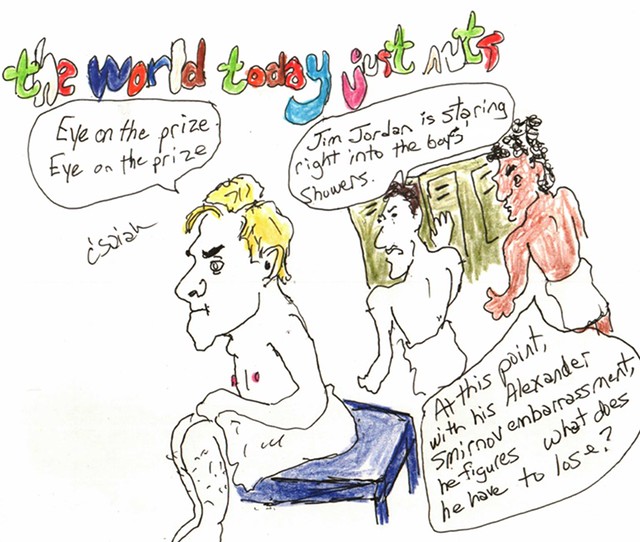
From a little over an hour ago, that's Isaiah's THE WORLD TODAY JUST NUTS "Jim Jordan Has More Free Time."


Okay.  AP reports:

The Beatles are getting the big-screen biopic treatment in not just one film, but a Fab Four of movies that will give each band member their own spotlight — all of which are to be directed by Sam Mendes.

For the first time, the Beatles, long among the stingiest rights granters, are giving full life and music rights to a movie project. Sony Pictures announced Monday a deal that may dwarf all music biopics that have come before it, with the stories of Paul McCartney, John Lennon, George Harrison and Ringo Starr spread out over a quartet of films.

That seems like nonsense to me.  And I'm a Beatles fan.  But, no, there is no need for four different films.  First, they will all have overlap during the early days of the group.  Second, they're not the same story or same type.  John Lennon was horribly shot down.  That's a sad story.  George Harrison is sad.  Ringo would be the obvious weakest.  I think, however, his might be the best if it reflected his sense of fun and wonder.  The dull one to me will be Paul McCartney.  Linda and Paul?  The great story ended when Heather Mills came along.  (That was after Linda died, to be clear.)  And was it really all of that?  Lillian Roxon would be to differ.  But Paul's lived way too long for someone who keeps recording.  He's done nothing worth buying since 1984's GIVE MY REGARDS TO BROADSTREET.  And many others don't grade as generously as I do.  

And why are we calling them 'movies'?  Are they going to be released in theaters or just end up on HULU like that crap Peter Jackson directed last year?

In other music news, Naledi Ushe (USA TODAY) reports:


Foreigner founder Mick Jones has announced his ongoing absences from the band's farewell tour, which began in 2022, has been due to a recent diagnosis.
"Several years ago, I was diagnosed with Parkinson’s disease," Jones revealed in a statement shared on social media Wednesday. "I want everyone to know that I am doing alright. However, I’ve always liked to be at my best when performing onstage, and sadly, at present, I find that a bit difficult."
The 79-year-old musician behind hits "Feels Like the First Time" and "I Want to Know What Love Is" added that he is "still very much involved in the background with Foreigner and remain a presence."


Foreigner is a strong group.  It often gets overlooked but it has been a very strong group.  That said, did not care for "Feels Like The First Time."  Couldn't stand that one.  Until I heard it done by The Treblemakers in PITCH PERFECT.  I loved that version. And Mick Jones is a great songwriter.  He wrote "Urgent" and I love Foreigner's version of that song but you have to hear Shannon do it as well.  She took it in another direction and it's a testament to Mick's songwriting that there's so much there that you can do with his songs.

"Cold As Ice," "Double Vision," "I Want To Know What Love Is," "Waiting For A Girl Like You" and "That Was Yesterday" are some of their great songs. 

 Lastly, Bryan Ressman (AMERICAN SONGWRITER) reports on Tori Amos' first album:

 Back in the 1980s, before she became the beguiling singer-songwriter that fans know today, Tori Amos fronted a synthy pop-rock band called Y Kant Tori Read. The title was supposed to be a play on why was allegedly kicked out of the famed Peabody Conservatory—for not reading sheet music. As she has admitted, this album was her rock-chick phase that tied in with what was going on in Los Angeles at the time when she signed with Atlantic Records in 1987. The band’s self-titled debut album emerged in 1988 and, as Amos once noted, “died a horrible, miserable death.” She has also said that some industry insiders did not take her seriously then either. But the album provides interesting insights into the artist that she became.

Amos formed the band in 1984, and it went through different permutations. The lineup that recorded the Y Kant Tori Read album was guitarist Steve Caton, who became a musical ally in the ’90s, bassist Brad Cobb, and future Guns N’ Roses drummer Matt Sorum. Studio musicians also factored in, including guitarist Steve Farris, drummer Vinny Coliauta (on one track), and percussionist Paulinho DaCosta. Fun fact: Background vocalists Zobbin Rander and Rick Nelson were actually Robin Zander and Rick Nielsen from Cheap Trick.

An Uphill Battle

Y Kant Tori Read’s debut album included the lead single and lone video for “The Big Picture.” In the video, shot in an alleyway, Amos vamped it up in any number of sexy outfits including tight leather pants and wielding a saber to tie in with the song “Pirates.” This was, after all, the big hair era. It’s not that Amos planned it to be this way. But at the time, a woman and her piano was not considered commercial enough for the masses. And given that the digital music revolution had begun, it would be an uphill battle.


 Closing with C.I.'s "Iraq snapshot:"


Wednesday, February 21, 2024.  For the third time, the US government vetoes a cease-fire, CNN reports on a War Crime with documented evidence, and much more.


England's Prince William may have joined the call for a cease-fire but the US government hasn't.  


As the BBC notes, the US government vetoed the resolution.  Edith M Lederer (AP) explains, "The United States on Tuesday vetoed an Arab-backed and widely supported U.N. resolution demanding an immediate humanitarian cease-fire in the Israel-Hamas war in the embattled Gaza Strip, saying it would interfere with negotiations on a deal to free hostages abducted in Israel."  13 nations voted in favor of the cease-fire.  The US voted against it.  And the UK?

Apparently unconcerned that the future kind of England -- William -- is calling for a cease-fire -- unconcerned despite his father's health scare -- they decided to abstain.  

At the UN, the UK stood with the US.  In England this morning, most Brits are expressing agreement with William.


Prince William is not the only official in England calling for a cease-fire.  BBC NEWS reports that the Laobur Party is as well:

Labour has called for an immediate humanitarian ceasefire in Gaza for the first time since the outbreak of the conflict in October.

The move comes after days of party debate on how to vote in Parliament on an SNP motion calling for a ceasefire.

Ten Labour frontbenchers quit in order to vote for the SNP's previous call for a ceasefire in November.

Shadow foreign secretary David Lammy said Labour had shifted because the situation in Gaza had "evolved".


On the vote at the United Nations, Julian Borger (GUARDIAN) notes, "Washington was widely lambasted for using its veto again at a time when nearly 30,000 Palestinians have been killed and more than 2 million people are under threat of famine."  Mona Zhang (POLITICO) adds, "Meanwhile, Arab states are weighing their next steps and considering bringing some version of the vetoed Algerian resolution to the floor of the U.N. General Assembly."  ALJAZEERA reminds that this was the US' third veto of a cease-fire at the UN Security Council and:

France’s UN envoy Nicolas de Riviere expressed regret that the resolution “could not be adopted, given the disastrous situation” in Gaza.

De Riviere added that France, which voted for the resolution, would continue to work towards all captives being released and for a ceasefire to be “implemented immediately”.


Hours after his ambassador to the United Nations vetoed the third cease-fire resolution to be proposed at the U.N. Security Council since Israel began its U.S.-backed bombardment of Gaza in October, President Joe Biden was scheduled to attend a high-dollar fundraiser at the home of an influential pro-Israel billionaire on Tuesday.

Tickets for the event hosted in Los Angeles by media mogul Haim Saban started at $3,300 and cost as much as $250,000. Other exclusive fundraising events for Biden, who is seeking reelection in November, have been disrupted in recent months by protesters demanding that the U.S. end its support for Israel, which has killed more than 29,000 Palestinians in Gaza since October

Co-hosts of the fundraiser include attorney Cliff and Leslie Gilbert-Lurie, whose own event in November was marked by demands for a cease-fire from people in a crowd as Vice President Kamala Harris spoke. Demonstrators also displayed fake blood at the Gilbert-Luries' home.

Nicole Mutchnik, a vice chair of the Anti-Defamation League, is also a co-host of Tuesday's event. Mutchnik's staunchly pro-Israel organization has frequently accused pro-Palestinian rights groups of anti-Jewish sentiment, equating anti-Zionism with antisemitism.

Jewish-led Palestinian rights group IfNotNow pointed out that Saban has been quoted as suggesting the U.S. should "scrutinize" Muslims "to get them to admit they are or they're not terrorists."


But the US government's refusal to call for a cease-fire isn't just about money and greed.  Jake Johnson (COMMON DREAMS) makes that clear in his reporting on the words of a member of Congress:

  Republican Rep. Andy Ogles of Tennessee said Tuesday that "we should kill 'em all" after an activist pressed him to respond to atrocities that the U.S.-backed Israeli military is committing against Palestinians in Gaza, including children.

"I've seen the footage of shredded children's bodies," the activist told Ogles. "That's my taxpayer dollars that are going to bomb those kids."

"You know what? So, I think we should kill 'em all, if that makes you feel better," Ogles responded. "Hamas and the Palestinians have been attacking Israel for 20 years. It's time to pay the piper." 

Tennessee trash.  Whomever dropped it in DC, can you come pick it up?  The country doesn't need him.

As the US veto continues to outrage,  and Muhammad Darwish (CNN) report:


Israeli forces fired on a United Nations convoy carrying vital food supplies in central Gaza on February 5, before ultimately blocking the trucks from progressing to the northern part of the territory, where Palestinians are on the verge of famine, according to documents shared exclusively by the UN and CNN’s own analysis.

CNN has seen correspondence between the UN and the Israeli military that show the convoy’s route was agreed upon by both parties prior to the strike. According to an internal incident report compiled by UNRWA, the main UN relief agency in Gaza, which was also seen by CNN, the truck was one of 10 in a convoy sitting stationary at an IDF holding point when it was fired upon.

No one in the convoy was hurt, but much of its contents – mainly wheat flour desperately needed to bake bread – were destroyed. Tracing the strike offers a window into the major challenges that humanitarian efforts face in getting aid to Gaza’s more than 2 million people – nearly 85% of whom are internally displaced – amid Israel’s nearly five-month bombardment of the strip.

“A convoy that had food on it, heading to the northern parts of the Gaza Strip. That convoy on its way in what we call the middle areas, it got hit. One of the trucks carrying supplies was hit by Israeli naval fire,” Juliette Touma, global director of communications for UNRWA, told CNN.     


War Crimes.


Gaza remains under assault. Day 138 of  the assault in the wave that began in October.  Binoy Kampmark (DISSIDENT VOICE) points out, "Bloodletting as form; murder as fashion.  The ongoing campaign in Gaza by Israel’s Defence Forces continues without stalling and restriction.  But the burgeoning number of corpses is starting to become a challenge for the propaganda outlets:  How to justify it?  Fortunately for Israel, the United States, its unqualified defender, is happy to provide cover for murder covered in the sheath of self-defence."   CNN has explained, "The Gaza Strip is 'the most dangerous place' in the world to be a child, according to the executive director of the United Nations Children's Fund."  ABC NEWS quotes UNICEF's December 9th statement, ""The Gaza Strip is the most dangerous place in the world to be a child. Scores of children are reportedly being killed and injured on a daily basis. Entire neighborhoods, where children used to play and go to school have been turned into stacks of rubble, with no life in them."  NBC NEWS notes, "Strong majorities of all voters in the U.S. disapprove of President Joe Biden’s handling of foreign policy and the Israel-Hamas war, according to the latest national NBC News poll. The erosion is most pronounced among Democrats, a majority of whom believe Israel has gone too far in its military action in Gaza."  The slaughter continues.  It has displaced over 1 million people per the US Congressional Research Service.  Jessica Corbett (COMMON DREAMS) points out, "Academics and legal experts around the world, including Holocaust scholars, have condemned the six-week Israeli assault of Gaza as genocide."   The death toll of Palestinians in Gaza is grows higher and higher.  United Nations Women noted, "More than 1.9 million people -- 85 per cent of the total population of Gaza -- have been displaced, including what UN Women estimates to be nearly 1 million women and girls. The entire population of Gaza -- roughly 2.2 million people -- are in crisis levels of acute food insecurity or worse."  ALJAZEERA notes, "At least 29,313 people have been killed and 69,333 wounded in Israel’s attacks on Gaza since October 7, the Palestinian Health Ministry reported."  Months ago,  AP  noted, "About 4,000 people are reported missing."  February 7th, Jeremy Scahill explained on DEMOCRACY NOW! that "there’s an estimated 7,000 or 8,000 Palestinians missing, many of them in graves that are the rubble of their former home."  February 5th, the United Nations' Phillipe Lazzarini Tweeted:


And the area itself?  Isabele Debre (AP) reveals, "Israel’s military offensive has turned much of northern Gaza into an uninhabitable moonscape. Whole neighborhoods have been erased. Homes, schools and hospitals have been blasted by airstrikes and scorched by tank fire. Some buildings are still standing, but most are battered shells."  Kieron Monks (I NEWS) reports, "More than 40 per cent of the buildings in northern Gaza have been damaged or destroyed, according to a new study of satellite imagery by US researchers Jamon Van Den Hoek from Oregon State University and Corey Scher at the City University of New York. The UN gave a figure of 45 per cent of housing destroyed or damaged across the strip in less than six weeks. The rate of destruction is among the highest of any conflict since the Second World War."   

This morning, Cindy McCain,  Executive Director of the UN World Food Programme, Tweets:


The conditions get worse and worse.  A cease-fire?  That would have allowed the delivery of aid.  But Joe Biden had to go soak up big bucks from corrupt donors and hope he can buy his way into a second term after his actions make clear that he doesn't deserve one.


NBC NEWS notes, "The World Food Program is pausing the delivery of food to northern Gaza until conditions are safe, saying its drivers were shot at and faced looting and beating. The agency said this decision would add to the 'unprecedented desperation' in Gaza, after earlier warning the enclave is at risk of famine. UNICEF warned yesterday that Gaza faced an 'explosion' in child deaths due to malnutrition and illness."  This morning, THE GUARDIAN notes:


Also Wednesday, the aid group Doctors Without Borders said that two people were killed when a shelter housing staff in the Gaza Strip was struck during an Israeli operation in an area where Palestinians have been told to seek shelter.

“While details are still emerging, ambulance crews have now reached the site, where at least two family members of our colleagues have been killed and six people wounded. We are horrified by what has taken place,” the group said in a post on social media.


The International Court of Justice, also known as the World Court, is holding the third day of hearings Wednesday into the legal consequences of Israel’s policies and practices “in the Occupied Palestinian Territory.” Dozens of countries are expected to present oral arguments during the hearings, which span six days, and deal with questions of Israeli control over the West Bank, East Jerusalem and Gaza. While the proceedings are not directly about the war in Gaza, they could intensify pressure on Israel over its military campaign there.

Palestinian officials offered impassioned remarks on Monday, with one arguing that “successive Israeli governments have given the Palestinian people only three options: displacement, subjugation or death.” Israel said it does not recognize the legitimacy of the hearings and will not attend. The United States is slated to speak Wednesday.

Here’s what to know.

This is an excerpt from a full story.


For more on the International Court of Justice, let's note yesterday's DEMOCRACY NOW!


AMY GOODMAN: This is Democracy Now!, democracynow.org. I’m Amy Goodman, with Juan González.

We go now to The Hague, where the International Court of Justice is holding a six-day hearing as over 50 countries are testifying against Israel’s occupation of the West Bank, East Jerusalem and Gaza. It’s the largest-ever participation in the World Court’s history.

Palestinian Foreign Minister Riyad al-Maliki said Monday, quote, “The genocide underway in Gaza is a result of decades of impunity and inaction.” Riyad Mansour, Palestinian envoy to the U.N., delivered emotional testimony Monday.

RIYAD MANSOUR: The state of Palestine appeals to this court to guide the international community in upholding international law, ending injustice and achieving a just and lasting peace, to guide us towards a future in which Palestinian children are treated as children, not as demographic threat, in which the identity of the group to which we belong does not diminish the human rights to which we are all entitled, a future in which no Palestinian and no Israelis is killed, a future in which two states live side by side in peace and security. The Palestinian people only demand respect for their rights. They ask for nothing more. They cannot accept nothing less and nothing else. The future of freedom, justice and peace can begin here and now.

AMY GOODMAN: That was Palestine’s permanent representative to the United Nations, Riyad Mansour, addressing the International Court of Justice Monday. Earlier today, South African Ambassador Vusi Madonsela addressed the court.

VUSI MADONSELA: The inordinate delay in achieving a fair and just settlement has resulted in an unending cycle of violence. A clear legal characterization of the nature of Israel’s regime over the Palestinian people can only assist in remedying the ongoing delay in achieving a just settlement. … We, as South Africans, sense, see, hear and feel to our core the inhumane discriminatory policies and practices of the Israeli regime as an even more extreme form of the apartheid that was institutionalized against Black people in my country.

AMY GOODMAN: For more, we’re joined from The Hague, where the ICJ hearing is taking place, by Ahmed Abofoul, legal research and advocacy officer at the Palestinian human rights organization Al-Haq. He contributed to their advisory opinion on the case.

Welcome back to Democracy Now! It’s great to have you with us. This is historic, what’s taking place right now, Ahmed, at the International Court of Justice. More than half the world’s countries are participating in this. Talk about the significance of this. And although we just played the South African envoy’s comments, this is not to be confused with that other case, the South Africa bringing the case around genocide against Israel in the court, that just happened a few weeks ago.

AHMED ABOFOUL: Sure. Well, first of all, thank you for having me again, Amy, and congratulations on Democracy Now!’s 28th anniversary. In this dystopian age of misinformation and biased media, especially in the West, we value your work, and we congratulate you and hope your viewers will continue to support your important work.

You’re absolutely right, Amy. This is a historical moment. For over 57 years, Israel has been perpetuating its occupation in the Occupied Palestinian Territories, dominating every aspect of their lives and maintaining this occupation to further facilitate and impose this apartheid regime, imposed on the Palestinian people as a whole. One of the important features of this occupation is that it is colonial in nature. So, it’s combined with the continued, unabated building of settlements and the theft of land and the demographic manipulation and engineering of the Occupied Palestinian Territory in an attempt to empty it from its Indigenous people — a very common feature of colonial regimes and projects trying to steal the land without the people.

This is a historical moment, Amy, because this is, as you mentioned, the most — the case with the most interest by states in the history of the advisory opinion procedure before the court. And it shows you that the world has something to say about this occupation.

The whole body of occupation — of the law of occupation shows us that occupation was not intended to last that long. Occupation is temporary in nature. But the way Israel perpetuated the occupation shows that Israel is not interested in ending that occupation, but it actually needs that occupation to further implement its strategy to acquire more land by force with as least Palestinians as possible.

And therefore, the premise of this case, I think there are three main legal arguments that Israel is violating what we call international law, peremptory norms from which no derogation is permitted. So, the first norm that Israel is violating is the acquisition of territory by force or the threat of the use of force. The second is Israel’s violations of the Palestinian people’s right to self-determination, which is also a peremptory norm. And the imposition of regime of racial discrimination and demographic manipulation in the Occupied Palestinian Territory and beyond, that is a regime of apartheid imposed on the Palestinian people as a whole, denying them their unalienable rights, including Palestinian refugees, who continue to be denied their right to return to their homes and villages.

So, this is an important moment, where for the first time we would have the principal organ of the United Nations telling us the legal consequences of Israel’s occupation. And it will be extremely difficult for Israel’s allies after that to justify Israel’s actions in any way possible. Israel has been instrumentalizing the rules of international humanitarian law, the body of law that governs the situation of occupation, to further its settler-colonial project in Palestine. I think after this decision, which I have no doubt that the court will decide that Israel’s occupation is illegal, it will be very difficult to support Israel and its policies by Israel’s allies, including the U.S. So, all eyes on the U.S. and how it will react to this important ruling.

JUAN GONZÁLEZ: And, Ahmed Abofoul, I wanted to ask you: For those who are not familiar with these international legal bodies, could you briefly summarize the difference between the International Court of Justice proceedings and the separate case that South Africa filed, the complaint of genocide at the International Criminal Court [sic] against Israel, especially in terms of the jurisdiction or the powers of the court to have any direct effect on Israel’s actions?

AHMED ABOFOUL: Yes, absolutely. I think you meant South Africa’s genocide case before the very same court, the International Court of Justice, and these are two different proceedings. The International Court of Justice can look into advisory proceedings, where any organ of the United Nations can ask the court to provide a legal opinion on what the court thinks of a certain matter. Usually such rulings are nonbinding for states, but they are of particular importance as they guide the whole United Nations and the member states in how to approach a certain matter or a certain question.

The other type of procedure is contentious cases, where states take each other to court when they have a disagreement on a matter of international law, so, for example, a disagreement on the interpretation of a particular convention to which both are parties and have accepted the court’s jurisdiction. And that’s exactly what South Africa did in the genocide case against Israel on the interpretation of the Genocide Convention, where it took Israel to court. So it’s a case between South Africa and Israel, while in the advisory opinion proceeding, there are no two parties. There is only the court that is deciding on the matter of question. And all states around the world are invited to provide their written statements, their oral interventions, to tell the court what is their position, what is their interpretation of the law on that particular matter, because international law is made by the practices of these states and what states around the world have accepted to be customary international law and have accepted to be the common interpretation of international law.

So, the law on occupation, as I said, is clear that occupation was not intended to last that long and is temporary in nature, but it didn’t set any time limit in which occupation has to end. So, that’s how Israel has been perpetuating this, often described as, prolonged occupation — it’s the longest occupation in modern history — claiming, under the mutual security pretext, that it needs to continue its control and needs to continue its domination of the Palestinian people and its violations of the peremptory norms.

JUAN GONZÁLEZ: And what is the role of the public in these cases? Is there any?

AHMED ABOFOUL: Of course, of course, absolutely. The public, you know, don’t have a standing in procedure, or, like, civil society organizations, for example, like the one I’m proudly associated with — that is, Al-Haq — can always submit to the court, but these submissions are not part of the proceedings. They are available at the seating of the court for states participating in the proceedings, but also for judges to read them and consult them. And we have already published a position paper outlining the key legal arguments in this case and our view on how the court should approach this case.

But if you’ll allow me, these rulings are usually of particular importance to be used after, so how, for example, the state in question will utilize this ruling in its diplomatic efforts, whether taking this ruling to the General Assembly to adopt a resolution to the same effect, or perhaps to the Security Council, although there will always be the U.S. veto. So, what comes after that decision, I think, is also of particular importance.

And historically, the ICJ cases have served in a way to provide guidance on what international law says and how states should behave. Obviously, not always the states have listened to such rulings, or they tried to disobey them. But, for example, in the situation in South Africa and the ruling on the illegal presence of South African apartheid in Namibia, it served and it created momentum for the mobilization on the ground which eventually led to the end of that regime. So, hopefully, this advisory opinion is also another step forward to ending Israel’s settler-colonial and apartheid regime imposed on the Palestinian people as a whole.

AMY GOODMAN: Can you talk, Ahmed Abofoul, about the response of the court? This is when it was run by Joan Donoghue, and important to point out. She came out of the State Department. She’s the head of the International Court of Justice. But she is no longer the head of the Court of Justice, but it was under her and it was her reading of the preliminary decision around South Africa bringing its genocide case to the court. If you can talk about who’s the new head of the court? And then I want to ask you about what just happened in Israel in the Knesset, voting not to expel Ofer Cassif, the lawmaker who’s a member of the Hadash party supporting the genocide case against Israel at the ICJ. I just wanted to play a clip of the Knesset member, Cassif, speaking to Democracy Now! about facing expulsion, which didn’t happen.

OFER CASSIF: They want me and my friends to shut up. They don’t want us to raise our voice against any kind of violence, because, as I said a million times, as someone who continuously for years object and oppose the Israeli occupation and siege against the Palestinian people, we said, I said, explicitly, that even the crimes of the siege and the occupation cannot and will never justify the massacre committed by Hamas. We added that the massacre, the criminal massacre by Hamas, cannot justify the massacre and assault of Israel on Gaza, in which around 30,000 people are already dead, were killed. The vast majority, more than 70%, are innocent civilians, around 10,000 children.

AMY GOODMAN: So, that’s a member of the Knesset, who remains so because they lost the vote to expel him, Ofer Cassif. And if you can respond to the new president, Nawaf Salam, who’s replacing Joan Donoghue?

AHMED ABOFOUL: Yeah. Well, as you said, Judge Nawaf Salam, who’s a Lebanese judge, he has been a member of the court since February 2018 and newly elected as president of the court since 6th of February, 2024. He is now the president of the court.

But if you’ll allow me, whether him or the American judge, judges before the ICJ, they don’t serve as agents of their state of nationality. They serve as independent judges who provide their personal views about international law and the interpretation of international law, after hearing the positions of the states. So, it’s not — it is not, in a way, usual to presume that because of the nationality of the president of the court, that the position would be aligned with the foreign policy of the state of that judge. That is not the case, whether American or Lebanese or any other nationality of the president of the court. It is presumed, and the presumption is of their professional, you know, way of work and deliver on their mandate in accordance with the law.

As to the voting to expel Ofer, the member of Knesset, it also — in my view, it shows you how radicalized Israeli society has become. So, even the very tiny minority that you have, where Israeli Knesset members are calling for the end of the occupation, are calling for the bare minimum of human decency — that is, a ceasefire — the rest of Knesset members, from the Israeli members, are mostly against that, and such tiny minority of those who call for Palestinian rights are often attacked. And as you said, there was an attempt to even remove him from the Knesset.

And I think it’s very telling to see also how supportive Israeli society has been in the genocide against the Gaza Strip. Amy, we need not to forget that right before the war, the Israeli society mobilized hundreds of thousands in the streets because of Netanyahu’s plan to, you know, attack the judiciary or to minimize their authority in reviewing government’s decision. But when it comes to Palestinians who are being oppressed, who are only a few meters away, the Israeli society somehow is unable to mobilize or call for the end of the occupation. So, in a way, it seems that the Israeli society has been radicalized into believing that for them to enjoy the privileges of this apartheid regime, they don’t mind the Palestinians being oppressed.

And unfortunately, the foreign policy of states that claim to be friends to Israel, I think, have contributed profoundly to such radicalization, simply because they’ve been ensuring impunity for Israel and Israeli war criminals who have been committing crimes for the past decades. So, I think, in a way, the reason that we have such extreme government at the moment, one of the most extreme and right-wing in the history of Israel, which has ministers who are proudly self-described as Islamophobic and homophobes and fascists and racist ministers, like Ben-Gvir and Smotrich, is a result of — in my view, of the U.S. and European foreign policy ensuring that Israel enjoys an exceptional treatment, that Israel is untouchable. It enjoys prevailing impunity where Israel can commit crimes, but no one is held accountable.

AMY GOODMAN: Ahmed, I’m so sorry that, well, when we last spoke, you had already lost some 60 members of your family. Born and raised in Gaza, you are. And I wanted just to ask, in this 30 seconds, about Benny Gantz’s comments, part of the war council, saying if the hostages are not home by Ramadan, which is like March 10th, the fighting will continue everywhere, including Rafah.

AHMED ABOFOUL: Yeah, well, it shows you also the character and the behavior of Israel. Israel is behaving like a pariah, is behaving like a rogue state, is not listening to anyone, is not listening to its closest allies.

Israel needs to have the humility to understand that the Palestine people are a free people, are not colonial subjects. They’re entitled to their rights. And Israel at some point will need to sit and listen with seriousness and consideration to the aspiration of the Palestinian people. The Palestinian people, Amy, are not asking for a favor. They’re asking for their unalienable basic human rights. And I think the world for long has misunderstood the Palestinians. We’re not even asking. We’re demanding those rights. We’re entitled to those rights, regardless of what Israel think about that.

AMY GOODMAN: Ahmed Abofoul, we want to thank you for being with us, legal research and advocacy officer at the Palestinian human rights organization Al-Haq, speaking to us from The Hague.

Next up, we turn to a surgeon who’s just returned from Gaza, wrote an L.A. Times op-ed headlined “I’m an American doctor who went to Gaza. What I saw wasn’t war — it was annihilation.” Back in 20 seconds.


Isaiah's THE WORLD TODAY JUST NUTS "I Sabby The Fool" went up last night.  The following sites updated:

Tuesday, February 20, 2024

Beyonce, the Mamas and the Papas, Todd Snider

sabby the fool


Isaiah has another THE WORLD TODAY JUST NUTS comic "I Sabby The Fool."


Beyonce's in the news.  Russell Falcon (NEXSTAR) reports:


Bey-haw! Just when it seemed like Beyoncé couldn’t possibly earn any more musical accolades, the 42-year-old artist earned another — her first country radio No. 1 hit.

In case you missed it, the second half of Super Bowl LVIII on Feb. 11 was semi-upstaged by Beyoncé announcing surprise music releases via Verizon commercial. And while the release of any new Beyoncé music would upend social media, the fact that new tracks “Texas Hold ‘Em” and “16 Carriages” are country generated even further fervor.


The tracks are the first piece of the artist’s forthcoming “Act II” album, which is part of her intended “Renaissance” trilogy of albums. The album, which will be Beyoncé’s eighth, is now expected to be entirely or majorly composed of country songs.


That's interesting.  And that could get her a Grammy for album of the year finally.  Album of the Year is not going to a group of hit songs.  It has to be an album with an overall visions.  C.I. was explaining that in a roundtable recently.  TAPESTRY is a cohesive album and won a Grammy, Stevie Wonder's TALKING BOOK the same.  Some people, C.I. noted, dismiss THRILLER as just a group of songs but there are actually themes that run through that whole album.

There are a lot of albums we like and we listen to but there are not a lot of great albums.  There's Joni Mitchell's BLUE, for example, Stevie Wonder's SONGS IN THE KEY OF LIFE, Lauryn Hill's THE MISEDUCATION OF LAURYN HILL.  These are benchmark albums that captured our ears and changed music.  

Beyonce's had a lot of hits.  And The Eagle's classic 'album' is GREATEST HITS.  For some groups, that's the reality.  They have great singles but not really great albums.  Beyonce could have a great best of tomorrow without recording another song.  But for album of the year, she's going to have to dig deeper than she has previously.   And she may not want it.  Singles get played on radio all the time and are streamed constantly.  There are artists who would kill to have the success on the singles chart that she has.  It's nothing to sneeze at.  


On the topic of albums, Sarah Norman (CURIOUS HISTORIAN) has compiled a list of albums recorded under duress.  One of the 30 albums is the Mamas and the Papas' PEOPLE LIKE US:


The Mamas and the Papas' album 'People Like Us' is a musical swan song that unfolds against the backdrop of contractual obligations, legal disputes, and a creative spark that had long dimmed.

Released in November 1971, three years after the group's original split, this album was born out of necessity rather than artistic inspiration. The former members found themselves still under contract with Dunhill Records, a label they had originally signed with when Lou Adler was at the helm.

However, by 1971, Dunhill had been acquired by ABC Records, and a contractual clause surfaced, requiring the group to produce one more album to avoid potential fines of up to $1 million. As a result, 'People Like Us' emerged, a collection that bears the weight of contractual obligations rather than the creative passion that had once defined the band. Despite its lukewarm reception and disappointment among fans and critics, the album offers a unique glimpse into a band trying to navigate the complexities of the music industry while their creative spark had already started to wane. It's a testament to the challenges faced by musicians when artistry meets contractual obligations, and a fitting final chapter in the Mamas and the Papas' storied career.


I actually think that album is far better than it's ever been given credit for.  In the UK, they've actually began a re-evaluation of the album (starting 9 years ago).  We should do that here as well.


Now for Todd Snider.  Todd's a singer-songwriter.  He's worked with a lot of artists over the years including Rita Coolidge.  He came of age during grunge.  SONGS FOR THE DAILY PLANET came out in 1994, his debut album, and was labeled "alternative country."  I bought it for the only song getting radio airplay on alt rock stations, "Talkin' Seattle Grunge Rock Blues."  It was a hidden track.  That upset a lot of people who bought the album and expected it to be like that (again, it was alternative country).  In the last 15 years, his albums have charted on the rock charts, indie charts and folk charts.  


2024 marks thirty years since singer/songwriter Todd Snider released his debut solo album Songs for the Daily Planet. Since then, he has released more than a dozen albums. Now, he’s looking to give back to his fans who have supported him throughout the last three decades. With that in mind, he’s releasing a whopping 14 live acoustic albums this year in what he’s calling the All My Songs project.
Snider isn’t going back and curating audio from his live sets and releasing them. Instead, he re-recorded all of his albums as solo acoustic projects. Throughout the year, he’ll release them to streaming services and as digital downloads on his website so fans can listen to them for free. The rollout starts this Friday (February 23) with Songs from the Daily Planet.


Closing with C.I.'s "Iraq snapshot:"


Tuesday, February 20, 2024.  The world watches as the assault on Gaza continues.

This morning, THE GUARDIAN notes:

WHO accuses Israel of hindering medical rescue missions to Nasser hospital, says destruction is 'indescribable'

The World Health Organization (WHO) has issued a lengthy statement on social media this morning describing a mission to transfer patients within the Gaza Strip, and reporting that its staff said “the destruction around Nasser hospital was ‘indescribable’”. It accused Israel of hindering and refusing its attempts to provide medical services to Gaza’s population.


Israeli troops forced doctors and other medical staff to leave the Nasser Medical Complex in Gaza, strip down to their underwear, and wait in the cold for hours before the troops allowed five doctors to go back into the building to treat patients, an eyewitness told CNN on Monday.

The incident comes as the Israeli military said it had arrested hundreds of militants at the hospital, which is in Khan Younis, including some posing as doctors.

Israeli forces also said they found medications with the names of Israeli hostages on them inside the hospital, releasing a video of soldiers showing medicine boxes with inscriptions and sometimes photos on the labels of who they apparently were prescribed to.

The eyewitness spoke to CNN in a rare telephone interview from the area of Nasser hospital, where there are few ways to communicate with the outside world.

The source said when the Israel Defense Forces (IDF) took control of the hospital last week, they broadcast a message saying: “Doctors, come outside.”

When the medics came out and were ordered to take off their clothes, they protested because of the frigid conditions.

“Take off your clothing,” the witness said the doctors were told.

The doctors then removed their clothes in the cold and were kept outside for several hours before Israeli troops chose five doctors to return to the complex to take care of patients. The eyewitness does not know what happened to the other doctors.

That left five doctors to treat dozens of patients in the old building of the compound, said the eyewitness, who has been inside the hospital and asked not to be named for fear of retribution.     


The world watches and the outrage builds.  There is no high ground for the government of Israel.  Nothing redeems nor justifies its actions. Amy Goodman (DEMOCRACY NOW!) notes, "In the U.S., the African Methodist Episcopal Church Bishops Council called on the Biden administration to end funding for what it called Israel’s 'mass genocide.' In Michigan, Rashida Tlaib, the only Palestinian American member of the U.S. Congress, is urging Democrats to vote “uncommitted” in next Tuesday’s presidential primary to protest President Biden’s complicity in Israel’s assault on Gaza."  Bethany Dawson (POLITICO) adds, "The U.K.’s top diplomat [David Cameron\ said conflict in Gaza must stop 'right now,' amid mounting international pressure on Israel not to launch a ground offensive in Rafah."  David Hughes (THE STANDARD) quotes Cameron stating, " “We are calling for a stop to the fighting right now, we think that what we need is a pause in the fighting and the hostages to come out and aid to go in. That should happen straight away."  Zack Beauchamp (VOX) observes:

The blame for this failure lies with Israel’s terrible wartime leadership: an extremist government headed by Benjamin “Bibi” Netanyahu, a venal prime minister currently on trial for corruption who has placed his personal interests over his country’s even during wartime.

“You couldn’t have had a worse government to respond to a worse moment,” says Dov Waxman, the director of UCLA’s Center for Israel Studies. “People like to separate the war from the government that’s running it, but I think you can’t.”

For more on the Israeli government's attacks on medical facilities in Gaza, let's note this from yesterday's  DEMOCRACY NOW!


AMY GOODMAN: This is Democracy Now!, democracynow.org, The War and Peace Report. I’m Amy Goodman.

Israel’s unrelenting assault on the Gaza Strip has killed over 29,000 Palestinians and injured another 69,000 since October 7th. We begin today’s show in the southern Gaza city of Khan Younis, where the Gaza Health Ministry is reporting one of Gaza’s largest hospitals, Al-Nasser Hospital, is no longer functional amidst a dayslong Israeli raid on the facility over the weekend. At least eight people at the hospital have reportedly died since Israeli soldiers cut off electricity and oxygen supplies.

The head of the World Health Organization, Dr. Tedros Adhanom Ghebreyesus, posted on X Sunday, quote, “Nasser hospital in #Gaza is not functional anymore, after a weeklong siege followed by the ongoing raid. Both yesterday and the day before, the @WHO team was not permitted to enter the hospital to assess the conditions of the patients and critical medical needs, despite reaching the hospital compound to deliver fuel alongside partners. There are still about 200 patients in the hospital. At least 20 need to be urgently referred to other hospitals to receive health care. Medical referral is every patient’s right. The cost of delays will be paid by patients’ lives. Access to the patients and hospital should be facilitated,” end-quote. The World Health Organization says it’s still trying to evacuate the remaining patients in the hospital in Khan Younis to other facilities.

On Friday, the Gaza Health Ministry said an aid convoy led by the United Nations was detained for seven hours and prevented from reaching the hospital. The ministry said Saturday Israeli forces, quote, “arrested a large number of the directors and staff” of the hospital while they were tending to the wounded. Up to 100 people were reportedly arrested.

On Sunday, Dr. Ahmed Moghrabi at Nasser Hospital sent Democracy Now! a video describing what happened when the hospital was stormed by Israeli troops.

DR. AHMED MOGHRABI: At 1:30, I was at the third floor with my family at the surgical building. We heard lots of quadcopters over our heads at the hospital. They were asking us by megaphone actually to evacuate the hospital immediately. Immediately. And after like five, 10 minutes, I heard a very big explosion. Actually, they bombed and shelling the third floor, where I’m staying. Exactly, they targeted the orthopedic department. And I took my phone. I recorded some couple of videos, and I posted on my Instagram how did people as a result of this explosion. It was like chaos, everybody running there and there.

So, I realized that it is invasion of IDF as I started hearing some dogs at the hospital yards. And actually, yeah, they destroyed the back wall of the hospital and released their dogs. I changed my scrub immediately, and I took this, my clothes. Actually, I brought this, my clothes. And I ran away from the hospital with my family, with many of patients, many of people, some of my medical staff there. And can you guess? It was like 2 a.m., early morning. It was cold.

And there was a checkpoint away from the main gate of the hospital, about like 50 meters only. There was tanks, soldiers, dogs. And they started checking everybody there. Everybody. So, it’s not allowed to cross the checkpoint without checking you. So, when my turn comes, I — actually, they asked me to go forward or to come to the checkpoint, me and other four people. Actually, I told my wife, my children that I might be arrested, so don’t worry. Maybe it will take two weeks, one month. So, I’ll be fine, blah, blah, blah. And they asked us — they asked us to look at the camera, big camera, in front for 30 minutes. It’s not one camera; it’s lots of cameras are there. You have to look forward for 30 minutes, half-minute. During this time, actually, they told us actually to move and leave my nurse. My nurse was standing next to me or beside me. And they took my nurse. They asked him to take off all his clothes — all his clothes — at this cold. And they took him inside. And they ordered me and others actually to go and to keep moving, just keep moving.

And I walked with my family about 10 kilometers that night. Ten kilometers, nothing remain in Khan Younis. Nothing. It’s like horror movies. No streets, no buildings are there. Only dead bodies all over around. Only dead bodies.

By the way, I was hearing my friend Rami was screaming. They were beating him, not only him, many, many, many. They took many.

I managed to get to Rafah early morning, and I spent that day on the street. On the street. Who remained of medical staff, actually, all of them are arrested. They arrested all the medical team who remained at Nasser Hospital. We don’t know the fate of my colleagues. Actually, from my department, from my department, they took one GP doctor, my assistant, Dr. Mahmoud. They took two nurses from my department, Rami and Mohammed. They took, I think, around 100. Around a hundred of medical staff already have been arrested by IDF.

Now I’m at Rafah. I came here actually to IJH hospital — EJH hospital in Rafah to say hello to my friends, actually. And this is the situation here. I built a tent, by the way, for my family. I went to the MSF shelter with my wife and my children. I’ll keep you updated. Thank you.

AMY GOODMAN: That was Dr. Ahmed Moghrabi, speaking Sunday from Rafah. He was forced to leave Al-Nasser Hospital with the Israeli raid. He was the head of plastic surgery there.

Last week, Democracy Now! was able to receive updates from one of the last remaining surgeons inside Al-Nasser Hospital, Dr. Khaled Alserr. This is the last video Dr. Alserr posted on his Instagram page from Friday evening.

DR. KHALED ALSERR: This ICU patient have just died because they cut all electricity at Nasser Medical Hospital. And aother six patients is awaiting the same fate.

AMY GOODMAN: We are looking at a dead patient. During the dayslong Israeli raid on Al-Nasser Hospital this weekend, people were unable to reach Dr. Khaled Alserr, raising concerns he had possibly been abducted. This morning Democracy Now! was able to reach Dr. Khaled Alserr’s cousin, Dr. Osaid Alser. He’s a Palestinian refugee from Gaza and a surgeon resident in training in Lubbock, Texas. We asked him if he’s heard anything from his cousin at Al-Nasser. This is what he shared with us.

DR. OSAID ALSER: Hi. This is Dr. Alser. This is just an update about Dr. Khaled Alserr, who’s my cousin. So, yesterday he texted in our group chat, where we have a telemedicine group to discuss trauma cases. And he reported that he is relatively OK, and he was not abducted, which is amazing. But it sounds like some of his colleagues were abducted, and some of the patients, as well. But he is still in Nasser Hospital taking care of the remaining patients in the orthopedic and burn units.

AMY GOODMAN: That is Dr. Osaid Alser, cousin of Dr. Khaled Alserr, still in Gaza.


With malnutrition and infectious diseases spreading rapidly, United Nations officials warned Monday that child deaths in the Gaza Strip are set to surge if Israel's war and blockade are allowed to continue.

In a joint statement, the United Nations Children's Fund (UNICEF), the World Food Program (WFP), and the World Health Organization (WHO) said that "food and safe water have become incredibly scarce" in Gaza, imperiling the health of children as well as pregnant and breastfeeding women.

The U.N. organizations cited a recent analysis by the Global Nutrition Cluster, which found that children in northern Gaza and Rafah—a severely overcrowded city that Israel is preparing to invade—are facing particularly severe malnutrition. But "while there are differences in the data from different governates," the analysis stressed, all the available evidence "indicates a dire nutrition situation for the entire population of Gaza."

The Global Nutrition Cluster found that more than 90% of Gaza children between the ages of 6 and 23 months are facing "severe food poverty," eating "two or fewer food groups each day." At least 90% of children under 5 years old have been impacted by one or more infectious diseases, the analysis estimated.

Infectious diseases are spreading among children in part due to the lack of clean water, a scarcity fueled by Israel's siege and attacks on the enclave's water infrastructure. "An increased number of infants now rely on formula milk for survival—which requires safe and clean water," the analysis notes.

Mike Ryan, executive director of the WHO's emergencies program, said Monday that "hunger and disease are a deadly combination."


Gaza remains under assault. Day 137 of  the assault in the wave that began in October.  Binoy Kampmark (DISSIDENT VOICE) points out, "Bloodletting as form; murder as fashion.  The ongoing campaign in Gaza by Israel’s Defence Forces continues without stalling and restriction.  But the burgeoning number of corpses is starting to become a challenge for the propaganda outlets:  How to justify it?  Fortunately for Israel, the United States, its unqualified defender, is happy to provide cover for murder covered in the sheath of self-defence."   CNN has explained, "The Gaza Strip is 'the most dangerous place' in the world to be a child, according to the executive director of the United Nations Children's Fund."  ABC NEWS quotes UNICEF's December 9th statement, ""The Gaza Strip is the most dangerous place in the world to be a child. Scores of children are reportedly being killed and injured on a daily basis. Entire neighborhoods, where children used to play and go to school have been turned into stacks of rubble, with no life in them."  NBC NEWS notes, "Strong majorities of all voters in the U.S. disapprove of President Joe Biden’s handling of foreign policy and the Israel-Hamas war, according to the latest national NBC News poll. The erosion is most pronounced among Democrats, a majority of whom believe Israel has gone too far in its military action in Gaza."  The slaughter continues.  It has displaced over 1 million people per the US Congressional Research Service.  Jessica Corbett (COMMON DREAMS) points out, "Academics and legal experts around the world, including Holocaust scholars, have condemned the six-week Israeli assault of Gaza as genocide."   The death toll of Palestinians in Gaza is grows higher and higher.  United Nations Women noted, "More than 1.9 million people -- 85 per cent of the total population of Gaza -- have been displaced, including what UN Women estimates to be nearly 1 million women and girls. The entire population of Gaza -- roughly 2.2 million people -- are in crisis levels of acute food insecurity or worse."  THE NATIONAL notes, "Gaza Health Ministry said on Tuesday that 29,195 Palestinians have been killed and 69,170 wounded in Israeli air strikes on Gaza since October 7." Months ago,  AP  noted, "About 4,000 people are reported missing."  February 7th, Jeremy Scahill explained on DEMOCRACY NOW! that "there’s an estimated 7,000 or 8,000 Palestinians missing, many of them in graves that are the rubble of their former home."  February 5th, the United Nations' Phillipe Lazzarini Tweeted:


And the area itself?  Isabele Debre (AP) reveals, "Israel’s military offensive has turned much of northern Gaza into an uninhabitable moonscape. Whole neighborhoods have been erased. Homes, schools and hospitals have been blasted by airstrikes and scorched by tank fire. Some buildings are still standing, but most are battered shells."  Kieron Monks (I NEWS) reports, "More than 40 per cent of the buildings in northern Gaza have been damaged or destroyed, according to a new study of satellite imagery by US researchers Jamon Van Den Hoek from Oregon State University and Corey Scher at the City University of New York. The UN gave a figure of 45 per cent of housing destroyed or damaged across the strip in less than six weeks. The rate of destruction is among the highest of any conflict since the Second World War."   


The US has proposed a draft resolution at the UN Security Council which calls for a temporary ceasefire in Gaza.

It has also warned Israel against invading the overcrowded city of Rafah.

The US has previously avoided the word "ceasefire" during UN votes on the war, but President Joe Biden has made similar comments.

However, the US plans to veto another draft resolution - from Algeria - which calls for an immediate humanitarian ceasefire.


A vote is expected to take place today.  Again, the US government has come out in favor of a 'pause' -- that is not a ease-fire.  A pause is what took place earlier this year.  It did not last.  I favor a cease-fire, not a pause.  However, a six week pause could allow some food, medical supplies and other aid -- all of which is sorely needed in Gaza -- to get in.  Chantal Da Silva (NBC NEWS) notes, "Over 90% of babies ages 6 to 23 months and pregnant and breastfeeding women are eating two or fewer food groups a day, according to the report from the Global Nutrition Cluster, a coalition of humanitarian groups."  EURO NEWS also notes the "report released by the Global Nutrition Cluster" which has found, "Over 80 percent of households in Gaza have access to less than one litre of safe water per person per day, according to the report, which also says there has been an increase in food insecurity, lack of diet diversity, and deteriorating infant feeding practices." THE NATIONAL reports, "The Palestine Red Crescent's Al Amal Hospital in Khan Younis is running out of essentials and only has drinking water for three days after Israeli attacks, the organisation said."

As the atrocities pile up, it's worth noting observations from Sukumar Muralidharan (THE WIRE)

Every hospital in Gaza has been in Israel’s narrative, a Hamas control centre where sinister terror acts are plotted in an underlying network of tunnels. It is a story-line that even the credulous U.S. media has had difficulty swallowing. An investigation by the Washington Post, published December 23, found Israel’s claims collapsing at the slightest scrutiny. There was nothing to suggest, the Washington Post found, that the Al-Shifa tunnels were not for anything but routine storage and internal transportation of kit and equipment. The rooms connected to the tunnel network “showed no immediate evidence of military use”. None of the five hospital buildings identified as Hamas control centres “appeared connected to the tunnel network”, nor was there any “evidence that the tunnels could be accessed from inside hospital wards”.


Abdullah al-Zaghari, head of the Palestinian Prisoner’s Society, has shared these updates at a news conference in Ramallah today:

  • There are testimonies and indicators that Palestinian men and female prisoners have been sexually assaulted. The statement issued by the UN yesterday pointed out for the first time that female prisoners are being violated in a grave manner, and serious crimes are being committed against them.
  • There are at least two female prisoners from Gaza who were raped. Many others threatened with rape, and have suffered sexual assault and strip-searches.
  • This is in addition to testimonies we received surrounding male prisoners who have been exposed to severe sexual assault including extreme beatings on genitals and attempts of rape as well as humiliating strip searches.

Al-Zaghari called for an independent international investigation into the developments, “one that will hold the occupation accountable and prevent it from continuing to carry out these crimes”.

Palestinian prisoner groups also stress that these crimes are happening in parallel and within the context of the horrific crimes being committed as part of the aggression against people in Gaza.

At least eight prisoners have died as a result of systematic torture policies, al-Zaghari added.


The following sites updated: